题目内容
The old Olympic Games began around the year 776 BC in Greece. Many of the sports __(1)__ the same as they are now. But then women were not __(2)__ to take part in the games.
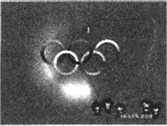
The first Olympic Games __(3)__ modern times happened in 1896. They were __(4)__ in Greece, where the games were born. Both the Summer and Winter Olympics are held __(5)__ four years. The Winter Olympics are usually held two years __(6)__ the Summer Olympics.
The 24th Summer Olympics were held in 1988 in Los Angeles
(洛杉矶). The competitors from the People's Republic of China __(7)__ the games for the first time. The Chinese competitors __(8)__ many medals since then. __(9)__ most of the medals were won by women. We hope men will __(10)__ their best to win more medals.|
(1)A .did |
B .had |
|
C .looked |
D .were |
|
(2)A .agreed |
B .hoped |
|
C .prepared |
D .allowed |
|
(3)A .of |
B .at |
|
C .in |
D .on |
|
(4)A .held |
B .hold |
|
C .begin |
D .began |
|
(5)A .in |
B .for |
|
C .each |
D .every |
|
(6)A .in front of |
B .before |
|
C .later |
D .earlier |
|
(7)A .take part in |
B .go to |
|
C .joined in |
D .joined |
|
(8)A .have won |
B .are winning |
|
C .had won |
D .won |
|
(9)A .Sadly |
B .But |
|
C .Hardly |
D .Once |
|
(10)A .work |
B .train |
|
C .compete |
D .do |
解析:
|
(1) 过去的许多运动和现在的一样,与 are 相对应的过去式为 were。(2) 那时女子不允许参加比赛。(3) “在现代”in modern times。(4) “被举行”be held。(5) 每四年举行一次奥运会。(6) 冬季奥运会在夏季奥运会前两年召开。(7) 参加某个比赛用 join in。(8)since then 提示用现在完成时 have won。(9) 上下两句构成意思转折,用 but。(10)do one's best 尽某人最大努力。 |

 阅读快车系列答案
完形填空
Last August we decided to spend a day in the country(乡村)as nobody likes 1 at home on a holiday if the weather is fine. 2 the only difficulty was that many 3 people had the 4 idea. We moved out of the city 5 behind a long line of 6 . After some time we came to a quiet country 7 . At last we stopped near a farm. We 8 the food out of the car and sat beside a path(小道)at the 9 of the hill. We were very happy sitting in the 10 grass. But very soon we 11 the bell ringing at the top of the hill.What we saw made us 12 up our things and 13 back to the car as 14 as possible.There were about two hundred sheep coming towards us 15 the hill.
1.A.studying |
B.staying |
C.sleeping |
D.playinng |
[ ] |
2.A.Instead |
B.So |
C.But |
D.Although |
[ ] |
3.A.old |
B.rick |
C.other |
D.young |
[ ] |
4.A.good |
B.same |
C.strange |
D.different |
[ ] |
5.A.slowly |
B.quickly |
C.carefully |
D.hard |
[ ] |
6.A.trucks |
B.buses |
C.cars |
D.bikes |
[ ] |
7.A.street |
B.road |
C.route |
D.way |
[ ] |
8.A.got |
B.put |
C.found |
D.fetched |
[ ] |
9.A.side |
B.foot |
C.top |
D.front |
[ ] |
10.A.cold |
B.cool |
C.warm |
D.hot |
[ ] |
11.A.noticed |
B.learned |
C.heard |
D.felt |
[ ] |
12.A.pick |
B.put |
C.get |
D.eat |
[ ] |
13.A.walk |
B.go |
C.come |
D.run |
[ ] |
14.A.hard |
B.quietly |
C.quickly |
D.carefully |
[ ] |
15.A.to |
B.up |
C.of |
D.down |
[ ] |
完形填空
Emily
and Peter have lived next door to each other as long as they can remember. When
they were ___(1)___ children, they ___(2)___ play together. They were good
friends, though they sometimes fought over toys. ___(3)___ they grew older, they
seldom(很少) played with each other. Emily preferred to be with girls and
Peter preferred to play with boys. When they were about fifteen years old, they
almost stopped ___(4)___ to each other, not because they disagreed with each
other, ___(5)___ because they belonged to different groups. Emily began to study
French and also enjoyed watching football games. Peter was only interested in
sports.
___(6)___
was football that brought Emily and Peter back together. One day, after Peter
went home, he looked into the window of Emily’s living room and saw ___(7)___
she was watching a football game on TV. He walked up and knocked at the door.
Emily was ___(8)___ to see him, but asked him to come in and they watched the
___(9)___ of the game together. They are good friends again. They ___(10)___
have different ideas about things
sometimes, but they agree with each other that football is the world’s best
game.
(1)
[ ]
|
A.a
little |
B.little |
|
C.a
few |
D.few |
(2)
[ ]
|
A.often |
B.used
to |
|
C.were used to |
D.themselves |
(3)
[ ]
|
A.When |
B.While |
|
C.So |
D.Because |
(4)
[ ]
|
A.speak |
B.spoke |
|
C.to speak |
D.speaking |
(5) [ ]
|
A.and |
B.but |
|
C.that |
D.so |
(6) [ ]
|
A.It |
B.This |
|
C.That |
D.What |
(7)
[ ]
|
A.what |
B. |
|
C.why |
D.if |
(8)
[ ]
|
A.surprise |
B.surprising |
|
C.surprised |
D.a surprise |
(9)
[ ]
|
A.other |
B.next |
|
C.later |
D.rest |
(10)
[ ]
|
A.yet |
B.also |
|
C.still |
D.too |