题目内容
1.她平静下来,开始讲那个故事。
She __________ __________ and began to tell the story.
2.学生们一个接一个地走出了教室。
The students walked ________ _______ the classroom ________ ________ ________
3.你必须往回走,因为你走的方向不对。
You must turn back because you are going in ________ ________ ________.
4.数千人在试图解救被大火围困的人。
________ ________ people are trying_______ _______ the people ________ in the fire.
5.我们应该帮助那些在危难中的人。
We must help those ________ __________ .
1.calmed down.
2.out of ;one by one.
3.the wrong direction.
4.Thousands of;to save;trapped.
5.in danger.
【解析】
1.】试题解析:平静短语calm down,根据句意判断,此句用过去时,故填calmed down。
2.】试题解析:一个接一个是固定短语one by one,walk out of走出。
3.】试题解析:go in the wrong direction固定短语,走错方向。
4.】试题解析:注意thousand的用法,前无具体数字修饰时,加s;try to do尽力做某事。
5.】试题解析:in danger处在危险之中。

A greeting is a way of saying “Hello” to someone. People in different countries greet each other in different ways. Here are some.
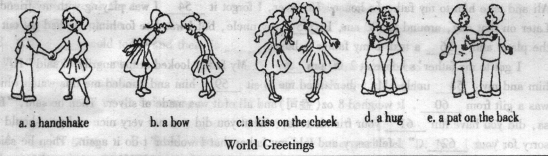
World Greetings
Philippines | The everyday greeting for friends is a handshake for both men and women. Men sometimes pat each other on the back. |
Japan | When people meet for the first time, they usually bow. In business, people also shake hands. In formal situations, people often exchange business cards. When you give a business card, give it with two hands. This is polite. Special note: In Japan, a smile can have different meanings. It usually means that the person is happy, or that the person thinks something is funny. But it can also mean that the person is embarrassed. |
New Zealand | Usually, both men and women shake hands when they meet someone for the first time. Fun fact: If you see two people pressing their noses together, they are probably Maori. The Maori are the native(当地的)people of New Zealand. This is their traditional greeting. |
Brazil | Men often shake hands when they meet for the first time. When women meet, they kiss each other on the cheek. Women also kiss male friends to say hello. When you shake hands, look at the person in the eyes. This shows interest and friendliness. |
1.In which country do men sometimes pat each other on the back?
A. Philippines B. Brazil
C. Japan D. New Zealand
2.In this passage, which of the following is NOT mentioned(提及)?
A. Kisses B. Hugs
C. Bows D. Handshakes
3.Of the five pictures above (a, b, c, d and e), which is the same way to greet each other in the four countries?
A. a B. b C. c D. d
4.Which of the following is TRUE according to the passage?
A.Both men and women shake hands in Brazil when they meet.
B.Japanese won’t smile until they feel very happy.
C.The Maori often press their noses together to greet each other.
D.In Philippines, people shake hands only when they meet for the first time.
5.What does the writer mainly want to tell us in the passage?
A. Different ways of greetings.
B. Four countries.
C. Some fun facts.
D. Some special notes.[HJ][LM]