题目内容
Many people say that they are working too many hours. They don't have enough time to relax or to stay with their family.
Work hours are different from one country to another. In France, people spend about 1,646 hours a year at work. In Japan, however, people work about 2,159 hours a year. That means a Japanese worker works 513 more hours a year than a French worker.
Why do people work so many hours? Some people work extra hours because they want to make more money. However, many companies don't pay overtime. Their workers don't get more pay for more work. Some people think it's their duty to work more hours. Some are afraid of losing their jobs if they don't work more hours.
Many people s ay that their vacations are too short. In France, people get five weeks of paid vacation a year. In Germany, they get four to six weeks, and in the United States, two weeks. One study shows fewer than half of workers used all their vacation days. In Great Britain, there is a saying, "All work and no play makes Jack a dull (迟钝的) boy." If that is true, there must be a lot of dull people in the world.
76. A Japanese worker works __ more hours a year than a French one.
A. 513 B. 1,646 C. 2,159 D. 3,805
77. The word "extra" in Paragraph 3 means ".
A. 正常的 B. 额外的 C. 有用的 D. 少量的
78. People in ________ get only two weeks of paid vacation a year.
A. France B. Germany
C. the United States D. Great Britain
79. Which of the following is true according to the passage?
A. No companies offer vacations to their workers.
B. Many people say they have enough time to relax.
C. Not all companies pay their workers for more work.
D. More than half of workers use all their vacation days.
80. What can we infer from the passage?
A. Many workers have to work long hours.
B. Many people have vacations long enough.
C. Work hours are the same around the world.
D. There are a lot of dull people in the world.
ABCCA


Hello! My name is Mike. I'm 16. Today I'd like to introduce my school day. I'm a student in No. 19 Middle School. Every day I must get up at 6
∶30. I have my breakfast at 7∶00. I always have an egg and a glass of milk. I leave for school at 7∶20. I have an English class at 9∶00. My favourite subject is chemistry. But my best friend Jack likes history and science. I'm at school from 7∶50 a.m. to 4∶30 p.m. At 4∶15 in the afternoon I must clean the classroom. I go home at 4∶30. I have supper at 6∶00 in the evening. I watch the CCTV news at 7∶00. I go to bed at 9∶00. It's a busy day. Here is Betty -- my sister's introduction about her school day.Hi! I am Betty. I get up at six ten in the morning every day. I wash my face and I brush my teeth. I go to school at six thirty. I go to school on my bike. I begin to have classes at seven thirty. We have seven lessons every day, four in the morning and three in the afternoon. I like English, Chinese and maths. But I don't like PE lessons very much. Classes are over at four twenty-five. After school, my friends and I go home. I get home at about a quarter to five. I have dinner with my family at six thirty. After dinner, I do my homework, and then I watch TV in our living room. I go to bed at nine. I am very happy every day!
(1) When does Mike have breakfast?
[ ]
|
A .At 6∶30. |
B .At 7∶00. |
C .At 7∶20. |
(2) What subject does Jack like?
[ ]
|
A .English. |
B .Chemistry. |
C .Science. |
(3) How many hours does Mike stay at school?
[ ]
A
.8 hours.B
.8 hours and 20 minutes.C
.8 hours and 40 minutes.(4) How does Betty go to school?
[ ]
|
A .By bike. |
B .By bus. |
C .On bike. |
(5) Which does Betty like?
[ ]
|
A .Chinese. |
B .Maths. |
C .Both A and B. |
(6) When does Betty get to her home?
[ ]
|
A .At 5∶15. |
B .At 4∶50. |
C .At 4∶45. |
Timetables are important. They help you know what your classes are and when your classes are. They help you get to your classes on time. A class timetable has the names and time of all classes. A good timetable has other information(信息) too. You can write your teachers’ names on it. In some schools, students have the same class in the same place every day—from Monday to Friday. The following timetable is fit(合适的) for those students.
| Time | Monday | Tuesday | Wednesday | Thursday | Friday |
| 7:50 | Meeting | Meeting | Meeting | Meeting | Meeting |
| 8:20 | Chinese | English | Maths | English | Chinese |
| 9:05 | Morning Exercises | ||||
| 9:30 | Maths | Chinese | English | Chinese | Maths |
| 10:25 | Maths | Chinese | Maths | PE | |
| 11:45 | Lunch | ||||
| 12:45 | History | Music | PE | Music | English |
| 13:30 | PE | Art | History | Art | History |
| 14:15 | Biology | Geography | Biology | Geography | Meeting |
| 15:00 | |||||
| Chinese : Mr Li Maths: Ms Feng English: Mr Black History: Mr Ge Geography: Mr Jiang Biology: Miss Song Art : Mr Xu Music: Mr Hu PE :Ms Wang Meeting: Ms Feng | |||||
66.Why do we say the timetables are important?
A. Because they can help us do the homework well.
B. Because they can help us know about out subjects.
C. Because they can help us know a lot about our classmates.
D. Because they can help us know a lot about our teachers.
67.What does the timetable include(包括)?
a. the names of the subjects b. the time of all classes
c. the classroom d. the teachers’ names
e. the workdays of a week
A. a c d e B. a b c e C. a b d e D. a b c d e
68.What class are the students having at 10:30 on Wednesday?
A. PE B. Maths C. English D. Chinese
69.How many classes does Ms Feng have on Friday?
A. One B. Two C. Three D. Four
70.Which of the following is Not right?
A. The students have an hour for lunch.
B. The students have seven lessons a day.
C. The students go to school five days a week.
D. The students do morning exercises and play ball games every day.
 was born in Brussels, on June 25th, 1928. His real name was Pierre Culliford. At first, he almost became a dentist’s assistant. Luckily, he got a job in a cartoon studio. There he met and worked with some of Europe’s most famous comic book artists such as Franquin and Morris. Unfortunately the studio closed down and Peyo decided to become a full-time comic artist. He found himself a pen name from his childhood nickname ‘Pe- yot’.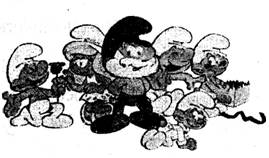
A school report
Name:Edward Scott School: Kelvin High School Grade: 8 Term ending: July 6th |
Math: He doesn’t do well in math, but he tried his best to catch up with others. |
Science: He can work out many difficult problems. Well done! (做得好) |
English: He is the best in the class. Keep it up(保持). |
French: His reading is very good, he can remember many words. |
History: He is not so good at this, but has done better than before. |
Geography: He is familiar(熟悉的) with the names of many places in the world. |
Music: He doesn’t like pop songs, though sings very well. |
No. in class: 9 absences: 8 |
Remarks(评语): Edward is able to do a lot better. He needs to do more work next semester. |
Class teacher: Ivy |
Principal: M. L. Martin |
School reopens: 1 September |
( ) 36. After reading this, we know it is ________________.
A. a studying plan of Edward Scott B. a studying plan of Ivy
C. a report card of Edward Scott D. a report card of Ivy
( ) 37. Which subject is not mentioned(提到) in the report?
A. PE B. Music C. Math D. History
( ) 38. Edward’s best subject is _________________.
A. science B. English C. geography D. French
( ) 39. Edward is not so good at ________________.
A. science and geography B. math and history
C. history and French D. music and English
( ) 40. Which sentence is not true?
A. Edward can’t sing songs very well.
B. Edward doesn’t do well in history.
C. Edward can do better if he works harder next term.
D. Edward learns two languages at school.