题目内容

书面表达。(20 分)

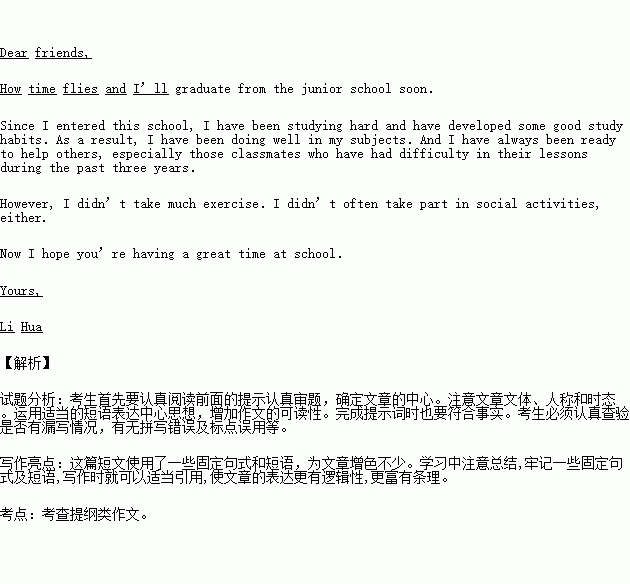
假如你是李华,即将初中毕业。请根据下面表格中的提示内容,给在读的学弟学妹们写一封信,讲述你对自己满意和不满意的方面,并希望他们在学校度过一段美好的时光。

满意的方面

学习努力,养成了良好的学习习惯

乐于助人,尤其是帮助那些在功课方面有困难的同学

不满意的方面

很少锻炼身体

不常参加社会活动

要求:

1.语言流畅,行文连贯;

2.80词左右。 (开头和结尾已给出,不计入总词数)

Dear friends,

How time flies and I’ll

Yours,

Li Hua
练习册系列答案

相关题目

During the Winter Olympics in Sochi(索契), 25,000 volunteers from Russia and other countries provided services for athletes and guests.The student Oksana Verkholyak helped translate Russian into English and Korean at the Games.She told us about their usual day.

“We get up at 7:30 in the morning.Then we have breakfast.Usually we have porridge for breakfast.There is always tea, coffee, bread and pies.After breakfast, we head for a bus stop and get on a bus which runs to the media center.It takes us 30 minutes to get there,” she said.

When volunteers arrived there, they went through the security (安全) check point.They couldn’t bring water or food with them.“Security guards check our bags.We are not allowed to have things made of metals.They check phones, video cameras, electric equipment and computers,” Oksana added.

In the evening volunteers got back to the apartment buildings.All of them were like one big family.They lived together and got some rest together—after dinner they went to the beach to watch the sunset.

Not only students helped organize the Sochi Olympics.There were many so-called silver volunteers who retired but didn’t lose interest in sports.Some of the volunteers had an experience working at the Olympic Games in other countries and even at the Moscow Olympics in 1980.

1.How many foreign languages did Oksana Verkholyak use at the Games?

A.One. B.Two. C.Three.

2.Where did the volunteers go first after breakfast?

A.To the apartment buildings.

B.To the security check point.

C.To a bus stop.

3.What couldn’t the volunteers take into the media center?

A.Water and computers.

B.Video cameras and phones.

C.Knives and hamburgers.

4.Which is NOT true about the silver volunteers?

A.They’re all young people.

B.They love sports.

C.Some of them have volunteered for the Olympics before.

5.What is the best title of this passage?

A.A volunteer’s day at Sochi Olympics

B.2014 Sochi Winter Olympics

C.Different jobs for volunteers

Here is a surprising and important fact: Mental work(脑力劳动) alone can’t make us tired. It sounds absurd(荒谬的). But a year ago, scientists tried to find out how long the human brain could work without reaching a stage of fatigue (疲劳). To the amazement of these scientists, they discovered that blood passing through the brain, when it is active, shows no fatigue at all! If we took a drop of blood from a day laborer(工人), we would find it full of fatigue toxins(毒素) and fatigue products. But if we took blood from the brain of an Albert Einstein, it would show no fatigue toxins at the end of the day.

In fact, brain can work as well at the end of eight or even twelve hours of effort as at the beginning. The brain is totally tireless. So what makes us tired?

Some scientists say that most of our fatigue comes from our mental and emotional(情绪的) attitudes(态度). One of England’s most outstanding scientists, J.A. Hartfield, says, “The greater part of the fatigue is of mental origin(源于精神的). In fact, fatigue of physical origin(源于身体的) is rare.” Dr. Brill, a famous American scientist, goes even further. He says, “One hundred percent of the fatigue of sitting workers in good health is because of emotional problems.”

What kinds of emotions make sitting workers tired? A feeling of being bored, angry, nervous or worried, a feeling of not being appreciated(被欣赏)--- those are the emotions that tire sitting workers. Hard work by itself seldom causes fatigue. We get tired because our emotions produce nervousness in the body.

1.What surprised the scientists a few years ago?

A. Fatigue toxins could hardly be found in a laborer’s blood.

B. Albert Einstein didn’t feel tired after a day’s work.

C. The brain could work for many hours without fatigue.

D. A mental worker’s blood was filled with fatigue toxins.

2.According to the writer, which of the following can make sitting workers tired?

A. Challenging mental work.

B. Unpleasant emotions.

C. Endless tasks.

D. Physical labor(体力劳动).

3.What’s the writer’s attitude towards the scientists’ ideas?

A. He agrees with them.

B. He doubts them.

C. He argues against them.

D. He is not willing to accept them.

4.We can infer from the passage that in order to stay energetic, sitting workers need to ________.

A. have some good food

B. enjoy their work

C. exercise regularly(规律地)

D. discover fatigue toxins

违法和不良信息举报电话:027-86699610 举报邮箱:58377363@163.com

精英家教网