题目内容
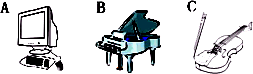
Frank wanted to learn to play _______ guitar, but he didn’t have _______ guitar.
- A.the ; the
- B.a ; the
- C.the ; a
- D.a ; a



| Sydney Tower Address: 100 market St, Sydney Phone: 02 9333 9222 Fax(传真): 02 9333 9203 Open time: 9:00 am to 10:30 pm (Saturday to 11:30 pm) Ticket:$60 ( for an adult(成年人)) $30 ( for a child) Website:www. sydneytower. com. au How to get there: train to Town Hall Station and a short walk along Market Street How to book(预订) tickets: by phone/ fax or through the web Attraction: Sydney’s best views are just the beginning! Sydney Tower takes you to the highest point above Sydney for exciting 360°views of our beautiful city. |
A. the highest point B. the biggest station C. the most beautiful park
【小题2】If you want to book a ticket to Sydney Tower, you can’t ________.
A. email sydneytower@ hotmail. com
B. fax 02 9333 9203
C. search www. sydneytower. com. au
【小题3】Frank wants to go to Sydney Tower with his two children, he will pay _______.
A. $60 B. $90 C. $120
【小题4】Last Saturday, John went to visit Sydney Tower. He had to get down(下来) the tower________.
A. after 11:30 pm B. before 11:30 pm C. at 10:30 pm
【小题5】The passage above is probably(可能) ________.
A. a piece of news B. an advertisement C. a story
A school bus is one that is used to take children to and from school.
In the USA, about 450,000 school buses take more than 25 million children to and from school. The yellow school bus is a US icon (象征). Yellow became the color of school buses in the USA in 1939. Dr. Frank got the good idea. He said it was easy for people to see yellow buses and the black letters on them in early morning or late afternoon. That would make children safer.
There are not many school buses in Britain, and they are not yellow. They have trackers (追踪器) on them, so kids are being tracked while they travel to and from school by bus. The trackers let parents know where the school bus is and whether their kids are on the bus.
Kindergarten (幼儿园) is a difficult time for some kids. It's the first time for them to go away from their parents. To make kids love their school, Japanese kindergartens and schools have colorful buses. The buses can easily make children want to take them--and then, go to school. Even some parents want to take them, too!
School buses are becoming more and more popular in China now. It saves a lot of time for students to take a school bus. It's said that there will be 3,000 yellow school buses on the road by the end of this year in Chongqing.
【小题1】According to Dr. Frank, school buses are safer for the students.
| A.yellow | B.black | C.white | D.colorful |
| A.save time | B.love their school |
| C.play games | D.do their homework |
| A.walk | B.take a taxi |
| C.ride a bike | D.take a school bus |
| A.school buses | B.school life |
| C.popular colors | D.students' safety |
Dear Peter,
My name is Frank. I am from America. Here is a picture of my friends. We are in the same grade. Look at the picture, in the middle, you can see my friend Jimmy. He likes all the sports. He likes to eat apples and French fries. You can see Helen in the picture, too. Helen likes math. Her favorite food is meat. But Sandra doesn’t like math. Look, Sandra is here in the picture. She can speak French. She likes ping-pong. Behind her, there is a girl. She is Sally. She is a black girl. She likes to swim. And she likes to eat ice cream. Maria and Rick are behind Jimmy. Maria likes computer very much. She plays computer games very well. Rick is fun. He can play soccer ball. He likes strawberries best. I like math, too. I like to eat bananas. All of us think Beijing Opera is fun. So we go to see it. But we can’t understand the words. So we don’t want to see it again. But my father likes it very much. He often watches it. He can understand it. One interesting thing:two of my English friends can understand it, too. They are Maya and Kelsey. They are not in the picture. They often go to see Beijing Opera like my father.
Can you send me a picture of your friends.
Yours,
Frank
【小题1】 Frank has__________ friends in the picture.
| A.seven | B.six | C.five | D.eight |
| A.Sally | B.Sandra | C.Frank | D.Peter |
| A.Jimmy, Sandra and Sally | B.Maria, Rick and Jimmy |
| C.Sally, Rick, Jimmy and Sandra | D.Helen, Frank and Rick |
| A.喜欢 | B.理解 | C.听说 | D.观看 |
| A.Because Beijing Opera is boring | B.Because Beijing Opera is bad |
| C.Because Beijing Opera is fun | D.Because they can’t understand it. |
|
Sydney Tower Address:100Market St, Sydney Phone:02 9333 9222 Fax(传真):02 9333 9203 Open time:9:00 am to 10:30pm(Saturdays 9:00am to 11:30pm) Ticket:$60(for an adult) $30(for a child) Website: www. Sydney tower. com. Au How to book tickets: by phone\fax or through the web Attraction: Sydney’s best views are just the beginning! Sydney Tower takes you to the highest point above Sydney for exciting 360° views of our beautiful city.
|
1.Sydney Tower is _____ in Sydney, Australia.
A. the busiest street B. the biggest station C. the highest point
2.If you want to book(预定) a ticket to Sydney Tower, you can not_____.
A.email Sydney tower @ hotmail.com
B.fax02 9333 9203
C.phone 02 9333 9222
3.Frank wants to go to Sydney Tower with his two children, he will pay_____.
A. $60 B. $90 C. $120
4.Last Saturday, Johnson went to visit Sydney Tower. He had to get down the tower______.
A. after 11:30pm B. before 11:30pm C. at 10:30pm
5.The passage above is probably______.
A. a piece of news B. an ad . C. a story