题目内容


When I crossed a small road on my first day in Kolkata, I was surprised because I heard a bell-not a horn (喇叭),  It was a tiny man pulling a rickshaw, He stopped and picked up two children from the front door of their house and pulled them to school. For many people, the rickshaw in Kolkata has many advantages. When the traffic is bad, rickshaws find a way through the traffic. If your miss your bus and there aren't any taxis, you can always find a rickshaw in Kolkata. Rickshaws are from your house to the market and waits for you. Then he loads (装载)all your things, drops you off outside your home and helps you unload, No other type of public transport offers this kind of service.

    From June to September, Kolkata gets heavy rain. Sometimes it rains for 48 hours without a break. In some parts of the city, the roads flood (水淹), and anything with an engine(发动机) is useless, But the rickshaw drivers never stop working, even with water all around them.
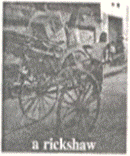
But not everyone thinks rickshaws are a good thing. The local government want to ban rickshaws. They believe it is wrong for one man to pull another person when there is modern transport in the city. However, there is a problem with this plan. Many of the rickshaw drivers come from the

countryside. The only job they can find in Kolkata is pulling a rickshaw, If the city bans rickshaws, these men won't have a job. So for the moment, the people of Kolkata still go by rickshaw.

1. What is the main idea of Paragraph 1?

    A. The rickshaw drivers carry things for local people in Kolkata.

    B. Parents need rickshaws for taking children to school in Kolkata.

    C. Rickshaws can find a way through the bad traffic in Kolkata.

D. Rickshaws are very useful for the people's daily life in Kolkata.

2. Which type of transport may you take when the roads flood in Kolkata?

   A. A bus.       B. A taxi.      C. A car.      D. A rickshaw.

3. What does the underlined word "ban" mean?

    A. make       B. increase     C. forbid      D. collect

4. What can we learn from the passage?

    A. The rickshaws in Kolkata have loud horns.

    B. The rickshaw is still a part of public transport in Kolkata.

    C. The local government offer many other jobs to the rickshaw driven.

D. The people in Kolkata are supposed to take rickshaws instead of cars.


1A   2D   3C   4B                 


练习册系列答案
相关题目

完形填空,请先阅读下面短文,掌握其大意,然后从各小题所给的A、B、C、D四个选项中选出可以填入相应空白处的最佳选项

I was so excited after I had found the holiday in the guidebook. It said, “Enjoy a week of sightseeing in one of Europe’s most beautiful cities 1 staying at one of its best hotels. ” Now I wasn’t so sure. I had waited fifteen minutes at reception (前台) when I 2 and now the shower in my room wasn’t working. I 3 hotel reception.

“Hello. This is Room 308. There isn’t any 4 in my bathroom.

“Are you sure?”

“Of course I’m sure!”

“I’ll 5 our hotel engineer at once. ”

An hour later, the engineer came to look at the 6 . He hit the pipes (水管) a few times and looked 7 . “Sorry, but I cannot fix it today. Maybe, tomorrow.” Then he 8 his hand. I couldn’t believe it! He wanted a tip (小费) for doing 9 ! I was very angry. But suddenly, I had a better idea. 10 , I gave the engineer a few coins. He hadn’t fixed my shower but he had taught me something 11 staying in his country. Two minutes later I was at the reception desk. I explained the 12 to the receptionist (接待员) and he replied, “Sorry. This is a 13 situation, but what can we do?” I knew exactly 14 to do. I gave the hotel manager a very large tip. Fifteen minutes later I 15 into Room 405. It was twice the size of Room 308, it had a wonderful view (景色) of the city, a comfortable bed and, most importantly, there was water in the bathroom.

1. A. since B. while C. after D. before

2. A. arrived B. passed C. left D. stopped

3. A. asked B. ordered C. called D. told

4. A. toothpaste B. water C. shampoo D. soap

5. A. send B. catch C. trouble D. watch

6. A. door B. TV C. shower D. fridge

7. A. proud B. worried C. angry D. excited

8. A. put up B. cleaned up C. looked after D. held out

9. A. nothing B. anything C. something D. everything

10. A. Seriously B. Especially C. Quickly D. Luckily

11. A. at B. with C. of D. about

12. A. problem B. idea C. way D. mistake

13. A. helpful B. perfect C. terrible D. busy

14. A. how B. what C. why D. where

15. A. broke B. looked C. rushed D. moved


Tom and Mike were good friends. Sometimes they were kind to each, sometimes they were not. But some of their classmates (同班同学) said they were like brothers.

One day they went out for a walk together. At noon they were very hungry and they went into a restaurant to have lunch. The waiter (侍者) came up to them and asked, “What can I do for you?”

“Please bring us two apples first.” said Tom. When the waiter put the two apples on the table, Mike took the bigger one at once (立刻). Tom got angry. “You are impolite (没有礼貌), Mike. Why didn’t you take the smaller one?” Tom said.

“But I was right,” said Mike with a smile. “If let you take first, which one will you choose(选择)?”  “Of course I’ll take the smaller one,” said Tom. “Yes,” Mike said, “If you take the smaller one. the bigger one will still be mine. don’t you think so?”  “Oh” Tom couldn’t answered.

(  )1. Tom and Mike were ________.

     A. always kind to each other        B. sometimes kind to each other

     C. brothers                      D. not classmates

(  )2. They went out for ________.

     A. lunch         B. a walk       C. apples         D. a restaurant

(  )3. The waiter brought them ________.

     A. two eggs      B. two oranges    C. two apples    D. some milk

(  )4. Mike took the ______ apple.

     A. better         B. bigger         C. smaller       D. worse

(  )5.---Who took the apple first?       ---___________.

     A. Mike        B. Tom       C. Both Tom and Mike  D. Nobody


违法和不良信息举报电话:027-86699610 举报邮箱:58377363@163.com

精英家教网