题目内容
He is afraid of ________ English in public.
A.speak B.speaking C.spoken D.speaks
B
【解析】
试题分析:句意:他害怕在公众面前说英语.本句中of是介词,后面接名词或者动名词作宾语,故选B.
考点:非谓语动词
点评:不定式作宾语表示具体的将要进行的动作,一般不用于介词后面。动名词作宾语往往表示抽象的,反复发生的动作。介词后面一般接动名词作宾语,也有部分动词后接动名词做宾语,注意和不定式作宾语表达含义的不同。

If you go to Finland, you’ll be surprised to find how “foolish” the Finnish people are.
Take the taxi drivers for example. Taxis in Finland are mostly high class Benz with a fare (票价) of two US dollars a kilometer. You can go anywhere in one, tell the driver to drop you at any place, say that you have some business to attend to, and then get off without paying your fare. And the driver would not show the least sign of worry.
The dining rooms in all big hotels not only serve their guests, but also outside diners. Hotel guests have their meals free, so their good faith is to wave their registration card to the waiter. With such a loose check, you can easily use any old registration card to take a couple of friends and dine free of charge.
With so many loopholes (漏洞) in everyday life, surely Finland must be a heaven to those who love to take “pretty advantages”. But the strange things is, all the taxi-passengers would always come back to pay their fare after they have attended to their business; not a single outsider has ever been found in the free hotel dining rooms. As the Finns always act on good faith and always show an attitude of “which is which” and “what is what” in everything they do, so to live in such a society has turned everyone into a real “gentleman”. In a society of such high moral practice, what need is there for people to take precautions (预防措施) against others?
【小题1】The word “foolish” probably means _____________.
| A.friendly | B.careful | C.strange | D.funny |
| A.he is sure that the passengers always act on good faith |
| B.he is afraid to make the passengers angry and unhappy |
| C.he thinks the passengers may be too poor to pay him |
| D.he is sure that the passengers are really in trouble |
| A.check the guests’ registration card carefully |
| B.give people meals without paying |
| C.serve their guests free of charge |
| D.only serve their guests free breakfast |
| A.No one takes advantages although there are many loopholes. |
| B.All the taxi-passengers come back to pay their fare after they have attended to their business. |
| C.Not a single outsider has ever been found in the free hotel dining rooms. |
| D.Finland is heaven for immoral people because they can always take advantages freely. |
| A.the Finns are foolish |
| B.the Finns take things seriously |
| C.the Finns are busy making money for the family |
| D.the Finns never take precaution against others |
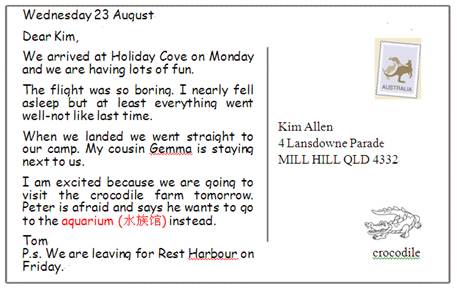
【小题1】Who is this postcard sent to?
| A.Peter. | B.Gemma. | C.Kim. | D.Tom. |
| A.Holiday Cove. | B.Rest Harbour. |
| C.Mill Hill. | D.Crocodile Farm. |
| A.He is so excited. | B.He is afraid of it. |
| C.He felt so boring. | D.He nearly fell asleep. |
If you go to Finland, you’ll be surprised to find how “foolish” the Finnish people are.
Take the taxi drivers for example. Taxis in Finland are mostly high class Benz with a fare (票价) of two US dollars a kilometer. You can go anywhere in one, tell the driver to drop you at any place, say that you have some business to attend to, and then get off without paying your fare. And the driver would not show the least sign of worry.
The dining rooms in all big hotels not only serve their guests, but also outside diners. Hotel guests have their meals free, so their good faith is to wave their registration card to the waiter. With such a loose check, you can easily use any old registration card to take a couple of friends and dine free of charge.
With so many loopholes (漏洞) in everyday life, surely Finland must be a heaven to those who love to take “pretty advantages”. But the strange things is, all the taxi-passengers would always come back to pay their fare after they have attended to their business; not a single outsider has ever been found in the free hotel dining rooms. As the Finns always act on good faith and always show an attitude of “which is which” and “what is what” in everything they do, so to live in such a society has turned everyone into a real “gentleman”. In a society of such high moral practice, what need is there for people to take precautions (预防措施) against others?
【小题1】The word “foolish” probably means _____________.
| A.friendly | B.careful | C.strange | D.funny |
| A.he is sure that the passengers always act on good faith |
| B.he is afraid to make the passengers angry and unhappy |
| C.he thinks the passengers may be too poor to pay him |
| D.he is sure that the passengers are really in trouble |
| A.check the guests’ registration card carefully |
| B.give people meals without paying |
| C.serve their guests free of charge |
| D.only serve their guests free breakfast |
| A.No one takes advantages although there are many loopholes. |
| B.All the taxi-passengers come back to pay their fare after they have attended to their business. |
| C.Not a single outsider has ever been found in the free hotel dining rooms. |
| D.Finland is heaven for immoral people because they can always take advantages freely. |
| A.the Finns are foolish |
| B.the Finns take things seriously |
| C.the Finns are busy making money for the family |
| D.the Finns never take precaution against others |
If you go to Finland, you’ll be surprised to find how “foolish” the Finnish people are.
Take the taxi drivers for example. Taxis in Finland are mostly high class Benz with a fare (票价) of two US dollars a kilometer. You can go anywhere in one, tell the driver to drop you at any place, say that you have some business to attend to, and then get off without paying your fare. And the driver would not show the least sign of worry.
The dining rooms in all big hotels not only serve their guests, but also outside diners. Hotel guests have their meals free, so their good faith is to wave their registration card to the waiter. With such a loose check, you can easily use any old registration card to take a couple of friends and dine free of charge.
With so many loopholes (漏洞) in everyday life, surely Finland must be a heaven to those who love to take “pretty advantages”. But the strange things is, all the taxi-passengers would always come back to pay their fare after they have attended to their business; not a single outsider has ever been found in the free hotel dining rooms. As the Finns always act on good faith and always show an attitude of “which is which” and “what is what” in everything they do, so to live in such a society has turned everyone into a real “gentleman”. In a society of such high moral practice, what need is there for people to take precautions (预防措施) against others?
1.The word “foolish” probably means _____________.
|
A.friendly |
B.careful |
C.strange |
D.funny |
2.Why wouldn’t the driver show the least sign of worry? Because _________.
|
A.he is sure that the passengers always act on good faith |
|
B.he is afraid to make the passengers angry and unhappy |
|
C.he thinks the passengers may be too poor to pay him |
|
D.he is sure that the passengers are really in trouble |
3.The dining rooms in all big hotels ___________.
|
A.check the guests’ registration card carefully |
|
B.give people meals without paying |
|
C.serve their guests free of charge |
|
D.only serve their guests free breakfast |
4.What’s FALSE according to the passage?
|
A.No one takes advantages although there are many loopholes. |
|
B.All the taxi-passengers come back to pay their fare after they have attended to their business. |
|
C.Not a single outsider has ever been found in the free hotel dining rooms. |
|
D.Finland is heaven for immoral people because they can always take advantages freely. |
5.The sentences “which is which” and “what is what” show that __________.
|
A.the Finns are foolish |
|
B.the Finns take things seriously |
|
C.the Finns are busy making money for the family |
|
D.the Finns never take precaution against others |