摘要:Section One 1. Why is the woman moving? A. She wants a larger room. B. She needs a cheaper room. C. She prefers a quieter room. 2. Where does this conversation probably take place? A. On a bus. B. In a theatre. C. At a supermarket. 3. What do we know about the restaurant? A. It has been the best place to eat. B. It will no longer offer Italian food. C. It is not serving as good food as before. 4. What did the woman buy today? A. A pair of boots. B. A jacket. C. A skirt. 5. What will the woman do? A. Work in Florida. B. Visit Disney World. C. Receive some visitors. Section Two Questions 6-7 are based on the 6th material. 6. What has the woman been busy doing? A. Helping young people to get a job. B. Giving evening classes to young people. C. Improving young people’s working conditions. 7. What do the young people desire? A. An easy job. B. A daytime job. C. A well-paid job. Questions 8-10 are based on the 7th material. 8. Where did the woman learn the story? A. From a paper. B. Over the radio. C. On the Internet. 9. How was the girl after being sent to the hospital? A. She was in less pain. B. She was completely out. C. She was in her wrong mind. 10. Why did the doctor send the message on line? A. To invite the doctor in Washington, D.C. B. To get in touch with the hospitals nearby. C. To look for some foreign medical experts. Questions 11-13 are based on the 8th material. 11. How many times has the woman sailed before? A. None. B. Once. C. Twice. 12. How much can the woman pay at most? A. £300 B. £370 C. £380 13. When will the woman most probably go? A. In August. B. In September. C. In October. Questions 14-16 are based on the 9th material. 14. What is the possible relationship between the two speakers? A. Passenger and conductor. B. Instructor and runner. C. Reporter and winner. 15. How many years has the woman been cycling? A. 5 B. 17 C. 22 16. What does the woman want to do now? A. Relax herself. B. Collect money. C.Work overtime. Questions 17-20 are based on the 10th material. 17. What is the main purpose of this talk? A. To advertise a computer learning school. B. To explain the importance of the computer. C. To describe how to program computers. 18. What do we know about most of the listeners? A. They are out of work. B. They are doctors and lawyers. C. They are not satisfied with their present jobs. 19. What is one of the advantages of computer programmers? A. They can win people’s respect. B. They can work in good condition. C. They can receive fine training. 20. What is the most attractive to the listeners? A. Training them during the day. B. Offering job opportunities. C. Protecting their belongings.

网址:http://m.1010jiajiao.com/timu3_id_3195932[举报]

阅读理解

  Section One

  The city is an accumulation of human civilization.Just as the American social philosopher (哲学家) Lewis Mumford put it, it is a special system which, fine and compact, has been designed to preserve the fruits of human civilization.Many Western languages have developed their versions of the term“civilization”from the same Latin (拉丁语的) word“civitas”(meaning“city”), and it is by no means a coincidence.The city has played a significant role in the perfection of order in human society.

  Section Two

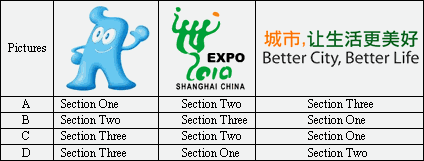
  The emblem, showing the image of three people-you, me, him/her holding hands together, symbolizes the big family of mankind.Inspired by the shape of the Chinese character“世”(meaning the world), the design conveys the organizers’ wish to host an Expo which is of global scale and which showcases the various urban cultures of the world.

  Section Three

  Created from the inspiration of Chinese character“人”, the design roots deeply in Chinese culture.It tells the world the eternal core (永恒的核心) and theme of Shanghai World Expo will be always human.The mascot“Haibao”will become the messenger for the theme of World Expo 2010 Shanghai China“Better City, Better Life”.

  The basic structure of the Chinese character“人”in which each stroke supports each other also shows the concept that the beautiful life should depends on mutual-help.If the human are willing to support one another, the harmony among human, nature, and society will be available.Such an urban life will be nice.

  Haibao’s confident smile is expressing his sincere greeting from China-“World Expo 2010 Shanghai China welcomes you!”

(1)

Section One mainly tells about ________.

[  ]

A.

the part cities play in human civilization

B.

the development of the word“city”

C.

why the Expo is held in Shanghai

D.

where human civilization originated

(2)

The underlined word“it”in Section One refers to ________.

[  ]

A.

the civilization

B.

the philosopher

C.

the word

D.

the city

(3)

Which correctly matches the sections with the pictures they describe?________

(4)

In Section Three, the second paragraph explains how the creation is connected with the ________ of the Chinese word“人”.

[  ]

A.

story

B.

meaning

C.

shape

D.

usage

(5)

The underlined word“stroke”in the second paragraph of Section Three means ________.

[  ]

A.

one of the ideas a word has

B.

a line made by a writing tool

C.

a member of a family or the society

D.

a person who has met with trouble

查看习题详情和答案>>

  In January 2008, during the first week of a six-month stay at the Children's Hospital of Philadelphia for leukemia (白血病) treatment, Michael wandered over to his hospital window in search of distraction (散心). The   36   first-grader watched a construction crew  37 on a 10-story addition to the hospital.  38 Michael's third-floor window, Ritchie, an iron-worker from the East Falls section of Philadelphia,  39 and saw this kid with no hair  40 face was pressed up to the window. “I waved, and he smiled and   41  . I'll never forget that,” says Ritchie, a father of three.
  As winter  42 spring, Michael watched, fascinated, as 3,000 tons of steel 43 formed the skeleton of the building. One day he colored a message for the crew and held  44 up to the window: Hi, Local Iron Workers. I'm Mike. Ritchie and the  45 crew messaged back. Over the  46 months, as his treatment continued, Ritchie and the crew  47 Michael up and cheered him with  48 signs like Be Strong Mike.
     49 the construction reached the third floor, Ritchie jumped across the   50 between the buildings and the two had a  51 chat. The hard hat with the tender heart wells up (涌出眼泪) when he thinks about it. "Michael  52  my life," says Ritchie. "I was a really hard-core (顽固不化的) person without a lot of sympathy. But I'd  53 seeing this kid every day waving at me and excited about the construction. I look at life 54  thanks to him." Today Michael is a 10-year-old third-grader in complete recovery. What does he hope to  55 when he grows up? "A construction worker," he says. 


36. A. strange   B. curious   C. serious   D. anxious

37. A. playing   B. studying   C. living   D. working

38. A. Below    B. Above    C. Under    D. Over

39. A. watched out B. watched at C. looked up  D. looked down

40. A. whom     B. whose    C. which    D. that

41. A. came back  B. came on   C. waved back  D. waved on

42. A. went off  B. went out   C. turned into D. turned to

43. A. gradually  B. immediately C. successfully   D. usually

44. A. that     B. it      C. one     D. itself

45. A. hospital  B. repair   C. construction  D. school

46. A. first    B. last     C. long     D. next

47. A. cheered   B. lighted    C. called    D. woke

48. A. discouraging        B. encouraging   C. surprising    D. interesting

49. A. Before   B. Since    C. While    D. When

50. A. ground    B. floor    C. space    D. story

51. A. face-to-face        B. hand-in-hand  C. neck-and-neck D. step-by-step

52. A. gave    B. changed   C. saved    D. took

53. A. pay attention toB. get down to      C. be used to   D. look forward to

54. A. differently B. happily   C. sadly    D. excitedly

55. A. have    B. get     C. be      D. appreciate


查看习题详情和答案>>

  “I wish Central Bank would be robbed,” George Pickens said to himself. He had been making this wish daily from the time he had started work as a teller(出纳)at the bank.

  Of course, George had a reason for wanting the bank to be robbed. He had a plan. It went like this:

  If Bank Robber A threatens(威胁)Bank Teller B

  What is to prevent Bank Teller B from keeping all the money left and declaring that it was stolen by Bank Robber A?

  Then one afternoon Bank Robber A, who was wearing a mask, appeared. He rushed to George’s cage with a gun.

  “All right,” he said, “Hand it over!”

  George reached into his cashbox(现金箱),took all the bills from top section, and passed them to the robber. The robber turned to leave with the bills.

  Then, while everyone watched Bank Robber A, Bank Teller B took the bills from the bottom section of the cashbox and put them into his own pockets.

  The next morning when George arrived at the bank, he was called into Mr Burrows’ office. “George,” the bank president said, “I want you to meet Mr Carruthers, who used to be president of our bank.”

  “Good morning, George,” said Mr Carruthers. “I was sorry to give you a hard time yesterday, but with so many banks being robbed these days I thought it would be a good idea to prove that our bank can be robbed too. That’s why I played my little game yesterday.”

  “I don’t understand,” said George. “What game?”

  The old man laughed. He placed a mask over his face, and said: “All right. Hand it over!” Mr Burrows laughed but George did not.

  “And the money?” George asked in a small voice.

  “Don’t worry,” Mr Carruthers said. “I put it all back in your cashbox. We’re just finishing up the audit(算账)now.”

  Behind them, the door opened and Mr Bell, the chief auditor(查账员), put his head into the room. “Mr Burrows,” he said seriously, “may I see you a moment?”

1. The underlined part “Bank Teller B” in the text refers to ____.

  A. Mr Bell        B. Mr Carruthers

  C. George        D. another teller at the bank

2. How do you think George felt when he was told that the money had all been ut back in his

  cashbox?

  A. Happy.        B. Surprised.

  C. Puzzled.         D. Worried.

3. We may infer that what the chief auditor wanted to tell Mr Burrows at the end of the story was

  that ____.

  A. there was no money left

  B. there was no money lost

  C. there was still money missing

  D. there was more money than expected


查看习题详情和答案>>

During my second year of college, I was a part-time waitress in Chicago. I spent most of my time on  36 and as little as possible on conversation. I wasn’t used to talking to unknown people except when taking  37 .

One night, a little old man came in and  38  himself in my section. I took his order and went on my way. But I  39 that he came in week after week and always sat at one of my tables. Slowly, I began having short 40 with him. His name was Mr. Rodgers, but he 41 that I call him Don. I learned that he and his wife had gone to dinner and a movie every Saturday. Since she had died, he  42 the tradition alone.

As the weeks went on, I began to sit and  43 talk with Don. We talked about his wife, his days  ___44 in the war, his son who had grown up and also served as a pilot in the army. Eventually, we began to talk about my  45 — going to school, my new boyfriend and the expectation of my future.

About four months after meeting him, I received  46 from a nurse telling me that Don was in hospital. He was  47 complications (并发症) from a heart operation. I  48 drove to the hospital to see him. The first thing he did was thank me for  49 him to visit the doctor. At first I didn’t know what he was  50 . Then I remembered that about three weeks earlier, Don was  51 about chest pains and I gave him the number of a  52 I know.

A nurse asked, “Are you his daughter?” and I replied, “No, I’m his  53 .”

54 can become good friends. I recently found it  55 to talk to customers at the restaurant and I have had a lot more fun.

36. A. school   B. work    C. cinema   D. home

37. A. orders   B. notes    C. advice    D. clothes

38. A. raised   B. greeted    C. seated    D. balanced

39. A. realized   B. wondered  C. understood  D. noticed

40. A. Examinations        B. Conversations

C. preparations        D. competitions

41. A. ordered   B. believed   C. refused   D. insisted

42. A. called off  B. left out    C. carried on  D. dealt with

43. A. actually   B. helplessly   C. obviously  D. hopefully

44. A. escaping  B. working   C. wandering  D. flying

45. A. ambition  B. identity    C. occupation  D. hobby

46. A. an article  B. a bill     C. an offer   D. a call

47. A. treating   B. experiencing  C. studying  D. observing

48. A. immediately B. eventually  C. frequently D. deliberately

49. A. forcing   B. forbidding  C. urging      D. inviting

50. A. going through B. setting aside  C. referring to   D. making up

51. A. arguing  B. complaining  C. discussing D. thinking

52. A. doctor    B. dentist    C. lawyer   D. manager

53. A. student   B. waitress   C. niece    D. secretary

54. A. Relatives   B. Colleagues  C. Neighbors  D. Strangers

55. A. unbelievable B. possible   C. enjoyable D. reasonable

查看习题详情和答案>>

阅读下面短文,从短文后各题所给的四个选项(A、B、C和D)中,选出可以填入空白处的最佳选项。

  I stopped at a red light only a mile or so from my goal of my brother's house.We were planning to   1   down together to North Carolina to be with my father who was critically ill.

  As I   2   at the stop light, I noticed Sharper's Florist over to the left.It was the same   3   I had stood as a young man nervously   4   some roses for my date-floods of   5   went through my mind.I noticed the liquor(酒)store straight ahead where my father and I had been many times before,   6   the beer of the week.We both liked German beer.

  The light finally turned   7  .And I made my left turn and went through the   8   section of our hometown.I remembered how each thanksgiving my   9   would be together, including my parents and my brother.I also remembered how my father would   10   some time every thanksgiving, making sure there was no one   11   in the neighborhoods surrounding where we lived.I can remember as a young boy going with him to   12   some food.I was scared.I had   13   been into this part of town this deeply before.But my father seemed   14   and went about his business.

  The people seemed to know him and   15   accepted what he came to offer.My father seemed able to give away the food in a way that honored those he was giving to.He would   16   at each place and talk a little.

  My father wanted to be sure   17   had food.If there were people he found who didn't have food, he would   18   and get more.That's the kind of man he was.

  I pulled into the driveway of my brother's home.I got out of the   19   and my brother Joel was there to meet me.We hugged and Joel said Dad had   20   just an hour ago.How I hoped I could see him for the last time! But I had no chance.

(1)

[  ]

A.

turn

B.

drive

C.

walk

D.

slow

(2)

[  ]

A.

waited

B.

thought

C.

rested

D.

looked

(3)

[  ]

A.

mark

B.

place

C.

way

D.

sign

(4)

[  ]

A.

picking out

B.

making out

C.

pointing out

D.

turning out

(5)

[  ]

A.

warnings

B.

complaints

C.

tears

D.

memories

(6)

[  ]

A.

selling

B.

drinking

C.

buying

D.

producing

(7)

[  ]

A.

yellow

B.

green

C.

red

D.

dark

(8)

[  ]

A.

high

B.

low

C.

poor

D.

rich

(9)

[  ]

A.

friends

B.

family

C.

brother

D.

classmates

(10)

[  ]

A.

spend

B.

waste

C.

plan

D.

pass

(11)

[  ]

A.

cold

B.

afraid

C.

thirsty

D.

hungry

(12)

[  ]

A.

eat

B.

seek

C.

send

D.

cook

(13)

[  ]

A.

almost

B.

never

C.

nearly

D.

really

(14)

[  ]

A.

calm

B.

nervous

C.

angry

D.

quiet

(15)

[  ]

A.

carefully

B.

easily

C.

gratefully

D.

hardly

(16)

[  ]

A.

stop

B.

move

C.

continue

D.

run

(17)

[  ]

A.

no one

B.

everyone

C.

someone

D.

anybody else

(18)

[  ]

A.

step forward

B.

stand out

C.

walk down

D.

go back

(19)

[  ]

A.

kitchen

B.

room

C.

car

D.

bus

(20)

[  ]

A.

passed away

B.

lain down

C.

gone out

D.

got up

查看习题详情和答案>>

违法和不良信息举报电话:027-86699610 举报邮箱:58377363@163.com

精英家教网