网址:http://m.1010jiajiao.com/timu3_id_3192998[举报]
—Shall I go and buy more food and drink for the party ?
—No, we have prepared a fridge of those , That be quite enough.
A.can B.may C.might D.ought to
查看习题详情和答案>>
We find that bright children are rarely held back by mixed-ability teaching. On the contrary, both their knowledge and experience are enriched. We feel that there are many disadvantages in streaming(把…按能力分班)pupils. It does not take into account the fact that children develop at different rates. It can have a bad effect on both the bright and the not-so-bright child. After all, it can be quite discouraging to be at the bottom of the top grade!
Besides, it is rather unreal to grade people just according to their intellectual (智力的) abilities. This is only one aspect of their total personality. We are concerned to develop the abilities of all our pupils to the full, not just their academic ability. We also value personal qualities and social skills, and we find that mixed-ability teaching contributes to all these aspects of learning.
In our classrooms, we work in various ways. The pupils often work in groups: this gives them the opportunity to learn to co-operate, to share, and to develop leadership skills. They also learn how to cope with personal problems as well as how to think, to make decisions, to analyze and evaluate, and to communicate effectively. The pupils learn from each other as well as from the teacher.
Sometimes the pupils work in pairs; sometimes they work on individual tasks and assignments, and they can do this at their own speed. They also have some library, and we teach them the skills they need in order to do this effectively. And expect our pupils to do their best, not their least, and we give them every encouragement to attain this goal.
1. Group work provides pupils with the opportunity_________.
A. to develop academic abilities B. to learn to teach.
C. to do some experiments D. to learn to be capable organizers.
2. By "held back" in the first paragraph the author means _________.
A. drawn to their studies B. prevented from advancing
C. made to remain in the same classes D. forced to study in the lower classes
3. In the passage the author's attitude towards " mixed-ability teaching" is ________.
A.questioning B. approving C. objective D. critical
4. The author's purpose of writing this passage is to _________.
A. offer advice on the proper use of the library
B. emphasize the importance of appropriate formal classroom teaching
C. argue for teaching bright and not -so-bright pupils in the same class
D. recommend pair work and group-work for classroom activities
5. The author argues that a teacher's chief concern should be the development of the student's _____.
A. total personality B. intellectual ability
C. learning ability and communicative skills D. personal qualities and social skills
完形填空 (共20小题;每小题1.5分,满分30分)
Michel is a young girl who works for the police 16 a handwriting expert. She has helped 17 many criminals(罪犯) by using her special talents (天才).
When she was fourteen, Michel was already 18 interested in the differences in her friends' 19 that she would spend hours 20 them. After 21 college she went to France for a 22 two-year class in handwriting at the School of Police Science.
Michel says that it is 23 for people at hide their handwriting. She can discover 24 of what she needs to know simply 25 looking at the writing with her own eyes, 26 she also has machines 27 help her make 28 different kinds of paper and ink. This knowledge is often 29 great help to the police.
Michel believes that handwriting is a good 30 of what kind of person the 31 is. "I wouldn't go out with a fellow 32 I didn't like his handwriting. " She says. But she 33 she fell in love with her future husband, a young policeman 34 she studied his handwriting. It is later proved to be 35 , however.
A. with B. by C. like D. as
A. search B. follow C. catch D. extra
A. so B. too C. quite D. extra
A. books B. letter C. tongues D. handwriting
A.writing B. studying C. settling D. uncovering
A.attending B. finishing C. starting D. stepping into
A. powerful B. natural C. special D. common
A.main B. safe C. easy D.impossible
A. most B. nothing C. little D. sight
A. with B. by C. of D. about
A. so B. for C. thus D. but
A. they B. in which C. that D. those
A. up B. out C. for D. into
A. of B. to C. with D. for
A. test B. sign(标记) C. means D. habit
A. thief B. criminal C. writer D. policeman
A. whether B. unless C. if D. after
A. adds B. tells C. repeats D. cries
A. before B. after C. shyly D. and
A.necessary B. all right C.important D. quite easy
查看习题详情和答案>>The rising costs of health care have become a problem for man y countries in the world. To deal with this problem, it is recommended that a big part of the state health budget be used for health education and disease prevention instead of treatment. Actually, many kinds of diseases are preventable in many ways and preventing a disease is usually much cheaper than treating it. For example, people could avoid catching a cold if they dressed warmly when the weather starts getting cold. But many people get sick because they fail to do so, and have to spend money seeing a doctor.
Daily habits like eating more healthy food would have kept millions of families from becoming bankruptif the patients had taken ways for early prevention. For example, keeping a balanced diet, such as not consuming too much animal fat and trying to have enough vegetables and fruits, seems to be quite important.
One very effective and costless way of prevention is regular exercise, which is necessary for a healthy mind and body. Regular exercise, such as running, walking, and playing sports is a good way to make people feel better or reduce stress.
In addition, health education plays a key role in improving people’s health. By giving people more information about health, countries could help people understand the importance of disease prevention and ways to achieve it. For example, knowing one’s family medical history is an effective way to help keep healthy. Information about health problems among close relatives will make them aware of what they should do to prevent certain diseases through lifestyle changes, which will work before it is too late.
However, paying more attention to disease prevention does not mean medical treatment is unimportant. After all, prevention and treatment are just two different means toward the same effect. In conclusion, we could save money on health care and treat patients more successfully if our country spends more money on health prevention and education.
【小题1】What’s the best title of the passage?
| A.Prevention or Education? | B.Exercise or Illness? |
| C.Health or Illness? | D.Prevention or Treatment? |
| A.Unable to be cured. | B.Unable to pay one’s debts. |
| C.Stronger than ever before. | D.More successful than ever before. |
| A.dressing warmly can prevent diseases. |
| B.a balanced diet is cheaper than regular exercise. |
| C.the more health education, the better. |
| D.the government’s health budget should be increased. |
 查看习题详情和答案>>
The rising costs of health care have become a problem for man y countries in the world. To deal with this problem, it is recommended that a big part of the state health budget be used for health education and disease prevention instead of treatment. Actually, many kinds of diseases are preventable in many ways and preventing a disease is usually much cheaper than treating it. For example, people could avoid catching a cold if they dressed warmly when the weather starts getting cold. But many people get sick because they fail to do so, and have to spend money seeing a doctor.
Daily habits like eating more healthy food would have kept millions of families from becoming bankruptif the patients had taken ways for early prevention. For example, keeping a balanced diet, such as not consuming too much animal fat and trying to have enough vegetables and fruits, seems to be quite important.
One very effective and costless way of prevention is regular exercise, which is necessary for a healthy mind and body. Regular exercise, such as running, walking, and playing sports is a good way to make people feel better or reduce stress.
In addition, health education plays a key role in improving people’s health. By giving people more information about health, countries could help people understand the importance of disease prevention and ways to achieve it. For example, knowing one’s family medical history is an effective way to help keep healthy. Information about health problems among close relatives will make them aware of what they should do to prevent certain diseases through lifestyle changes, which will work before it is too late.
However, paying more attention to disease prevention does not mean medical treatment is unimportant. After all, prevention and treatment are just two different means toward the same effect. In conclusion, we could save money on health care and treat patients more successfully if our country spends more money on health prevention and education.
1.What’s the best title of the passage?
A.Prevention or Education? B.Exercise or Illness?
C.Health or Illness? D.Prevention or Treatment?
2.Which of the following can replace the underlined word “bankrupt”?
A.Unable to be cured. B.Unable to pay one’s debts.
C.Stronger than ever before. D.More successful than ever before.
3.We learn from the passage that ______.
A.dressing warmly can prevent diseases.
B.a balanced diet is cheaper than regular exercise.
C.the more health education, the better.
D.the government’s health budget should be increased.
4.Which of the following shows the structure of the passage?
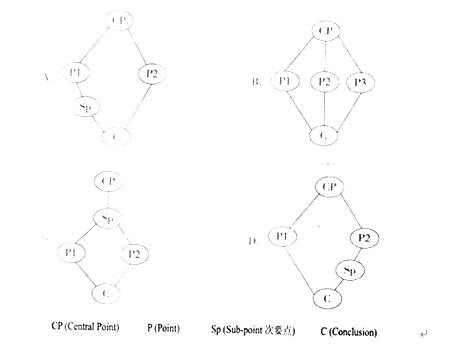
查看习题详情和答案>>