网址:http://m.1010jiajiao.com/timu3_id_3189569[举报]
完形填空
阅读下面短文,掌握其大意,然后从以下各题所给的四个选项中(A、B、C、D)中,选出最佳选项。
Science is based upon observation. However, observation 1 is not science. Scientists 2 state a problem, which then guides them in their observations. But without observation people generally are not 3 of a problem. This then raises a question 4 comes first, the observation or the problems?
Curiosity awakens a need 5 observation. Observation will usually 6 specific questions in the mind of a scientist. To 7 his curiosity he begins to make observations. 8 , he formulates a specific statement that can be tested. This statement is called a hypothesis (假设). It is the starting point for an experiment.
9 experimenting, the scientist tries to show or prove that the hypothesis is true or false. He 10 use good 11 to create an experiment that 12 the problem. The experiment must produce valid information or data. The date 13 during the experiment are observations.
Observations can be made directly and indirectly. For direct observation, instruments are 14 used. Some instruments used by modern scientists are quite simple; others are very 15 .
To complete his experiment, the scientist must state his observations in numerical 16 . This means that he has to make measurements. With the results from these he can make more 17 comparisons or descriptions to 18 his hypothesis. The results of a scientific experiment 19 on a valid hypothesis can often 20 a better understanding of the world and the universe.
1.
[ ]
2.
[ ]
3.
[ ]
4.
[ ]
5.
[ ]
6.
[ ]
7.
[ ]
8.
[ ]
9.
[ ]
10.
[ ]
11.
[ ]
12.
[ ]
13.
[ ]
14.
[ ]
15.
[ ]
16.
[ ]
17.
[ ]
18.
[ ]
19.
[ ]
20.
[ ]
Elijah McCoy(1843~1929), a mechanical engineer, worked with locomotives and parts of locomotives. He invented a self-lubricating(自动加油)machine. The machine makes it possible for machines to lubricate themselves—to put oil on themselves, that is.
McCoy, a black man who was the son of slaves, called his first lubricating machine a“lubricator cup”. The cup allowed small drops of oil to drip continuously onto the moving parts, keeping the machine in good running order.
As slaves, McCoy’s parents lived in Kentucky. They fled from the United States and settled in Canada. Elijah was born in Colchester, Ontario, Canada, in 184(3) McCoy’s father worked hard in Canada. With pride, he sent Elijah to Edinburgh, Scotland. The boy was then fifteen years old. Elijah McCoy attended a school of engineering in Edinburgh. He studied mechanical engineering. Upon completing his studies, McCoy returned to the United States. No one wanted to hire a black man as a mechanical engineer. Finally McCoy took a job as a fireman for the Michigan Central Railroad.
McCoy shoveled(铲)coal and oiled the moving parts of the locomotive. This was a hard job for a mechanical engineer! But McCoy gave some thoughts to his work. Suddenly he had an idea. Why couldn’t a train oil itself? McCoy then invented the self-lubricating machine.
Perhaps you have heard the expression“the real McCoy”. The expression is applied(应用)to high quality tools and machines. Railroad men who used the self-lubricating machine boasted(自夸)of having“the real McCoy”.
(1) McCoy’s first invention was ________.
[ ]
A.a machine used to make other machines lubricate themselves
B.some cups which could put oil on themselves
C.a kind of cup used to drop oil to itself
D.a machine which dripped continuously and always kept in good running order
(2) McCoy ________ and returned to the US after completing his study of engineering.
[ ]
A.left the US with his parents when he was 15
B.left Canada for Scotland in 1858
C.fled from the US and came to Canada in 1843
D.with his parents came to Scotland when he was a slave in the US
(3) McCoy was a famous American ________ who invented a self-lubricating machine
[ ]
A.son of slaves
B.fireman
C.mechanical engineer
D.real McCoy
(4) It was unfair that ________.
[ ]
A.a black man took a job as a fireman
B.a train couldn’t oil itself
C.“the real McCoy”was applied to tools and machines
D.an engineer should be offered a job of shoveling coal and oiling machines
(5) McCoy not only invented a lubrication machine, he also ________.
[ ]
A.was“the real McCoy”
B.added a phrase to the English language
C.invented many other lubricating machines
D.could make trains keep in good running order
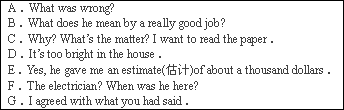
查看习题详情和答案>>根据对话内容,从对话后的选项中选出能填入空白处的最佳选项。选项中有两项多余选项。
-Please turn off that light, Harry!
- 1
-If we turn on too many lights, all the electricity in the house will go off.
-Now who told you that?
-The electrician(电工)。
- 2
-I had to call him today.
- 3
-When I turned on the washing machine, all the lights went out.
-Well, didn’t the electrician take care of it?
-Yes, but he said it would take a lot more work to do a really good job.
- 4
-He said we needed new wiring throughout the house and a lot of other things.
-Did he tell you how much it would cost?
- 5
-A thousand dollars! That’s a lot of money.And just when we need to get some work done on the car too.
A teacher was asking one of her pupils some questions, but not even one of the answers was correct. So the teacher __(1)___ to ask him some very simple questions. She hoped that he could give at least one __(2)___ answer.
“Now Sam,”said the teacher,“__(3)___ is Waterloo?”
“Waterloo?”said the boy.“Oh, it's a kind of __(4)___ machine, I think.”
The teacher was __(5)___. She shook her head and raised __(6)___ question,“Sam, be __(7)___, please. Now tell me the __(8)___ to a very, very simple question: Who was Washington?”
“Well,”the answer __(9)___ quickly,“Washington must be the man who uses that washing machine.”
The teacher got __(10)___, but she didn't __(11)___. She thought and thought, and at last she thought of the __(12)___ question--if this could be __(13)___ a question: Who is the __(14)___ of the United States now?
Sam thought for a long time, but he had no __(15)___ at all. Then the teacher lost her temper(脾气). She __(16)___,“Bush!”Sam looked __(17)___ and sat down.“Stand up!”Sam stood up again. He looked __(18)___.“Oh, I'm __(19)___.”he said,“I thought you were calling the __(20)___ student.”
|
(1)A.changed |
B.turned |
C.began |
D.ought |
|
(2)A.good |
B.fine |
C.satisfied |
D.correct |
|
(3)A.what |
B.who |
C.which |
D.how |
|
(4)A.unknown |
B.wonderful |
C.washing |
D.drinking |
|
(5)A.happy |
B.surprised |
C.excited |
D.frightened |
|
(6)A.another |
B.the other |
C.other |
D.one |
|
(7)A.clever |
B.strict |
C.good |
D.serious |
|
(8)A.answering |
B.answer |
C.reason |
D.fact |
|
(9)A.was |
B.replied |
C.came |
D.went |
|
(10)A.angry |
B.astonished |
C.delighted |
D.excited |
|
(11)A.give in |
B.give out |
C.give over |
D.give up |
|
(12)A.hardest |
B.most difficult |
C.easiest |
D.funniest |
|
(13)A.made |
B.called |
C.had |
D.found |
|
(14)A.president |
B.governor |
C.ruler |
D.leader |
|
(15)A.plan |
B.opinion |
C.mind |
D.idea |
|
(16)A.called |
B.said |
C.shouted |
D.explained |
|
(17)A.back |
B.around |
C.up |
D.sorry |
|
(18)A.happy |
B.satisfied |
C.sad |
D.puzzled |
|
(19)A.afraid |
B.sorry |
C.excited |
D.glad |
|
(20)A.next |
B.first |
C.last |
D.beat |