网址:http://m.1010jiajiao.com/timu3_id_3135581[举报]
听力
(共两节,满分30分)第一节
(共5小题;没小题1.5分,满分7.5分)听下面
5段对话。每段对话后有一个小题,从小题中所给的A、B、C三个选项中选出最佳选项。听完每段对话后,你都有10秒钟的时间来回答有关小题和阅读下一小题。每段对话仅读一遍。例:
How much is the shirt?A.£19.15
B.£9.15
C.£9.18
答案
B。1.What do the speakers need to buy?
A.A fridge
B.A dinnertabil
C.A few chairs
2.Where are the sperkers?
A.In a resourant.
B.In a hotel.
C.In a school.
3.What does the womam mean?
A.Cathy will be at the part.
B.Cathy is too buay to come.
C.Cathy is going to be invited.
4.Why does the woman plan to go to town
A.To pay her bills in the bank.
B.To buy books in a bookstore.
C.To get some money from te bank.
5.What is the woman trying to do?
A.Finish some writing.
B.Print an article.
C.Find a newapaper.
第二节(共15小题;第小题1.5分,满分22.5分)
听下面
5段对话。每段话后有几个小题,从题中所给的A、B、C三个选项中选出最佳选项。听每段对话前,你将有时间阅读各个小题,每小题5秒钟;听完后,各小题给出5秒钟的作答时间。每段对话读两遍。听第
6段材料,回答第6、7题。6.What is the man doing?
A.Changing seats on the plane.
B.Asking for a window seat.
C.Trying to find his seat.
7.What is the woman’s seat number?
A.6A
B.7A
C.8A
听第
7材料,回答第8、9题。8.Why doesn’t the woman take the green T-shist?
A.It’s too small.
B.It’s too dark.
C.It’s too expensive.
9.What dose the woman buy in the end?
A.A yellow T-shirt.
B.A bule T-shirt.
C.A pink T-shirt.
听第8材料,回答第10至12题。
10.How long has the man been in London?
A.One year.
B.A few years.
C.A couple of months.
11.Why did the woman leave her hometown?
A.To lend a city life.
B.To open a restaurart.
C.To find a job.
12.Where did the woman come from?
A.London.
B.Arnside.
C.Lancaster.
听第9材料,回答第13至16题
13.What is a daypack?
A.A box.
B.A bag.
C.A lock.
14.What surpriscs the girl at school?
A.A lot of discussious in class.
B.Teachers giving little homework.
C.Few students asking quescions in class.
15.At what time of the school term does the comversation most probably take place?
A.At the end of it.
B.In the middle of it.
C.At the beginning of it.
16.What do we know about the girl?
A.She is new to she school.
B.She wriers for the school newspaper.
C.She seldom asks questions in class.
听第10段材料,回答第17至20题。
17.What does Mr Henry Stone do?
A.A bank clerk
B.A teacher
C.A writer
18.What does Henry like doing at airports?
A.Watching people
B.Telling stories
C.Reading magazines
19.What did Henry learn from the newspaper that day?
A.A valuable suitcase was missing.
B.A man stole money from a bank.
C.A woman ran away from home
20.Why was the woman at the airport?
A.She was traveling on business.
B.She was seeing the man off.
C.She was leaving for Greece.
Part I Listening Comprehension(30 marks)
Section A(22.5 marks)
Directions:In this section, you'll hear six conversations between two speakers.For each conversation, there are several questions, and each question is followed by three choices marked A, B and C.Listen carefully and then choose the best answer for each question.You will hear each conversation TWICE.
Conversation 1
1.How long does the woman need to work every day?
A.Three hours.
B.Four hours.
C.Five hours.
2.How much can the woman earn each day?
A.5 dollars.
B.10 dollars.
C.20 dollars.
Conversation 1
M:Do you have any work experience?
W:No, I’ve never worked in a restaurant before.
M:Do you think you can get along will with customers?
W:Yes, I think so.
M:Can you make sure to be here from four to eight in the afternoon?
W:Yes, I'm always on time.
M:Then you can start tomorrow.Monday through Friday.Five dollars an hour.
W:That's fine.
Conversation 2
3.What's the possible relationship between the speakers?
A.Boss and employee.
B.Mother and son.
C.Teacher and student.
4.When will the man come back?
A.This Monday.
B.This Wednesday.
C.This Friday.
Conversation 2
M:Mrs.Sharon, I say…, I have to …
W:What's the matter, Richard?
M:Er, I'd like to take two days off.My mother's ill.I need to stay with her.
W:I'm sorry to hear that.You mean you will be back here this Wednesday?
M:Yes, I hope I can come back earlier.
W:That's all right.By the way, don't worry about your lessons.I'll certainly help you with them.
Conversation 3
5.What can we know about Nancy and Steve?
A.They will divorce soon.
B.They have two daughters.
C.They divorced last year.
6.Who will help Nancy out in the woman's opinion?
A.Her daughter.
B.Her parents.
C.Her friends.
Conversation 3
M:Kate, Nancy and Steve are breaking up.
W:It's really a shame.I’ve heard that they quarrel, but they’ve always made up afterward.
M:Things are not working out this time.They are getting a separation soon.
W:What will happen to their daughter, Bonnie?
M:Nancy is going to take her.
W:The cost of living is so high.It will be difficult for her to take te responsibility.
M:She seems to have made up her mind.She said she would rather be a single parent than cope with an unhappy marriage.
W:Well, I hope her parents will be able to help her out.
Conversation 4
7.How often does the woman pay the tax?
A.Once a month.
B.Twice a year.
C.Once a year.
8.Why does the woman have to pay more taxes?
A.The government has raised the tax rate.
B.She didn't pay taxes last year.
C.She has got extra money.
9.What can we know about the woman?
A.She is an accountant.
B.She taught in a night school.
C.She lives upon a small income.
Conversation 4
W:Henry, our income tax is due soon.Did you call our accountant?
M:He's figuring out our taxes right now.I gave him all the records on our income and expenses last week.
W:The government has taken away taxes from our paychecks all year.I hope we get some of that money back or at least that we won't have to pay more.
M:Remember the money your aunt left us when she died, and the money you made when you taught in a night school?
W:Yes.
M:Well, that's all taxable income.That money has put us in a higher tax bracket.
W:What does that mean?
M:It means we have to pay more taxes.
W:Well, it looks like we'll have to make more money this year just to pay last year's taxes.
Conversation 5
10.What can we know about the kid from Haiti?
A.He doesn't get on well at school.
B.He is often late for school.
C.He doesn't speak much English.
11.How many countries are mentioned in the conversation?
A.Six.
B.Five.
C.Four.
12.How does the woman help the immigrant kids?
A.She has spent much time with them after class.
B.She gives them more lessons than other kids.
C.She pays more attention to them at class.
Conversation 5
M:Kate, how's the new student in your class doing?
W:The kid from Haiti? He's having a rough time communicating since he doesn't speak much English.However, the other kids seem to involve him pretty well.
M:Our students are used to new kids who don't speak much English since we have had so many new immigrant families moving into our school district.
W:Don't I know it! This year I have had a Vietnamese, an Ethiopian, a Cuban and the kid from Haiti in my class.I spend a lot of time with them after class so that they can catch up.
M:It must have been hard for you since you have to give them special attention in order to help them.
W:It has been.Nevertheless, it's really rewarding to see them progress and make friends.
Conversation 6
13.When will the speakers have the exams?
A.In one week.
B.In two weeks.
C.In three weeks.
14.What will the woman do this summer?
A.Teach English.
B.Find a job.
C.Study Chinese.
15.How did the man learn Chinese?
A.By speaking.
B.By reading.
C.By listening.
Conversation 6
M:Well, Jenny.The school year is almost over.We just have two weeks before exams.What are you going to do this summer?
W:I'm going to teach English to some immigrants in the university's community service program.
M:That sounds interesting.Don't you need to speak a foreign language for the job?
W:No.You just have to present the language simply and give the students a chance to practice speaking.
M:But that's the way I was taught to speak Chinese.But speaking Chinese didn't help me learn to read and write Chinese.
W:My students don't want to read and write English.They are more interested in speaking.
M:You sound very knowledgeable about all this.How do you know so much?
W:I took teaching English as a second language course last year when you were in China.I’ve also talked with the program administrators quite a lot.I think I would like to be an ESL teacher when I graduate.
SECTION B
Directions:In this section, you'll hear a mini-talk.Listen carefully and then fill in numbered blanks with the information you’ve got.Fill each blank with NO MORE THAN 3 WORDS.
You'll hear the mini-talk TWICE.
About friendship
Section B
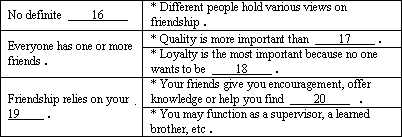
We often say, “A friend in need is a friend indeed.” But what is the exact meaning of friendship? No one can really offer a definite concept, because different people hold various views on friendship.
Everyone has his own friendship and some have a lot of friends.But in fact, quantity is not so important as quality.Loyalty is the most important for friendship.No one wants to make friends with those who will betray them.
No matter whether you are married or not, no matter where you live and work, your friends are your friends.It is not based on bloodline.It relies on your intention.To you, some friends are fun-loving, some give encouragement, some offer knowledge, and others help you to find your own identity.Before your friends, you may act as a supervisor, a learned brother, a lovely child, a gentleman or a playmate.In a word, friendship helps you to be a full person.So friendship can benefit.
Keys:
Jeanne Calment, a French woman, became a record breaker on 17 October, 1995, when at the age of 120 years and 238 days, she became the longest-lived human being on record. A Japanese man died in 1986 at the age of 120 years and 237 days.
Jeanne Calment lives in a small old people’s home in the south of France; her husband, her only child and her grandson have all died. She is nearly blind and deaf and is always in a wheelchair, but her doctor describes her as being more like a 90-year-old woman in good health than someone of 120. She still has a lively sense of humor. When asked on her 120th birthday what she expected of the future, she replied: A very short one. She also remarked that she thought the good Lord had forgotten all about her.
So what is the key to a long life? According to some doctors, diet, exercise and no smoking are the three important factors. Jeanne Calment has followed two of the tips. She has always eaten a healthy diet, and she used to do exercise every day until she broke her leg at the age of 115. However, until recently she drank two glasses of strong red wine a day, and she does smoke (now only a little). Besides, Jeanne Calment might have got very good genes from her parents. Her father lived to the age of 94 and her mother to 86.
A local lawyer bought her house when she was 80 under an agreement that he would pay her some money every year until her death. It must have seemed a good move at the time, but so far the lawyer has paid her at least three times the value of the house. Every year on her birthday, Jeanne Calment sends him a card saying: Sorry, I’m still alive!
1.How does Jeanne Calment feel about her old age?
A. She is miserable and unhappy. B. She is cheerful and humorous.
C. She would like to live much younger. D. She feels she is going to die very soon.
2. We can owe her good health and long life to _______.
A. smoking only a little every day
B. her giving up smoking and drinking
C. drinking two glasses of strong red wine every day
D. the good genes from her parents, a healthy diet and some exercise
3. Which of the following word could best replace the word “move” in the fourth paragraph?
A. deal B. trick C. march D. sport
4. Why does Jeanne Calment say “Sorry, I’m still alive” to the lawyer every year on her birthday?
A. Because she had an agreement at 80 with the lawyer which was to her advantage.
B. Because she has asked the lawyer to pay her more rent than they first agreed.
C. Because the lawyer has paid her much more money than the value of the house.
D. Because the house she sold to the lawyer is worth the money he has already paid.
查看习题详情和答案>>
It was the first snow of winter – an exciting day for every child but not for most teachers. Up until now, I had been old enough to dress myself, but today I would need some help. Miss Finlayson, my kindergarten teacher, had been through first snow days many times, but I think she may still remember this one.
I managed to get into my wool snow trousers. But I struggled with my jacket because it didn’t fit well. It was a hand-me-down from my brother, and it made me wonder why I had to wear his ugly clothes. At least my hat and scarf were mine, and they were quite pretty. Finally it was time to have Miss Finlayson help me with my boots (靴子).
In her calm, motherly voice she said, “By the end of winter, you will all be able to put on your own boots.” I didn’t realize at the time that this was more a statement of hope than of confidence (信心).
I handed her my boots and stuck out my foot. Like most children, I expected grown-ups to do all the work. After much pushing, she managed to get the first one into place and then, with a sigh, worked the second one on too.
I announced, “They’re on the wrong feet.”
She struggled to get the boots off and went through the joyless task of putting them on again.
“They’re my brother’s boots, you know,” I said. “I hate them!”
Somehow, from long years of practice, she managed to act as though I wasn’t an annoying (烦人的) little girl, She pushed and pushed, less gently this time. With a greater sigh, seeing the end of her struggle with me, she asked, “Now, where are your mittens (连指手套)?”
I looked into her eyes and said, “I didn’t want to lose them, so I hid them in the toes of my boots.”
1. The little girl was more satisfied with her_________.
A. trousers B. jacket C. boots D. hat
2.Miss Finlayson had difficulty with the girl’s boots mainly because________.
A. the girl got them from her brother B. the girl put something in them
C. they were on the wrong feet D. they did not fit the girl well
3.Why does the author say Miss Finlayson would remember that first snow day?
A. Because the little girl was in her brother’s clothes.
B. Because it was the most exciting day of the winter.
C. Because the little girl played a trick on her.
D. Because the little girl wore a pretty scarf.
4.We can learn from the text that Miss Finlayson_________.
A. was losing confidence in the little girl
B. gradually lost patience with the little girl
C. became disappointed with the little girl
D. was getting bored with the little girl
查看习题详情和答案>>
阅读下面短文,并根据短文后的要求回答问题(请注意问题后的字数要求)。
[l]Fear and pain are two of the most useful things that human beings and animals have, if they are properly used. If fire did not hurt when it burnt, children would play with it until their hands were burnt away. Similarly, if pain existed but fear didn’t, a child would burn himself again and again, because fear would not warn himself to keep away from the fire that had burnt himself before. A really fearless soldier is not a good soldier because he will soon be killed; and a dead soldier is of no use to his army. Fear and pain are therefore two guards without which human beings and animals might soon die out.
[2] In our first sentence we suggested that fear should be properly used. If, for example, you never go out of your house because of the danger of being knocked down and killed in the street by a car, you are letting fear rule you too much. Even in your house you are not absolutely safe: A plane may crash on your house, or you may get cancer!
[3] The important thing is not to let fear rule you, but to use fear as your servant and guide instead. Fear will warn you of dangers; then you have to decide what action to take.
[4] In many cases, you can take quick and successful action to avoid the danger. For example, you see a car coming straight towards you. Fear warns you, then you jump out of the way, and all is well.
[5] In some cases, however, you decide that there is nothing that you can do to ___________. For example, you can’t prevent a plane crashing onto your house. In this case, fear is no longer of any use, and you have to try to overcome it.
1.What is mainly talked about in this passage? (no more than 15 words)
_________________________________________________________________________
2.How does the author support his idea in Paragraph 2? (no more than 5 words)
_________________________________________________________________________
3.Why does the author say that a fearless soldier is not a good soldier? (no more than 15 words)
_________________________________________________________________________
4.What benefit can we get from “fear” according to the passage? (no more than 10 words)
__________________________________________________________________________
5.Fill in the blank in Paragraph 5 with proper words. (no more than 5 words)
__________________________________________________________________________
查看习题详情和答案>>