网址:http://m.1010jiajiao.com/timu3_id_3135161[举报]
Should doctors ever lie to benefit their patients ― to speed recovery or to cover the coming of death? In medicine as in law, government, and other lines of work, the requirements of honesty often seem dwarfed (变矮小)by greater needs: the need to protect from brutal(讨厌的) news, to uphold(支持) a promise of secrecy or to advance the public interest.
What should doctors say, for example, to a 46-year-old man coming in for a routine physical checkup just before going on vacation with his family who, though he feels in perfect health, is found to have a form of cancer that will cause him to die within six months? Is it best to tell him the truth? If he asks, should doctors reject that he is ill, or minimize the gravity of the illness? Should they at least hide the truth until after the family vacation?
Doctors face such choices often. At times, they see important reasons to lie for the patients’ own sake; in their eyes, such lies differ sharply from self-serving ones.
Studies show that most doctors sincerely believe that the seriously ill patients do not want to know the truth about their condition, and that informing them of risks destroying their hope, so that they may recover more slowly, or deteriorate(恶化)faster, perhaps even commit suicide (自杀).
But other studies show that, contrary to the belief of many physicians, a great majority of patients do want to be told the truth, even about serious illness, and feel cheated when they learn that they have been misled. We are also learning that truthful information, humanely conveyed (传达), helps patients cope with illness: help them tolerate pain better, need less medicine, and even recover faster after surgery.
There is an urgent need to debate this issue openly. Not only in medicine, but in other professions as well, practitioners may find themselves repeatedly in difficulty where serious consequences seem avoidable only through deception(欺骗). Yet the public has every reason to know the professional deception, for such practices are peculiarly likely to become deeply rooted, to spread, and to trust. Neither in medicine, nor in law, government, or the social sciences can there be comfort in the old saying, “What you don’t know can’t hurt you.”
72. According to the author’s opinion, lies ________.
A. can benefit the patients
B. can help the patients to recover
C. can do nothing to the patients’ illness
D. can not benefit the patients
73. Which of the following statements is NOT true?
A. There is a need to discuss whether to lie or not.
B. It is true that “What you don’t know can’t hurt you” .
C. The truthful information helps patients to deal with their illness.
D. Most of the doctors believe that the seriously ill patients do not want to know the truth about their condition.
74. What is the main idea of the last paragraph?
A. There is an urgent need to debate this issue openly.
B. Neither in medicine, nor in law, government, or the social sciences can there be comfort in the old saying, “What you don’t know can’t hurt you.”
C. The public has every reason to be cautious of the professional deception.
D. We need to discuss this issue in medicine, but not in other professions.
75. What does the author mainly discuss in the passage?
A. Who benefits from deception.
B. Deception is beneficial to patients.
C. Whether patients should be told the truth of their illness.
D. Whether patients really want to know the truth of their illness.
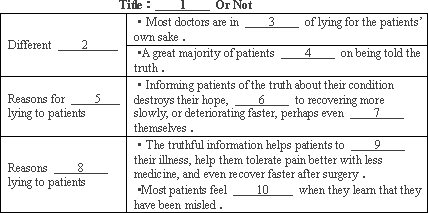
查看习题详情和答案>>请认真阅读下面短文,并根据所读内容在文章后表格中的空格里填入最适当的单词。注意:每空1个单词。
Should doctors ever lie to benefit their patients to speed recovery or to cover the coming of death? In medicine as in law, government, and other lines of work, the requirements of honesty often seem dwarfed by greater needs; the need to protect patients from brutal news, to uphold a promise of secrecy or to advance the public interest.
What should doctors say, for example, to a 46-year-old man coming in for a routine physical checkup just before going on vacation with his family who, though he feels in perfect health, is found to have a form of cancer that will cause him to die within six months? Is it best to tell him the truth? If he asks, should doctors reject that he is ill, or minimize the gravity of the illness? Should they at least hide the truth until after the family vacation?
Doctors face such choices often.At times, they see important reasons to lie for the patients’ own sake; in their eyes, such lies differ sharply from self-serving ones.
Studies show that most doctors sincerely believe that the seriously ill patients do not want to know the truth about their condition, and that informing them of risks destroys their hope, so that they may recover more slowly, or deteriorate faster, perhaps even commit suicide.
But other studies show that, contrary to the belief of many physicians, a great majority of patients do want to be told the truth, even about serious illness, and feel cheated when they learn that they have been misled.We are also learning that truthful information, humanely conveyed, helps patients cope with illness; help them tolerate pain better with less medicine, and even recover faster after surgery.
There is an urgent need to debate this issue openly.Not only in medicine, but in other professions as well, practitioners may find themselves repeatedly in difficulty where serious consequences seem avoidable only through deception.Yet the public has every reason to know the professional deception, for such practices are peculiarly likely to become deeply rooted, to spread, and to trust.Neither in medicine, nor in law, government, or the social sciences can there be comfort in the old saying, “What you don’t know can’t hurt you.”
Should doctors ever lie to benefit their patient–to speed recovery or to cover the coming of death? In medicine as in law, government, and other lines of work, the requirements of honesty often seem dwarfed(变矮小)by greater needs: the need to protect from brutal news or to uphold a promise of secrecy; to advance the public interest.

What should doctors say, for example, to a 46-year-old man coming in for a routine physical checkup just before going on vacation with his family who, though he feels in perfect health, is found to have a form of cancer that will cause him to die within six months? Is it best to tell him the truth? If he asks, should the doctor reject that he is ill, or minimize fee gravity of the illness? Should they at least hide the truth until after the family vacation?
Doctors face such choices often.At times, they see important reasons to lie for the patient's own sake; in their eyes, such lies differ sharply from self-serving ones.
Studies show that most doctors sincerely believe that the seriously ill patients do not want to know the truth about their condition, and that informing them risks destroying their hope, so that they may recover more slowly, or deteriorate(恶化)faster, perhaps even commit suicide(自杀).
But other studies show that, contrary to the belief of many physicians; a great majority of patients do want to be told the truth, even about serious illness, and feel cheated when they learn that they have been misled.We are also learning that truthful information, humanly conveyed, helps patients cope with illness: help them tolerate pain better, need less medicine, and even recover faster after operation.
There is urgent need to debate this issue openly.Not only in medicine, but in other professions as well, practitioners may find themselves repeatedly in difficulty where serious consequences seem avoidable only through deception(欺骗).Yet the public has every reason to know professional deception, for such practices are peculiarly likely to become deeply rooted, to spread, and to trust.Neither in medicine, nor in law, government, or the social sciences can there be comfort in the old saying, "What you don't know can't hurt you."
1.What is the passage mainly about?
A.Whether patients really want to know the truth of their condition.
B.Whether patients should be told the truth of their illness.
C.Whether different studies should be carried on.
D.Whether doctors are honesty with their patients.
2.For the case mentioned in paragraph 2, most doctors will ____.
A.tell the patient the truth as soon as possible
B.choose to lie to him about his condition at that moment
C.tell him to shorten the family vacation
D.advise him to cancel the family vacation
3.Which of the following is TRUE?
A.Sometimes government tells lies because they need to meet the public interest.
B.Doctors believe if they lie, those seriously-ill patients will recover more quickly.
C.Truthful information helps patients deal with their illness in some cases.
D.Many patients don't want to know the truth, especially about serious illness.
4.From the passage, we can learn that the author's attitude to professional deception is ____.
A.supportive B.indifferent C.opposed D.neutral
查看习题详情和答案>>
 B
B
Should doctors ever lie to benefit their patient–to
speed recovery or to cover the coming of death? In
medicine as in law, government, and other lines of
work, the requirements of honesty often seem dwarfed
(变矮小)by greater needs: the need to protect from
brutal news or to uphold a promise of secrecy; to advance
the public interest.
What should doctors say, for example, to a 46-year-old man coming in for a routine physical checkup just before going on vacation with his family who, though he feels in perfect health, is found to have a form of cancer that will cause him to die within six months? Is it best to tell him the truth? If he asks, should the doctor reject that he is ill, or minimize fee gravity of the illness? Should they at least hide the truth until after the family vacation?
Doctors face such choices often.At times, they see important reasons to lie for the patient's own sake; in their eyes, such lies differ sharply from self-serving ones.
Studies show that most doctors sincerely believe that the seriously ill patients do not want to know the truth about their condition, and that informing them risks destroying their hope, so that they may recover more slowly, or deteriorate (恶化) faster, perhaps even commit suicide(自杀).
But other studies show that, contrary to the belief of many physicians; a great majority of patients do want to be told the truth, even about serious illness, and feel cheated when they learn that they have been misled.We are also learning that truthful information, humanly conveyed, helps patients cope with illness: help them tolerate pain better, need less medicine, and even recover faster after operation.
There is urgent need to debate this issue openly.Not only in medicine, but in other professions as well, practitioners may find themselves repeatedly in difficulty where serious consequences seem avoidable only through deception (欺骗).Yet the public has every reason to know professional deception, for such practices are peculiarly likely to become deeply rooted, to spread, and to trust.Neither in medicine, nor in law, government, or the social sciences can there be comfort in the old saying, "What you don't know can't hurt you."
60.What is the passage mainly about?
A.Whether patients really want to know the truth of their condition.
B.Whether patients should be told the truth of their illness.
C.Whether different studies should be carried on.
D.Whether doctors are honesty with their patients.
61.For the case mentioned in paragraph 2, most doctors will ____.
A.tell the patient the truth as soon as possible
B.choose to lie to him about his condition at that moment
C.tell him to shorten the family vacation
D.advise him to cancel the family vacation
62.Which of the following is TRUE?
A.Sometimes government tells lies because they need to meet the public interest.
B.Doctors believe if they lie, those seriously-ill patients will recover more quickly.
C.Truthful information helps patients deal with their illness in some cases.
D.Many patients don't want to know the truth, especially about serious illness.
63.From the passage, we can learn that the author's attitude to professional deception is ____.
A.supportive B.indifferent C.opposed D.neutral
63.From the passage, we can learn that the author’s attitude to professional deception is .
A.supportive B.indifferent C.opposed D.neutral
查看习题详情和答案>>
 B
B
Should doctors ever lie to benefit their patient–to
speed recovery or to cover the coming of death? In
medicine as in law, government, and other lines of
work, the requirements of honesty often seem dwarfed
(变矮小)by greater needs: the need to protect from
brutal news or to uphold a promise of secrecy; to advance
the public interest.
What should doctors say, for example, to a 46-year-old man coming in for a routine physical checkup just before going on vacation with his family who, though he feels in perfect health, is found to have a form of cancer that will cause him to die within six months? Is it best to tell him the truth? If he asks, should the doctor reject that he is ill, or minimize fee gravity of the illness? Should they at least hide the truth until after the family vacation?
Doctors face such choices often.At times, they see important reasons to lie for the patient's own sake; in their eyes, such lies differ sharply from self-serving ones.
Studies show that most doctors sincerely believe that the seriously ill patients do not want to know the truth about their condition, and that informing them risks destroying their hope, so that they may recover more slowly, or deteriorate (恶化) faster, perhaps even commit suicide(自杀).
But other studies show that, contrary to the belief of many physicians; a great majority of patients do want to be told the truth, even about serious illness, and feel cheated when they learn that they have been misled.We are also learning that truthful information, humanly conveyed, helps patients cope with illness: help them tolerate pain better, need less medicine, and even recover faster after operation.
There is urgent need to debate this issue openly.Not only in medicine, but in other professions as well, practitioners may find themselves repeatedly in difficulty where serious consequences seem avoidable only through deception (欺骗).Yet the public has every reason to know professional deception, for such practices are peculiarly likely to become deeply rooted, to spread, and to trust.Neither in medicine, nor in law, government, or the social sciences can there be comfort in the old saying, "What you don't know can't hurt you."
60.What is the passage mainly about?
A.Whether patients really want to know the truth of their condition.
B.Whether patients should be told the truth of their illness.
C.Whether different studies should be carried on.
D.Whether doctors are honesty with their patients.
61.For the case mentioned in paragraph 2, most doctors will ____.
A.tell the patient the truth as soon as possible
B.choose to lie to him about his condition at that moment
C.tell him to shorten the family vacation
D.advise him to cancel the family vacation
62.Which of the following is TRUE?
A.Sometimes government tells lies because they need to meet the public interest.
B.Doctors believe if they lie, those seriously-ill patients will recover more quickly.
C.Truthful information helps patients deal with their illness in some cases.
D.Many patients don't want to know the truth, especially about serious illness.
63.From the passage, we can learn that the author's attitude to professional deception is ____.
A.supportive B.indifferent C.opposed D.neutral
63.From the passage, we can learn that the author’s attitude to professional deception is .
A.supportive B.indifferent C.opposed D.neutral
查看习题详情和答案>>