网址:http://m.1010jiajiao.com/timu3_id_3087692[举报]
American public education has changed in recent years. One change is that increasing numbers of American parents and teachers are starting independent public schools called charter schools.
In 1991, there were no charter schools in the Unite States. Today, more than 2300 charter schools operate in 34 states and the District of Columbia. 575000 students attend these schools. The students are from 5 years of age through 18 or older.
A charter school is created by groups of parents, teachers and community members. It is similar in some ways to a traditional public school. It receives tax money to operate a number of students. The charter school must prove to local or state governments that its students are learning. These governments provide the school with the agreement, or charter that permits it to operate.
Unlike a traditional public school, however, the charter school does not have to obey most laws governing public schools. Local, state or federal governments cannot tell it what to teach.
Each school can choose its own goals and decide the ways it wants to reach those goals. Class sizes are usually smaller than in many traditional public schools. Many students and parents say teachers in charter schools can be more creative.
However, state education agencies, local education-governing committees and unions often oppose charter schools. They say these schools may receive money badly needed by traditional public schools. Experts say some charter schools are doing well while others are struggling.
Congress provided 200 million dollars for establishing charter schools in the 2006 federal budget. But, often the schools say they lack enough money for programs. Many also lack needed space. District officials say they have provided 14 former school buildings for charter education. Yet charter school supporters say officials should try harder to find more space.
Title
 | |||
 | |||
查看习题详情和答案>>
American public education has changed in recent years. One change is that increasing numbers of American parents and teachers are starting independent public schools called charter schools.
In 1991, there were no charter schools in the United States. Today, more than 2300 charter schools operate in 34 states and the District of Columbia. 575000 students attend these schools. The students are from 5 years of age through 18 or older.
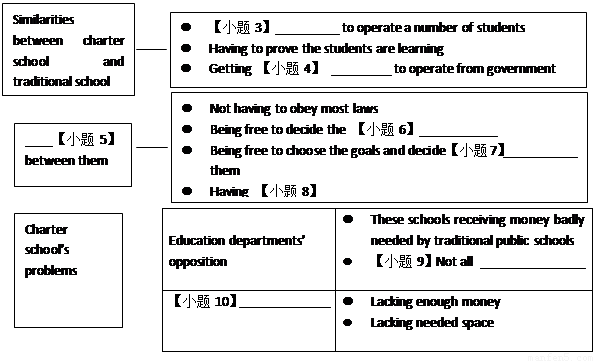
A charter school is created by groups of parents, teachers and community members. It is similar in some ways to a traditional public school. It receives tax money to operate a number of students. The charter school must prove to local or state governments that its students are learning. These governments provide the school with the agreement, or charter that permits it to operate.
Unlike a traditional public school, however, the charter school does not have to obey most laws governing public schools. Local, state or federal governments cannot tell it what to teach.
Each school can choose its own goals and decide the ways it wants to reach those goals. Class sizes are usually smaller than in many traditional public schools. Many students and parents say teachers in charter schools can be more creative.
However, state education agencies, local education-governing committees and unions often oppose charter schools. They say these schools may receive money badly needed by traditional public schools. Experts say some charter schools are doing well while others are struggling.
Congress provided 200 million dollars for establishing charter schools in the 2006 federal budget. But, often the schools say they lack enough money for programs. Many also lack needed space. District officials say they have provided 14 former school buildings for charter education. Yet charter school supporters say officials should try harder to find more space.
Charter Schools in America
| Definition | Charter schools are called 1 ___________ public schools. | ||
| 2 _______ between charter school and traditional school | ★3 _______ tax money to operate a number of students. ★ Having to make 4. _______ know the students are learning. ★ Getting 5 _________ to operate from government. | ||
| 6 _______ between charter school and traditional school | ★ Not having to obey most laws. ★ Having the 7_______ to decide what to teach. ★ Being free to choose the goals and decide the 8_________ of teaching them. ★ Having smaller class sizes. ★ Having teachers who are more creative | ||
| The problems | Education departments’ opposition | ★These schools receiving money badly needed by traditional public schools. ★ Not 9__________ doing well. | |
| 10 ___________ difficulties | ★ Lacking enough money ★ Lacking needed space | ||
American public education has changed in recent years. One change is that increasing numbers of American parents and teachers are starting independent public schools called charter schools.
In 1991, there were no charter schools in the Unite States. Today, more than 2300 charter schools operate in 34 states and the District of Columbia. 575000 students attend these schools. The students are from 5 years of age through 18 or older.
A charter school is created by groups of parents, teachers and community members. It is similar in some ways to a traditional public school. It receives tax money to operate a number of students. The charter school must prove to local or state governments that its students are learning. These governments provide the school with the agreement, or charter that permits it to operate.
Unlike a traditional public school, however, the charter school does not have to obey most laws governing public schools. Local, state or federal governments cannot tell it what to teach.
Each school can choose its own goals and decide the ways it wants to reach those goals. Class sizes are usually smaller than in many traditional public schools. Many students and parents say teachers in charter schools can be more creative.
However, state education agencies, local education-governing committees and unions often oppose charter schools. They say these schools may receive money badly needed by traditional public schools. Experts say some charter schools are doing well while others are struggling.
Congress provided 200 million dollars for establishing charter schools in the 2006 federal budget. But, often the schools say they lack enough money for programs. Many also lack needed space. District officials say they have provided 14 former school buildings for charter education. Yet charter school supporters say officials should try harder to find more space.
Title
 |
|||
 |
查看习题详情和答案>>
American public education has changed in recent years. One change is that increasing numbers of American parents and teachers are starting independent public schools called charter schools.
In 1991, there were no charter schools in the United States. Today, more than 2300 charter schools operate in 34 states and the District of Columbia. 575000 students attend these schools. The students are from 5 years of age through 18 or older.
A charter school is created by groups of parents, teachers and community members. It is similar in some ways to a traditional public school. It receives tax money to operate a number of students. The charter school must prove to local or state governments that its students are learning. These governments provide the school with the agreement, or charter that permits it to operate.
Unlike a traditional public school, however, the charter school does not have to obey most laws governing public schools. Local, state or federal governments cannot tell it what to teach.
Each school can choose its own goals and decide the ways it wants to reach those goals. Class sizes are usually smaller than in many traditional public schools. Many students and parents say teachers in charter schools can be more creative.
However, state education agencies, local education-governing committees and unions often oppose charter schools. They say these schools may receive money badly needed by traditional public schools. Experts say some charter schools are doing well while others are struggling.
Congress provided 200 million dollars for establishing charter schools in the 2006 federal budget. But, often the schools say they lack enough money for programs. Many also lack needed space. District officials say they have provided 14 former school buildings for charter education. Yet charter school supporters say officials should try harder to find more space.
Charter Schools in America
|
Definition |
Charter schools are called 1 ___________ public schools. |
||
|
2 _______ between charter school and traditional school |
★ 3 _______ tax money to operate a number of students. ★ Having to make 4. _______ know the students are learning. ★ Getting 5 _________ to operate from government. |
||
|
6 _______ between charter school and traditional school |
★ Not having to obey most laws. ★ Having the 7_______ to decide what to teach. ★ Being free to choose the goals and decide the 8_________ of teaching them. ★ Having smaller class sizes. ★ Having teachers who are more creative |
||
|
The problems |
Education departments’ opposition |
★These schools receiving money badly needed by traditional public schools. ★ Not 9__________ doing well. |
|
|
10 ___________ difficulties |
★ Lacking enough money ★ Lacking needed space |
||
查看习题详情和答案>>
II. 完形填空(共15题,每小题2分,共30分)
American public education has changed in recent years. One change is that increasing numbers of American parents and teachers are starting independent public school 11 charter schools (特许学校).
In 1991, there were no charter schools in the United States. Today, more than2,300 charter schools 12 in 34 states and the District of Columbia. 575,000 students 13 these schools. The students are from 5 years of age through 18 or older.
A charter school is 14 by groups of parents, teachers and community (社区) members, It is similar in some ways 15 a traditional public school. It receives tax money to operate just as other public schools do. The 16 it receives depends on the number of students. The charter school must prove to local or state governments that its students are learning. These governments 17 the school with the agreement, or charter that permits it to operate.
Unlike a traditional public school, 18 the charter school does not have to obey most laws which govern public schools. Local, state or federal governments cannot tell it what to 19 .
Each school can choose its own goals and decide the ways it wants to 20 those goals. Class sizes usually are smaller than those in many traditional public schools. Many students and parents say 21 in charter schools may be more creative.
However, state education agencies, local education-governing committees and unions are often 22 charter schools. They say these schools may receive money badly 23 by traditional public schools. Experts say some charter schools are doing well while others are struggling.
Congress provided 200million dollars for 24 charter schools in the 2002 federal budget (预算). But often the schools say they lack enough money for their 25 .Many also lack needed space.
11. A. called B. asked C. known D. said
12. A. study B. organize C. operate D. perform
13. A. finish B. attend C. leave D. cut
14. A. taught B. held C. created D. understood
15. A. to B. with C. by D. in
16. A. attention B. amount C. expense D. information
17. A. buy B. review C. give D. provide
18. A. besides B. moreover C. thus D. however
19. A. teach B. discuss C. have D. get
20. A. set B. reach C. settle D. define
21. A. farmers B. workers C. teachers D. soldier
22. A. against B. for C. in D. with
23. A. treated B. needed C. earned D. wasted
24. A. needing B. spending C. comparing D. establishing
25. A. programs B. parents C. records D. words