网址:http://m.1010jiajiao.com/timu3_id_3084211[举报]
Joy Mangano was 33 and divorced(离婚), had three kids under age 7, and was hardly keeping up payments on her small two-bedroom home by working extra weekend hours as a waitress.
“Sometimes I would lie in bed and think. I don’t know how I’m going to pay the bills,” Mangano said.
But she had a gift for seeing the obvious. She knew how hard it was to mop the floor. “I was tired of bending down, putting my hands in dirty water and wringing(拧)out a mop.” Mangano says. “So, I thought: There’s going to be a better way.”
How about a “self wringing” mop? She designed a special tool that could be twisted(转动)in two directions while not making hands wet and dirty. She set out to sell it, first only a few at flea markets(跳蚤市场).
Then Mangano met with the media. But would couch potatoes(泡在电视机前的人)buy a mop? The experts on shopping TV were less than certain. They gave it a try, and it failed. Mangano was sure it would sell if they’d let her do the on-camera demonstration.
QVC took a chance on her. “I got onstage and the phones went crazy. We sold every mop in minutes.”
Today she’s the president of Ingenious Designs, a multimillion-dollar company, and one of the stars of the Home Shopping Network. Talking about her household inventions is “as natural for me as it is for parents to talk about their children”.
Today one of her favorite products is Huggable Hangers. The thin, space-saving inventions are the most successful gadget(器具)ever sold on HSN, with 100 million hanging out there in closets across the country. Of course, you couldn’t possibly sell hangers on TV.
(1)What would be the best title for the passage?
[ ]
A.There is going to be a better way
B.A woman invented the self-wringing mop
C.An ordinary woman sells her invention on TV
D.Women can all achieve remarkable success
(2)What does the underlined sentence “the phones went crazy” (in Paragraph 6) mean?
[ ]
A.Many people made calls to say they were mad.
B.There were lots of calls to order the new mop.
C.Many people were mad to see me on TV.
D.The telephone broke down at my home.
(3)Which is the correct order of the following events?
a.Mangano invented the most popular Huggable Hangers.
b.Mangano was tired of mopping the floor.
c.Mangano designed a self-wringing mop.
d.Mangano was ever worried about how to pay the bills.
e.Mangano did an on-camera demonstration to sell her mops.
[ ]
(4)What conclusion can be made from the story?
[ ]
A.Women can invent household tools because they often do housework.
B.Mangano treated her household inventions as she treated her children.
C.Mangano used to lie in bed and think of how to invent household tools.
D.One can make life better through work though it is sometimes hard.
查看习题详情和答案>>
第一节(共5小题;每小题1.5分,满分7.5分)
听下面5段对话。每段对话后有一个小题,从题中所给的A、B、C三个选项中选出最佳选项,并标在试卷的相应位置。听完每段对话后,你都有10秒种的时间来回答有关小题和阅读下一小题。每段对话仅读一遍。
1.What are the speakers talking about?
A. The traveling to the Great Wall B. A film produced on the Great Wall
C. The pictures the man took on the Great Wall
2.What does the woman mean?
A. She will attend another lecture on Friday morning.
B. She has mixed up the dates. C. The man doesn’t need to remind her
3.Where does the conversation most probably take place?
A. In the café B. In the kitchen C. In the store
4.Where did the man think they were supposed to meet?
A. At the information desk B. On the platform
C. At the ticket office
5.Why is the woman so happy?
A. Her article is in the latest issue of the journal
B. She has won a prize for her research
C. She has got her paper on classroom activities published.
第二节(共15小题;每小题1.5分,满分22.5分)
听下面5段对话或独白。每段对话或独白后有几个小题,从题中所给的A、B、C三个选项中选出最佳选项,并标在试卷的相应位置。听每段对话或独白前,你将有时间阅读各个小题,每小题5秒钟;听完后,各小题将给出5秒钟的作答时间。每段对话或独白读两遍。
听第6段材料,回答6-7题。
6.What’s the relationship between the speakers?
A. Husband and wife B. Doctor and patient C. Doctor and nurse
7.Why doesn’t the man’s head hurt that much?
A. He has had some pills B. He’s frightened C. He’s treated
听第7段材料,回答8-10题。
8.Where does the conversation take place?
A. At a travel agency B. In a bank C. At an airport
9.What does the woman show the man for here identification?
A. Her ID card B. Her credit card C. Her passport
10.How much will the woman get at last?
A. $ 294 B. $200 C. $147
听第8段材料,回答第11-13题。
11.What can we know about the man’s school?
A. There are several other schools like it nowadays.
B. Many children in it have been sent to special school
C. A lot of children in it are physically disabled.
12.Why did the man decide to start the school.
A. He wanted to bring all children together for their education
B. There were not enough special schools
C. The disabled children have no choice to go to school
13.What happens in classes in the school?
A. Quick learners and slow learners are together for all classes.
B. Slow learners sometimes work better and more quickly than quick learners.
C. Quick learners sometimes act as teachers of slow learners
听第9段材料,回答第14-17题。
14.Where are the speakers?
A. At the radio station B. On the Tv show C. In the forest
15.How many kinds of trees grow in one square kilometer according to the man?
A. About 1,500 B. About 750 C. About 5,000
16.What does the woman do?
A. An announcer B. A student C. A scientist
17.What can we know from the conversation?
A. People can’t see any of the trees in other places.
B. The speakers hear many birds singing
C. The man is an insect researcher
听第10段材料,回答第18-20题。
18.Who are the main characters of the science fiction?
A. A group of soldiers B. A group of sailors
C. Two young people
19.What book is the third one mentioned in the text?
A. A historical novel B. A sports journal C. A biography
20.What can we know from the text?
A. Give Me Shelter is written by Alan Cooper
B. Jump for the Stars tells us something about Tracy McGrady
C. The speaker is a bookstore keeper
查看习题详情和答案>>
第一节:听独白或对话(共5小题;每小题1.5分,满分22.5分)
听下面5段对话或独白。每段对话或独白后有几个小题,从题中所给的A、B、C三个选项中选出最佳选项,并标在试卷的相应位置,听每段对话或独白前,你将有时间阅读各个小题,每小题5秒钟;听完后,各小题将给出5秒钟的作答时间。每段对话或独白读两遍。
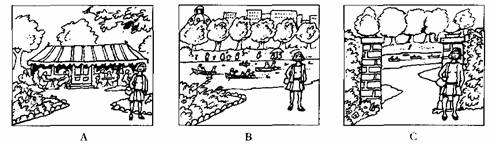
听第1段对话,回答第1-3题。
1.Where does Jane ask Tom to meet her at first?
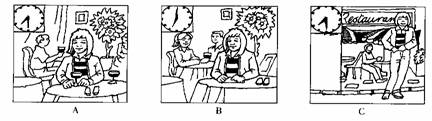
2.When and where do they agree to meet finally?
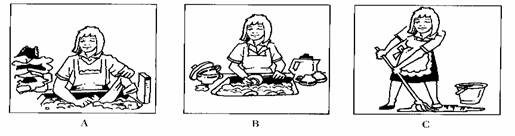
3.What does Jane have to do before going out to meet Tom?
听第2段对话,回答第4-6题。
4.According to Peter, what is the problem with the building?
A. The air-conditioning is too strong.
B. The air-conditioning is out of order.
C. The air-conditioning stops working sometimes.
5.Why did Peter miss the breakfast yesterday morning?
A. He overslept.
B. He couldn't fall asleep the night before.
C. He talked with his roommates late into the night.
6.How many students will be staying in this room?
A. Two. B. Three. C. Four.
听第3段对话,回答第7-9题。
7.Which subject (s) does David find particularly difficult?
A. Math. B. English. C. The sciences.
8.What does David do to help his uncle with the cows?
A. He milks the cows on Sundays and cleans the cowshed sometimes.
B. He drives the tractor on Sundays and does the milking sometimes.
C. He cleans the cowshed on Sundays and drives the tractor sometimes.
9.What is David going to do now?
A. He is going to work on his own farm.
B. He is preparing to attend an agricultural college.
C. He is going to study hard to pass the exams.
听第4段对话,回答第10-12题。
10.What is the probable relation between the man and woman?
A. A research student and a stranger.
B. A social worker and a businessman.
C. A businessman and a research student.
11.What made the woman begin to smoke at the age of 17?
A. Her boyfriend offered her a cigarette.
B. She often went to parties with her friends.
C. She wanted to follow her friends’ example.
12.What was the result of the woman's first attempt to stop smoking?
A. She stopped smoking for a while.
B. She managed to give up smoking completely.
C. She began to smoke fewer cigarettes than before.
听第5段对话,回答第13-15题。
13.What do the students come to the school for?
A. Visiting the school.
B. Attending summer courses.
C. A sightseeing tour of the area.
14.How long has the school been open?
A. Twenty years. B. Five years. C. Twenty-five years.
15.What could the students do in the study center if they were out late the night before?
A. Talk to the teachers. B. Use the equipment. C. Do the homework.
第二节:听取信息(共5小题;每小题1.5分,满分7.5分)
听下面1段对话。请根据题目要求,从所听到的内容中获取必要的信息,填入答题卡 标号为16—20的空格中。听录音前,你将有10秒钟的阅题时间,录音读两遍。你有80秒钟的作答时间。
|
Caller information |
|
|
Name of caller |
John Smith |
|
Where to go |
London |
|
When to go |
(16.) |
|
What to do there |
(17.) |
|
How long to stay |
A week or so |
|
Ticket information |
||||
|
Class |
Airline |
Price |
When to leave |
When to arrive |
|
Economy |
(18.) |
RMB 5600 |
7:40 a.m. |
In the morning |
|
Pacific Airline |
(19.) |
11:40 a.m. |
(20.) |
查看习题详情和答案>>
第二节 任务型阅读(共10分)
请认真阅读下列短文,并根据所读内容在文章后表格中的空格里填入最恰当的单词。
注意:每空格1个单词,不得使用文章中的单词。
Although many Chinese students say that their knowledge of English grammar is good, most would admit that their spoken English is poor. Whenever I speak to a Chinese student they always say, “My spoken English is poor.” However, their spoken English does not have to remain “poor”! I would like to suggest that there may be some reasons for their problems with spoken English.
First, they fail to find suitable words to express themselves due to a limited vocabulary. Obviously the better answer is to expand their vocabulary. However, you can speak with a limited vocabulary, if your attitude is positive. Others will follow you as long as you use the words that you know.
Second, they are afraid of making mistakes. Sometimes they make mistakes when they are speaking because they are shy and nervous. Yet students should remember that their goal should be FLUENCY NOT ACCURACY. Your aim in writing is to be accurate following the rules for grammar and using the right words and spelling them correctly. However, in speaking your aim is fluency. Your want to get your message across, to talk to someone in English, as quickly and as well as you can, even though sometimes you may use a wrong word or tense, but it doesn’t matter because the person you are speaking to will understand you and make allowances for any mistakes he hears.
The third reason is that not enough attention is paid to listening. You have one mouth but two ears! All that hearing is necessary for you to start speaking.
Fourth, most Chinese students are reactive rather than proactive language learners. Instead of actively seeking out opportunities to improve their spoken English they passively wait for speaking opportunities to come to them and wonder why their English always remains poor. If you have this proactive(〈心理〉前摄的)outlook, then you will see English opportunities wherever you go.
If you do not use your English beyond the classroom you will forget that English you know. Remember: USE IT OR LOSE IT! You can learn how to speak English better by speaking English more.
Title: some reasons for their problems with spoken English
| Reasons | Context |
| (1)_____of vocabulary | You have to (2)______ their vocabulary. |
| You should take a positive attitude towards(3)_______ English. | |
| (4) _____ about making mistakes | Shyness and (5)_____ make it easy to make mistakes. |
| Fluency is more (6)_______ than accuracy when speaking English. | |
| (7) _____ of attention while listening | All that hearing is necessary for you to start speaking. |
| (8) _____ of proactive outlook | As language learners, most Chinese students are (9) _______ instead of being active. |
| You should take (10) _______ of all opportunities to improve your spoken English. |
假如你叫李华,你的好友李莉3个月前随父母搬到了上海。最近你收到她的来信向你倾诉她所碰到的烦恼和问题。请针对她来信中的问题,给她写一封120词左右的回信。
Li Hua ,
It’s three months since I moved to Shanghai with my parents. Now I am studying at a new school, but I don’t know the school very well and I don’t have any friends here. I’m not sure how to talk to my new classmates. Sometimes I am nervous and I cannot answer their questions. I feel really uncomfortable when they talk to me.
I miss you and my old friends very much. I don’t know what I should do. I hope you can give me some advice.
Yours,
Lily
_____________________________________________________
_____________________________________________________
_____________________________________________________
查看习题详情和答案>>