摘要: The male sales director felt very when his judgment on the market situation, which was all the time, proved wrong A. upset; changed B. frustrated; flexible C. let down; reliable D. disappointed; changeable

网址:http://m.1010jiajiao.com/timu3_id_3078361[举报]

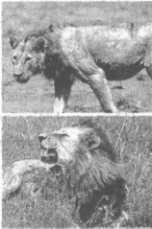
  The male lion’s splendid mane(鬃毛)sets him apart from other cats-and it’s great attraction for the ladies-so why would he do without it? That question has puzzled scientists since 1833, when the first reports of“maneless”lions streamed in from around the world.Now.a research team reports that lions from the Tsavo region of Kenya deliberately delay mane growth to fit in with the region’s harsh temperatures.

  John Patterson.a hunter and a British Colone1.Was one of the first to document manelessness in Tsavo’s famous man-eaters.Ever since.naturalists have developed more evolutionary descriptions.Some researchers suggested that lions lost their manes because they were caught too many times in Tsavo’s thorn bushes everywhere.Others argued that Tsavo’s aggressive lions have unusually high testosterone(雄激素)levels, known to cause male pattern baldness(秃顶)in humans Still others supposed that Tsavo’s lions were a distinct group of were related to a lion pictured in prehistoric caves,which no longer existed.

  But expert Thomas Gnoske at the Field Museum in Chicago, Illinois, considered something these researchers didn’t:lion shipped to zoos in cooler climates grow longer manes.This made him wonder whether hot temperatures account for Tsavo’s thinning lions.To find out.Gnoske and his colleagues studied museum records and conducted 10 year of fieldwork in Tsavo and in the Serengeti.which is about l0 degrees cooler.In an article published online this month in the Jourmal of Zoology.the team reports that lions in the Serengeti grow a full mane in 5 years-by the time they’re ready to be parents-but that Tsavo’lions don’t have much of mane until age 8.well past their reproductive period.

  Gnoske thinks smaller manes improve a young, energetic lion’s ability to keep cool.Bushy manes probably evolved to attract females in cooler climates where heat stress was not an issue, Gnoske says, and lions can’t just turn off that program, though they’re in a place like Tsavo.“They’re hard-wired to grow a mane;period, and they’ll develop as large of a mame as they possibly can.”

  Scientist Roland Kays of the New York State Museum in Albany says he is surprised by the delay in mane development.However, he expresses concern about the accuracy of using field observations to judge the age of Tsavo’lions.Gnoske says his team is now focusing its research On Tsavo lions with known birth dates, but it will be a challenge to keep track of the wide-ranging animals, especially since radio collars are prohibited in Tsavo’s national parks.

(1)

What does the passage mainly talk about?

[  ]

A.

Studies on different kinds of lions in Tsavo.

B.

Researches on why the lion lost his mane.

C.

Comparisons of lions in Tsavo and Serengeti.

D.

Different ways of studying manelessness of male lions.

(2)

Gnoske did fieldwork in Serengeti mainly to find out ________.

[  ]

A.

whether it has a much lower temperature

B.

whether lions in Serengeti grow longer manes

C.

how male lions in Serengeti attract females

D.

at what age lions in Serengeti are ready to be parents

(3)

Which of the following statements is true according to the text?

[  ]

A.

Gnoske was the first to report maneless lions in Tsavo.

B.

Gnoske found that Tsavo’s lions developed a full mane when they were ready to be parents.

C.

Some scientists believed that thorn bushes caused the manelessness of the lions in Tsavo.

D.

Roland thinks it accurate to judge the age of lions by using field observations.

(4)

It can be inferred from the passage that ________.

[  ]

A.

John Patterson was the first to study lions in Tsavo and Serengeti

B.

most scientists agree that high testosterone levels account for the manelessness of Tsavo’s lions

C.

Gnoske thinks that Tsavo’s male lions won’t grow long manes even at an old age.

D.

still much more research work remains to be done to test Gnoske’s idea.

(5)

Which part of a magazine do you suppose this passage is taken from?

[  ]

A.

Travel

B.

Science

C.

Entertainment

D.

History

(6)

The underlined words“that program”(paragraph 4) most probably refer to ________.

[  ]

A.

being observed in field

B.

growing up and having babies

C.

being caught in thorn bushes

D.

growing manes to attract females

查看习题详情和答案>>

阅读理解

  At a primary school in a small town in the east of South Carolina, second-grade teachers Garneau and Lynne are convinced that separating elementary-age boys and girls produces immediate academic improvement in both genders(性别).

  David Chadwell, South Carolina's expert of single gender education says,“Boys and girls learn, hear and respond to their surroundings differently.We can teach boys and girls based on what we now know.”

  Male and female eyes are not organized in the same way, he explains.The organization of the male eye makes it sensitive to motion and direction.“Boys understand the world as objects moving through space,”he says.

  The male eye is also drawn to cooler colors like silver and black.It's no accident that boys tend to create pictures of moving objects instead of drawing the happy colorful family, like girls do in their class.

  The female eye, on the other hand, is drawn to warmer colors like red, yellow and orange.To attract girls, Chadwell says, the teacher doesn't need to move as much as in boy's class.Using descriptive phrases and lots of colors in presentations or on the blackboard gets their attention.

  Boys and girls also hear differently.“When someone speaks in a loud tone, girls understand it as yelling,”Chadwell says.“They think you're mad and can shut down.”Girls are more sensitive to sounds.He advises girls' teachers to watch the tone of their voices.Boys' teachers should sound more forceful, even excited.

  A boy's nervous system causes him to be more cautious when he is standing, moving, and the room temperature is around 69 degrees Fahrenheit.Stress in boys, he says, tends to increase blood flow to their brains, a process that helps them stay focused.Girls are more focused when seated in a warmer room around 75 degrees Fahrenheit.Girls also respond to stress differently.When exposed to threat and conflict, blood goes to their guts(肠道), leaving them feeling nervous or anxious.

  These differences can be applied in the classroom, Chadwell adds.“Single gender programs are about making the best use of the learning.”

(1)

What is David Chadwell's attitude toward separating elementary-age boys and girls while learning?

[  ]

A.

Supportive

B.

Worried

C.

Concerned

D.

Uninterested

(2)

To engage boy in a class, the teacher ________.

[  ]

A.

must have a moving object in this hand

B.

needs to wear clothes in warm color

C.

has to speak politely

D.

had better move constantly while teaching

(3)

Which of the following shows the organization of the passage?

(①=Paragraph 1 ②=Paragraph 2 ③=Paragraph 3……⑧=Paragraph 8)

[  ]

A.

B.

C.

D.

(4)

Which of the following students is most likely to be focused?

[  ]

A.

A boy sitting in a warm room

B.

A standing boy who is faced with stress

C.

A girl standing in a cold room

D.

A girl who is facing a lot of pressure

查看习题详情和答案>>

Urban grasshoppers change their tune for females

grasshopper

Grasshoppers that live in noisy urban environments are having to change their song, a study has found.

Researchers suggest that high levels of background noise may affect the grasshoppers’ mating process. They say the insects are forced to increase the volume of the low-frequency sections of their call. Results of the study, by scientists from the University of Bielefeld, Germany, are published in the journal Functional Ecology. The research, which shows traffic noise could upset bow-winged grasshoppers’ (Chorthippus biguttulus) mating system, is the first of its kind, according to lead researcher Ulrike Lampe.

"Effects of man-made noise on communication has only been studied with vertebrates(脊椎动物), so far," said Ms Lampe, a PhD student at the University of Bielefeld’s Department of Evolutionary Biology. The scientists caught 188 male bow-winged grasshoppers from noisy roadsides and quiet rural locations.

According to Ms Lampe: "Bow-winged grasshoppers are a good model organism to study sexual selection because females can respond to male loving songs with their own low-frequency signal, if they are attracted to a male song." The grasshoppers produce their mating call by rubbing a toothed file on their hind-legs against a vein that is located on their front wings. The male’s song consists of short phrases of two to three seconds. The first part of the call consists of slower ticking sounds that increase in speed, leading to a buzzing sound towards the end of the phrase.

In order to stimulate the males to begin mating calls, scientists exposed the males to a female and recorded the results in the laboratory. The team then analysed the differences between the results of each group of grasshoppers. “Results showed that compared to males from rural locations, urban grasshoppers shift the frequency peak of the lower part of their spectrum(频谱) upwards," Ms Lampe explained. This would make sense to avoid low-frequency noise, as traffic noise could mask signals in that part of the frequency spectrum. The team’s findings demonstrate that traffic noise could be upsetting the grasshopper’s mating system."Increased noise levels could affect grasshopper courtship in several ways," commented Ms Lampe. "It could prevent females from hearing male loving songs properly, prevent females from recognising males of their own species, or impair females’ ability to estimate how attractive a male is from his song."

67. What is the usage of the grasshoppers’ songs?

A. To make our urban hear better.

B. To attract the mate grasshoppers.

C. To fight against the urban noise.

D. To attract the female grasshoppers.

68. How did scientist prove their conclusion?

A. By using statistics.

B. By arguing a topic.

C. By quoting person’s theory.

D. By comparing the results.

69. What does the underlined word “mask” mean?

A. Cover.    B. Affect.     C. Prevent.     D. Destroy.

70. What can be inferred from the passage?

A. Urban environment affects some animal lives.

B. Urban grasshoppers have to change their tune.

C. Grasshoppers shift the peak of spectrum.

D. Grasshoppers don’t like living in noisy urban areas.

查看习题详情和答案>>

阅读理解

ubmission Guidelines

  Before sending us a manuscript(稿件), look through recent issues(刊物)of the Post to get an idea of the range and style of articles we publish.You will discover that our focus has broadened to include well-researched, timely and informative articles on finance, home improvement, travel, humor, and many other fields.

  The Post’s goal is to remain unique, with content that provides additional understandings on the ever-evolving American scene.

  In addition to feature-length(专题长度的)articles, the Post buys anecdotes, cartoons, and photos.Payment ranges from $25 to $400.

  Our nonfiction needs include how-to, useful articles on gardening, pet care and training, financial planning, and subjects of interest to a 45-plus, home-loving readership.For nonfiction articles, indicate any special qualifications you have for writing about the subject, especially scientific material.Include one or two published pieces with your article.We prefer typed articles between 1000 and 2000 words in length.We encourage you to send both printed and online versions.

  We also welcome new fiction.A light, humorous touch is appreciated.We are always in need of straight humor articles.Make us laugh, and we’ll buy it.

  Feature articles average about 1000 to 2000 words.We like positive, fresh angles to Post articles, and we ask that they be thoroughly researched.

  We normally respond to article submissions within six weeks.You are free to submit the article elsewhere at the same time.

  Please submit all articles to Features Editor, The Saturday Evening Post, 1100 Waterway Boulevard, Indianapolis, IN 46202,(317)634-1100.

(1)

Before sending a manuscript to the Post, a contributor is advised to.

[  ]

A.

get a better understanding of American issues

B.

find out the range of the articles in the post

C.

increase his knowledge in many fields

D.

broaden his research focus

(2)

to submit nonfiction articles,a contributor must _________.

[  ]

A.

provide his special qualification

B.

be a regular reader of the Post

C.

produce printed version

D.

be over 45 year old

(3)

From the passage we can learn that the Post _________.

[  ]

A.

allows article submission within six weeks

B.

favor science articles within 2,000 words

C.

have a huge demand for humorous works

D.

prefers nonfiction to fiction article

查看习题详情和答案>>

Inside China Daily

  China, Japan ink fishery accord

  The New China -Japan Fishery Agreement will be put into effect starting June this year, Chinese vice - minister of agriculture, Qi Jingfa told a press conference yesterday in Beijing.

                                                                —Page 2

  Offshore funeral

  The remains of more than 500 dead will be scattered at sea this spring near the mouth of Yangtze River in Shanghai. To save space Shanghai officials discouraged land burials. 

—Page 3

  The only wise choice

  Co -operation with the mainland for a peaceful reunification should be the only wise choice for the newly elected Taiwan leader.                     

—Page 4

  Interest in activity such as fairs, galleries and exhibitions has caused the art market to take shape in China.                           —Page 9

  Two sides of a story.

  The government’s efforts to cut the homework burden of primary and middle school students have drawn mixed reactions.                               

—Page 10

  Blind, but not out.

  Yang Jia, an English professor at the Chinese Academy of Science meets the challenges brought by the sudden loss of her eyesight and continues to make it in her work.   

—Page 11

 The above section may possibly appear on ________ of China Daily.

  A. Page 5            B. the Front Page

  C. Page 9            D. the last page

 From the text we can learn that ________ .

  A. no one will be buried in the ground after they die in Shanghai

  B. Chinese fishermen can go fishing freely in Japan soon

  C. a blind professor can work better

  D. more and more people have begun to do art business

 When you look through this issue of China Daily, you are sure to find ________ .

  A. how Taiwan’s new leader was made

  B. that people think differently of reducing pupils’ burden

  C. sad stories about students with heavy burden in primary and middle schools

  D. interesting stories of art fairs, galleries and exhibitions of different shapes in China

查看习题详情和答案>>

违法和不良信息举报电话:027-86699610 举报邮箱:58377363@163.com

精英家教网