网址:http://m.1010jiajiao.com/timu3_id_3074608[举报]
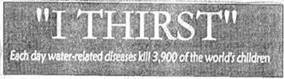 Across the world, 1.1 billion people have no access to clean drinking water. More than 2.5 billion people lack basic sanitation.(卫生设备)
The combination proves deadly. Each year, diseases related to inadequate water and sanitation kill between 2 and 5 million people and cause an estimated 80 percent of all sicknesses in the developing world. Safe drinking water is a precondition for health and the fight against child death rate, inequality between men and women, and poverty.
Consider these facts:
●The average distance that women in Africa and Asia walk to collect water is 6 kilometers.
●Only 58 percent of children in sub-Saharan Africa are drinking safe water. and only 37 percent of children in South Asia have access to even a basic toilet.
●Each year in India alone, 73 million working days are lost to water-borne diseases.
Here are three ways you can help:
1)Write Congress
Current U.S. foreign aid for drinking water and sanitation budgets only one dollar per year per American citizen. Few members of Congress have ever received a letter from voters about clean drinking water abroad.
2)Sponsor a project with a faith-based organization
Many U.S. religious groups already sponsor water and sanitation projects, working with partner organizations abroad. Simply put a single project by a U.S. organization can make safe water a reality for thousands of people.
3)Support nonprofit water organizations
Numerous U.S.-based nonprofits work skillfully abroad in community-led projects related to drinking water and sanitation. Like the sample of non-profits noted as follows, some organizations are large, other small-scale, some operate worldwide, others are devoted to certain areas in Africa, Asia, or Latin America. Support them generously.
1. The three facts presented in the passage are used to illustrate that________.
A. poverty can result in water-borne diseases
B. people have no access to clean drinking water
C. women’s rights are denied in some developing countries
D. safe drinking water should be a primary concern
2. The intended readers of the passage are________.
A. Americans
B. overseas sponsors
C. Congressmen
D . U.S.-based water organizations
3. The main purpose of the passage is to call on people to _________.
A. get rid of water-related diseases in developing countries
B. donate money to people short of water through religious groups
C. fight against the worldwide water shortage and sanitation problem
D. take joint action in support of some nonprofit water organizations
4. What information will probably be provided following the last paragraph?
A. A variety of companies and their worldwide operation.
B. A list of nonprofit water organizations to make contact with.
C. Some ways to get financial aids from U.S. Congress.
D. A few water resources exploited by some world-famous organizations.
查看习题详情和答案>>
Across the world, 1.1 billion people have no access to clean drinking water. More than 2.5 billion people lack basic sanitation. (卫生设备)
The combination proves deadly. Each year, diseases related to inadequate water and sanitation kill between 2 and 5 million people and cause an estimated 80 percent of all sicknesses in the developing world. Safe drinking water is a precondition for health and the fight against child death rate, inequality between men and women, and poverty.
Consider these facts:
●The average distance that women in Africa and Asia walk to collect water is 6 kilometers.
●Only 58 percent of children in sub-Saharan Africa are drinking safe water., and only 37 percent of children in South Asia have access to even a basic toilet.
●Each year in India alone, 73 million working days are lost to water-borne diseases.
Here are three ways you can help:
Write Congress
Current U.S. foreign aid for drinking water and sanitation budgets only one dollar per year per American citizen. Few members of Congress have ever received a letter from voters about clean drinking water abroad.
Sponsor a project with a faith-based organization
Many U.S. religious groups already sponsor water and sanitation projects, working with partner organizations abroad. Simply put a single project by a U.S. organization can make safe water a reality for thousands of people.
Support nonprofit water organizations
Numerous U.S.-based nonprofits work skillfully abroad in community-led projects related to drinking water and sanitation. Like the sample of non-profits noted as follows: some organizations are large, other small-scale, some operate worldwide, others are devoted to certain areas in Africa, Asia, or Latin America. Support them generously.
72. The three facts presented in the passage are used to illustrate that________.
A. poverty can result in water-borne diseases
B. people have no access to clean drinking water
C. women’s rights are denied in some developing countries
D. safe drinking water should be a primary concern
73. The intended readers of the passage are________.
A. Americans B. overseas sponsors
C. Congressmen D. U.S.-based water organizations
74. The main purpose of the passage is to call on people to _________.
A. get rid of water-related diseases in developing countries
B. donate money to people short of water through religious groups
C. fight against the worldwide water shortage and sanitation problem
D. take joint action in support of some nonprofit water organizations
75. What information will probably be provided following the last paragraph?
A. A variety of companies and their worldwide operation.
B. A list of nonprofit water organizations to make contact with.
C. Some ways to get financial aids from U.S. Congress.
D. A few water resources exploited by some world-famous organizations.
查看习题详情和答案>> Across the world, 1.1 billion people have no access to clean drinking water. More than 2.5 billion people lack basic sanitation.(卫生设备)
The combination proves deadly. Each year, diseases related to inadequate water and sanitation kill between 2 and 5 million people and cause an estimated 80 percent of all sicknesses in the developing world. Safe drinking water is a precondition for health and the fight against child death rate, inequality between men and women, and poverty.
Consider these facts:
●The average distance that women in Africa and Asia walk to collect water is 6 kilometers.
●Only 58 percent of children in sub-Saharan Africa are drinking safe water. and only 37 percent of children in South Asia have access to even a basic toilet.
●Each year in India alone, 73 million working days are lost to water-borne diseases.
Here are three ways you can help:
1)Write Congress
Current U.S. foreign aid for drinking water and sanitation budgets only one dollar per year per American citizen. Few members of Congress have ever received a letter from voters about clean drinking water abroad.
2)Sponsor a project with a faith-based organization
Many U.S. religious groups already sponsor water and sanitation projects, working with partner organizations abroad. Simply put a single project by a U.S. organization can make safe water a reality for thousands of people.
3)Support nonprofit water organizations
Numerous U.S.-based nonprofits work skillfully abroad in community-led projects related to drinking water and sanitation. Like the sample of non-profits noted as follows, some organizations are large, other small-scale, some operate worldwide, others are devoted to certain areas in Africa, Asia, or Latin America. Support them generously.
The three facts presented in the passage are used to illustrate that________.
A. poverty can result in water-borne diseases
B. people have no access to clean drinking water
C. women’s rights are denied in some developing countries
D. safe drinking water should be a primary concern
The intended readers of the passage are________.
A. Americans
B. overseas sponsors
C. Congressmen
D . U.S.-based water organizations
The main purpose of the passage is to call on people to _________.
A. get rid of water-related diseases in developing countries
B. donate money to people short of water through religious groups
C. fight against the worldwide water shortage and sanitation problem
D. take joint action in support of some nonprofit water organizations
What information will probably be provided following the last paragraph?
A. A variety of companies and their worldwide operation.
B. A list of nonprofit water organizations to make contact with.
C. Some ways to get financial aids from U.S. Congress.
D. A few water resources exploited by some world-famous organizations.
查看习题详情和答案>>Across the globe, single parent homes are on the rise. In the US, the 2000 census (人口普查) showed 24.8 million, or nearly 24 percent of the nation’s 105.5 million households, were traditional two-parent homes. By comparison, 9.8 million households, or 9 percent of all US households were headed by an adult raising a child alone. The 1990 census showed 26 percent of homes were led by a married mother and father, and 8 percent of homes were led by a single parent.
Similar increases occurred in other countries. In the UK, lone-parent homes increased from 3.3 percent in 1990 to 5.5 percent in 1999. Single parent households in Australia rose from 5.8 percent in 1990 to 7.6 percent in 1999. Belgium saw the increase from 1.8 percent to 2.7 percent during the same period of time. These countries tend to have greater acceptance of the single parent because there are fewer nearby family members to disapprove, Riche, a Census Bureau director, said.
Just as in the US, those changes raised new questions about how involved govenment should be in helping single parent families. Some research suggests children raised in two-parent families are better off than those who depend on one.
“The position of one-parent families in any country is very much a gender (性别) issue-women’s opportunities, especially working-class women on low income,” said Sue Cohen, coordinator (协调员) of the Single Action Parents Network in England.
5.Not considering the exact number of the single-parent families, which country saw the fastest rise rate in 1999, compared with 1990?
A.UK. B.Australia. C.America. D.Belgium.
6.What is the cause of the rise of single parent families across the globe?
A.The nearby family members have a favourable opinion.
B.A lone parent is well off enough to support his /her children.
C.A lot of problems have arisen in two-parent families.
D.We cannot get enough proving information from the text.
7.Which of the following is TRUE about the increase of single parent families according to the passage?
A.It will somewhat limit the growing population of younger generation.
B.Governments should take actions about the social problems brought about by it.
C.Single parent families are not looked down upon in any country mentioned here.
D.Generally speaking, the single parents needn’t worry since they are highly paid.
8.Which of the following diagrams correctly shows the rise of single parent families in the US from
1990 to 2000?

Across the globe, single parent homes are on the rise. In the US, the 2000 census (人口普查) showed 24.8 million, or nearly 24 percent of the nation’s 105.5 million households, were traditional two-parent homes. By comparison, 9.8 million households, or 9 percent of all US households were headed by an adult raising a child alone. The 1990 census showed 26 percent of homes were led by a married mother and father, and 8 percent of homes were led by a single parent.
Similar increases occurred in other countries. In the UK, lone-parent homes increased from 3.3 percent in 1990 to 5.5 percent in 1999. Single parent households in Australia rose from 5.8 percent in 1990 to 7.6 percent in 1999. Belgium saw the increase from 1.8 percent to 2.7 percent during the same period of time. These countries tend to have greater acceptance of the single parent because there are fewer nearby family members to disapprove, Riche, a Census Bureau director, said.
Just as in the US, those changes raised new questions about how involved govenment should be in helping single parent families. Some research suggests children raised in two-parent families are better off than those who depend on one.
“The position of one-parent families in any country is very much a gender (性别) issue-women’s opportunities, especially working-class women on low income,” said Sue Cohen, coordinator (协调员) of the Single Action Parents Network in England.
Not considering the exact number of the single-parent families, which country saw the fastest rise rate in 1999, compared with 1990?
A.UK. B.Australia. C.America. D.Belgium.
What is the cause of the rise of single parent families across the globe?
A. The nearby family members have a favourable opinion.
B.A lone parent is well off enough to support his /her children.
C.A lot of problems have arisen in two-parent families.
D. We cannot get enough proving information from the text.
Which of the following is TRUE about the increase of single parent families according to the passage?
A. It will somewhat limit the growing population of younger generation.
B. Governments should take actions about the social problems brought about by it.
C. Single parent families are not looked down upon in any country mentioned here.
D. Generally speaking, the single parents needn’t worry since they are highly paid.
Which of the following diagrams correctly shows the rise of single parent families in the US from 1990 to 2000?
