网址:http://m.1010jiajiao.com/timu3_id_3068652[举报]
第一节:听对话或独白
听下面5段对话或独白。每段对话或独白后有几个小题,从题中所给的A,B,C三个选项中选出最佳选项,并标在试卷的相应位置。听每段对话或独白前,你将有时间阅读各个小题,每小题5秒钟;听完后,各小题将给出5秒钟的作答时间。每段对话或独白读两遍。
听下面一段对话,回答第1-3小题。
1.Why was the man late for class?
A.He got up late.
B.Due to the heavy traffic.
C.He didn’t catch the bus.
2.What can we know from the dialogue?
A.A car pool is a kind of organization that owns cars and sends people to work.
B.Car pool is the name of a company that helps people hire cars.
C.People who join a car pool live nearby and ride in one car.
3.How does the woman know so much about the car pool?
A.She has joined a car pool.
B.She has read about it in the paper.
C.She works in it.
听下面一段对话,回答第4-6小题。
4.Which of the following is true about the car?
A.It’s new and small.
B.It’s old and bought in America.
C.It’s second-hand and from another country.
5.Why does Mike’s friend want to sell the car?
A.She needs money to buy a new house.
B.She can’t afford to keep it in the city.
C.She lives near her workplace.
6.How much does the man agree to pay for the car?
A.More than 5,000 dollars.
B.Less than 5,000 dollars
C.Not mentioned.
听下面一段对话,回答第 7-9小题。
7.Where does the conversation most probably take place?
A.In the post office.
B.In a shopping center.
C.At the railway station.
8.What can we learn from the dialogue?
A.The man has to write down the return address as required.
B.The man bought two sets of glasses.
C.The man has to pay more than $8.20.
9.Which statement of the following is true according to the dialogue?
A.The man has to fill in a form.
B.If the man chooses the second class, it will take ten days to arrive.
C.It is a rule to write down the return address.
听下面一段对话,回答第 10-12小题。
10.What is the telephone number of Blue Travel Agency?
A.7489932.
B.7389932.
C.7489942.
11.When does Jill want to go to New York?
A.In May.
B.In April.
C.In March.
12.In what way will Jill return?
A.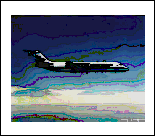
B.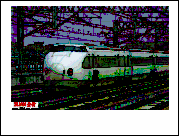
C.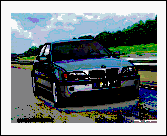
听下面一段独白,回答第13-15小题。
13.Why did the man lose his temper?
A.Because the bird couldn’t repeat his master’s name.
B.Because the bird screamed all day long.
C.Because the bird failed to say the name of the town.
14.Who killed the three chickens?
A.The man in the kitchen.
B.The pet bird.
C.The fourth chicken.
15.Why was the man shocked at the scene the next morning?
A.The bird had finally understood his threat to kill it.
B.The bird managed to escape from the chicken house.
C.The bird had learned to scream back at him.
第二节:听取信息
听下面一段独白,请根据题目要求,从听到的内容中获取必要的信息,填入答题卷上标号为16-20的空格中。听录音前你将有10秒钟的阅题时间,录音读两遍,你将有80秒钟的作答时间。

第一节:听力理解(5段共15小题;每小题2分,满分30分)
每段播放两遍,各段后有几个小题,各段播放前每小题有5秒钟的阅题时间。请根据各段播放内容及其相关小题,在5秒钟内从题中所给的A、B、C项中,选出最佳选项。
听第一段对话,回答第1-3题。
1.What’s the relationship between the two speakers?
A.Professor and student.
B.Manager and secretary.
C.School master and teacher.
2.What can we learn about the man?
A.He is kind.
B.He is helpful.
C.He is careful.
3.What can we learn from the dialogue?
A.The man only pointed out two mistakes by the woman.
B.The woman always makes many mistakes in her work..
C.The man is too hard on the woman all the time.
听第二段对话,回答第4-6题。
4.What are the two talking about?
A.Mrs.Smith.
B.Mr.Downs.
C.Mr.Downs’ son.
5.How long does a school day last?
A.At least 8 hours.
B.About 6 hours.
C.Less than 4 hours.
6.How does Jack usually go to school?
A.By bus.
B.On foot.
C.By car.
听第三段对话,回答第7-9题。
7.Who answered the phone?
A.Tom.
B.Tom’s wife.
C.Susan.
8.When are they going to New Zealand?
A.In half a year.
B.In a couple of months.
C.In two weeks.
9.Where are they going to meet?
A.At Susan’s.
B.At Tom’s.
C.In New Zealand.
听第四段对话,回答第10-12题。
10.Why does the speaker give the talk to the students?
A.To scold them.
B.To praise them.
C.To encourage them.
11.How does the speaker offer to help the students?
A.By letting them skip(不参加)the test.
B.By talking to them in person.
C.By treating them like Einstein.
12.What exam will the students have after their meeting with the teacher?
A.The final.
B.The midterm.
C.The test on Einstein.
听第五段对话,回答第13-15题。
13.What can Maria see?
A.Many trains.
B.Many planes.
C.Many people.
14.What’s the woman afraid of?
A.Driving in.
B.Taking ferries.
C.Getting lost.
15.What kind of city is New York, according to the man?
A.An easy city to get around in.
B.A city full of subways.
C.A city difficult to get around in.
第二节:听取信息(共5小题;每小题1分,满分5分)
听下面1段独白。请根据题目要求,从所听到的内容中获取必要的信息,填入答题卷标号为16~20的空格中。听录音前,你将有10秒钟的阅题时间。录音读两遍,你有80秒的作答时间。

听力
第一节:
听下面5段对话或独白。每段对话或独白后有几个小题,从题中所给的A、B、C三个选项中选出最佳选项。听完每段对话或独白前,你将有时间阅读各个小题,每小题5秒钟;听完后,各小题将给出5秒钟的作答时间。每段对话读两遍。
听第1段材料,回答第1至2题。
1.What is the man doing?
A.Asking for help.
B.Making an apology.
C.Expressing dissatisfaction.
2.Where does the conversation probably take place?
A.At an airport.
B.At a hospital.
C.At a school.
听第2段材料,回答第3至5题。
3.Why doesn’t the man want to see Mrs Cathy?
A.He thinks she is not kind
B.He is tired of waiting for people.
C.He thinks she is boring.
4.Whom does the man have to see at 10 a. m?
A.Mr White.
B.Mr Potter.
C.Mrs Cathy.
5.What is the relationship between the speakers?
A.Father and daughter.
B.Husband and wife.
C.Boss and secretary.
听第3段材料,回答第6至8题。
6.Where was the woman when the hurricane took place?
A.In her father’s friend’s house.
B.In the house with her husband.
C.On her way home.
7.When did the hurricane hit the area where the woman lived?
A.At 3∶30 a. m. on August29.
B.At 5∶00 a. m. on August 30.
C.At noon on August 30.
8.Why did they chive very slowly?
A.Too many cars were on the road.
B.Broken branches were everywhere.
C.There was a very strong wind.
听第4段材料,回答第9至11题。
9.Who is the speaker?
A.A student.
B.A player.
C.A manager.
10.What time does the center open?
A.9∶00a. m.
B.9∶00p. m.
C.5∶00 p. m.
11.What is the speaker mainly talking about?
A.Different sports rules.
B.Different indoor sports.
C.Different sporting activities.
听第5段材料,回答第12至15题。
12.Why are people interested in vegetable gardening?
A.Because people can make money from it.
B.Because people can relax themselves.
C.Because people can sell vegetables.
13.In what season(s)can a well-kept garden provide fresh, vegetables?
A.In late autumn.
B.From late spring to autumn.
C.From spring to late autumn.
14.What is needed to keep the garden well?
A.Great efforts.
B.A lot of money.
C.little time.
15.What can you learn from Professor Smith?
A.Tips on how people grow vegetables.
B.Reasons for doing vegetable gardening.
C.Kinds of vegetables people prefer.
第二节:听取信息
听下面一段独白,请根据题目要求,从所听到的内容中获取必要的信息。听力材料朗读两遍。你有90秒钟的答题时间。
A summary of research into the ways Chinese students in Auckland spend their leisure time.
How many?On 8th November 2004, a survey was conducted among(16)________ Chinese students.
In what way?Conducted by means of a(17)________ given to the students to complete.
Ways(18)________ of the students went shopping
56% of the students spend time(19)________ or doing nothing at all
(20)________ of the students said they spend all their time on school and homework
听力
第一节:听力理解(5段共15小题;每小题2分,满分30分)
每段播放两遍。各段后有几个小题,各段播放前每小题有5秒钟的阅题时间。请根据各段播放内容及其相关小题,在5秒钟内从题中所给的A、B、C项中,选出最佳选项。
听第1段对话,回答第1-3题。
1.What does the woman say about the house?
A.It is located in the city centre.
B.The transportation is convenient.
C.Parking around it is a problem for her.
2.What does the man think of the bathroom?
A.It is made full use of.
B.It looks very popular.
C.It is in good condition.
3.Why does the man come to the woman's house?
A.Because he will rent it.
B.Because he plans to buy it.
C.Because he wants to help her rent it out.
听第2段对话,回答第4-6题。
4.What do we know about the man?
A.He has a full-time job.
B.He lives in his parents' house.
C.He and his wife earn less than $5,000 a year.
5.What advice does the woman give the man?
A.He should include his parents' income.
B.He should go to her office and fill out forms.
C.He should give her his information in more detail.
6.What day is it today?
A.Thursday.
B.Friday.
C.Saturday.
听第3段对话,回答第7-9题。
7.How many objects will the woman choose for an academic year?
A.Four.
B.Eight.
C.Twelve.
8.What does the woman think of completing the registration form?
A.It will be a time-consuming work.
B.It is unnecessary to complete it by hand.
C.There seems to be something wrong with it.
9.What does the man advise the woman to do with the registration form?
A.Go back home to finish it.
B.Fill it out online in the computer lab.
C.Go to the teaching building and ask for more information.
听第4段对话,回答第10-12题。
10.Where does the conversation probably take place?
A.In a garage.
B.In a shop.
C.In a restaurant.
11.What advice does the man give the woman about fixing her car?
A.She should get familiar with her car.
B.She should avoid being overcharged.
C.She should look for a person she can trust.
12.What does the woman say about the mechanic?
A.He has fixed her car before.
B.He is one of her neighbours.
C.He will drive her home today.
听第5段对话,回答第13-15题。
13.What is the probable relationship between the speakers?
A.Engaged couple.
B.Mother and son.
C.Wife and husband.
14.Why do people want to protect their money and property according to the man?
A.Because marriages don't last long nowadays.
B.Because they don't believe each other at all.
C.Because they don't plan on being together forever.
15.What can we learn from the conversation?
A.The man wants to protect his money.
B.The woman is thinking about a divorce.
C.The man wants to have many children.
第二节:听取信息(共5小题;每小题1分,满分5分)
听下面一段对话,请根据题目要求,从所听到的内容中获取必要的信息,填入标号为16-20的空格中。听录音前,你将有10秒钟的阅题时间,录音读两遍。你将有60秒钟的作答时间。

听力
第一节:听力理解(5段共15小题,每小题2分,满分30分)
每段播放两遍。各段后有几个小题,各段播放前每小题有5秒钟的阅题时间。请根据各段播放内容及其相关小题,在5秒钟内从题中所给的A、B、C项中,选出最佳选项。
听第一段对话,回答第1至3题。
1.What did the woman buy?
A.A video recorder.
B.A video camera.
C.A CD-player.
2.What was the seller's excuse for not opening the box?
A.It's a store rule.
B.If it is opened, nobody will buy.
C.If it is opened, other people won't believe it's new.
3.What do you think of the guy on the sidewalk?
A.He is an excellent seller.
B.He is a very poor beggar.
C.He cheats others out of their money.
听第二段对话,回答第4至6题。
4.What is the general idea the woman has on modern art?
A.She thinks very highly of it.
B.She thinks most modern art is good.
C.She doesn't think modern artists are serious.
5.Why does the man want to stop discussing the matter of modern art?
A.It is no good talking about the problem.
B.His opinion does not sound reasonable.
C.He will lose the argument soon.
6.What will the woman most probably do if there is a modern art exhibition?
A.Do anything except visit the show.
B.Visit the show as much as possible.
C.Take photos of it.
听第三段独白,回答第7至9题。
7.Where is the speaker from?
A.A noisy city.
B.A developed town.
C.A quiet original village.
8.What can we see in the speaker's hometown?
A.Wide roads running alongside a big river.
B.Few ducks swimming in the river.
C.A river running into the sea.
9.How will people in the speaker's hometown gain more money?
A.They will develop agriculture and the fishing industry.
B.They will develop the tourist industry.
C.They will mine valuable minerals.
听第四段对话,回答第10至12题。
10.Why do people in Finland wear paper boots in winter?
A.They feel they are the warmest boots.
B.They don't have enough money to buy expensive boots.
C.They can only find paper to protect themselves from the cold.
11.Which of the following can be made of paper now?
A.Cars.
B.Beds.
C.Planes.
12.What can we learn from the conversation?
A.The woman will give a lecture about paper.
B.Researching paper is the woman's favorite.
C.The woman is an expert on paper.
听第五段独白,回答第13至15题。
13.Why did Marie Curie leave Warsaw?
A.Because she wanted to go to school for a general education in Cracow.
B.Because she took part in a students' revolutionary organization.
C.Because her family would move to Cracow.
14.When did Marie Curie get married?
A.In 1894.
B.In 1895.
C.In 1903.
15.What can we learn about Marie Curie from the speaker?
A.She was the first woman who became Professor of General Physics in the Faculty of Sciences.
B.She and her husband were awarded the Nobel Prize for Physics in 1911.
C.After a short illness, she died in France in 1921.
第二节:听取信息
听下面一段对话,请根据题目要求,从所听到的内容中获取必要的信息,填入标号为16至20的空格中。听录音前,你将有10秒钟的阅题时间。录音读两遍,你将有60秒钟的作答时间。
