网址:http://m.1010jiajiao.com/timu3_id_3057483[举报]
Can you communicate with others when you live in a foreign country with no or little knowledge of its language? Of course, it is possible. You can communicate your moods and intentions to one another without words, because all human beings share a lot of common visual(看见的)signals. These signals are as effective as words during communication.
The gestures of the head play a key role in body language. The movements of eyes and eyebrows are as important as head movements in body language.
Besides the gestures of the head or the movements of the eyes and eyebrows, the action of arms, hands and legs is also a large part of body language. Extending one's arm and shaking hands with others is a greeting in both formal and informal cases. This part of body language might date back to primary tribes(部落).
Like handshaking, there are still many other forms of body language presented by hands. Raising one's hand and making a circle with his thumb(拇指)and for finger signals, that something is OK. Clasped(握紧的)hands raised above the head, a traditional picture accepted by sportsmen after winning a fight, is a display of triumph that grows out of a kind of feeling following a victory. Waving one's hands, a speaker can make his words more powerful and vigorous(有活力的).
Besides hand gestures, there are times when a person says something with his legs as well as with his head and eyes. The leg gestures often reflect one's attitude towards something or someone that person is with.
According to the above facts, body language has offered a more reliable(可靠的)way to understand one's mind by means of gestures. Though it is soundless and wordless, once you understand it, you will feel the world is bigger than you realized.
【小题1】 Which of the following is the proper title for this passage?
| A.Body Language | B.How to Communicate with the People around You |
| C.The History of Body Language | D.Gestures And Languages |
| A.hand shaking suggests that the speaker is excited |
| B.head plays a less important part in body language |
| C.actors and actresses are good at gestures |
| D.people began to use body language long long ago |
| A.Soundless and wordless. | B.Difficult to understand. |
| C.Powerful and vigorous. | D.Effective and normal |
| A.clasp their hands to announce their victory |
| B.clasp their hands to express their excited feeling |
| C.have a picture taken as soon as possible |
| D.show a sign of thankfulness |
Can you communicate with others when you live in a foreign country with no or little knowledge of its language? Of course, it is possible. You can communicate your moods and intentions to one another without words, because all human beings share a lot of common visual(看见的)signals. These signals are as effective as words during communication.
The gestures of the head play a key role in body language. The movements of eyes and eyebrows are as important as head movements in body language.
Besides the gestures of the head or the movements of the eyes and eyebrows, the action of arms, hands and legs is also a large part of body language. Extending one's arm and shaking hands with others is a greeting in both formal and informal cases. This part of body language might date back to primary tribes(部落).
Like handshaking, there are still many other forms of body language presented by hands. Raising one's hand and making a circle with his thumb(拇指)and for finger signals, that something is OK. Clasped(握紧的)hands raised above the head, a traditional picture accepted by sportsmen after winning a fight, is a display of triumph that grows out of a kind of feeling following a victory. Waving one's hands, a speaker can make his words more powerful and vigorous(有活力的).
Besides hand gestures, there are times when a person says something with his legs as well as with his head and eyes. The leg gestures often reflect one's attitude towards something or someone that person is with.
According to the above facts, body language has offered a more reliable(可靠的)way to understand one's mind by means of gestures. Though it is soundless and wordless, once you understand it, you will feel the world is bigger than you realized.
1. Which of the following is the proper title for this passage?
|
A.Body Language |
B.How to Communicate with the People around You |
|
C.The History of Body Language |
D.Gestures And Languages |
2.After reading the passage we can conclude that ________.
|
A.hand shaking suggests that the speaker is excited |
|
B.head plays a less important part in body language |
|
C.actors and actresses are good at gestures |
|
D.people began to use body language long long ago |
3.What's the characteristic of body language?
|
A.Soundless and wordless. |
B.Difficult to understand. |
|
C.Powerful and vigorous. |
D.Effective and normal |
4.When sports men win a match, they probably ________.
|
A.clasp their hands to announce their victory |
|
B.clasp their hands to express their excited feeling |
|
C.have a picture taken as soon as possible |
|
D.show a sign of thankfulness |
查看习题详情和答案>>
Can you communicate with others when you live in a foreign country with no or little knowledge of its language? Of course, it is possible. You can communicate your moods and intentions to one another without words, because all human beings share a lot of common visual(看见的)signals. These signals are as effective as words during communication.
The gestures of the head play a key role in body language. The movements of eyes and eyebrows are as important as head movements in body language.
Besides the gestures of the head or the movements of the eyes and eyebrows, the action of arms, hands and legs is also a large part of body language. Extending one's arm and shaking hands with others is a greeting in both formal and informal cases. This part of body language might date back to primary tribes(部落).
Like handshaking, there are still many other forms of body language presented by hands. Raising one's hand and making a circle with his thumb(拇指)and for finger signals, that something is OK. Clasped(握紧的)hands raised above the head, a traditional picture accepted by sportsmen after winning a fight, is a display of triumph that grows out of a kind of feeling following a victory. Waving one's hands, a speaker can make his words more powerful and vigorous(有活力的).
Besides hand gestures, there are times when a person says something with his legs as well as with his head and eyes. The leg gestures often reflect one's attitude towards something or someone that person is with.
According to the above facts, body language has offered a more reliable(可靠的)way to understand one's mind by means of gestures. Though it is soundless and wordless, once you understand it, you will feel the world is bigger than you realized.
- 1.
Which of the following is the proper title for this passage?
- A.Body Language
- B.How to Communicate with the People around You
- C.The History of Body Language
- D.Gestures And Languages
- A.
- 2.
After reading the passage we can conclude that ________.
- A.hand shaking suggests that the speaker is excited
- B.head plays a less important part in body language
- C.actors and actresses are good at gestures
- D.people began to use body language long long ago
- A.
- 3.
What's the characteristic of body language?
- A.Soundless and wordless.
- B.Difficult to understand.
- C.Powerful and vigorous.
- D.Effective and normal
- A.
- 4.
When sports men win a match, they probably ________.
- A.clasp their hands to announce their victory
- B.clasp their hands to express their excited feeling
- C.have a picture taken as soon as possible
- D.show a sign of thankfulness
- A.
When travelling, you may think that if you don't know the language, you can communicate using
gestures. However, very few gestures are universally understood and interpreted. What is perfectly
acceptable in this country may be rude in other cultures.
1. Pointing at something using the index finger. It is impolite to point with the index finger in the
Middle and Far East. Use an open hand or your thumb in Indonesia.
2. Making a "V"sign. This means "victory"in most parts of Europe when you make the sign with
your palm facing away from you. But if you face your palm in, the gesture is very rude.
3. Smiling. This facial expression is universally understood. However, cultures can provide different
reasons for smiling. The Japanese may smile when they are confused or angry while in other parts of
Asia people smile when they are embarrassed. People in some cultures only smile to friends. It is
important not to judge people for not smiling, or for smiling at what we would consider "inappropriate"
times.
4. Waving one's hand with the palm facing outward to greet someone. In parts of Europe, waving the
hand back and forth can mean "No". To wave "goodbye", raise the palm outward and wave the fingers
together; but this is rude in Nigeria if the hand is too close to another person's face.
5. Forming a circle with one's fingers to mean "OK". Although this means "OK"in the U. S. and many
other countries, there are some notable exceptions. In Brazil and Germany the gesture is obscene
(猥亵的), while in Japan it means"money". In France, it has the additional meaning of "zero"or
"worthless".
B. the same gesture can have different meanings
C. a smile always suggests friendliness
D. we can still communicate without knowing the languages
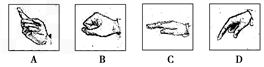
B. Impolite.
C. Uncomfortable.
D. Ordinary.
B. make a "V"sign
C. point at objects around you
D. make the "OK"gesture
B. warn readers of impolite gestures
C. show the different meanings of gestures in different countries
D. teach readers how to understand gestures in other countries
阅读理解
“Maybe I'll just move him right out the door,” the boss replied. Ray was very glad and no longer worried. The boss was mad at Don now, not at him. Sure enough, within a month of that meeting, Don was looking for a new job. “Serves him right,” Ray thought. Unfortunately, the guy who was brought in to take Don's place wasn't much better.
Well, then an astonishing thing happened. Ray's department was working on a box design for a toy. A new employee named Jack was doing the artwork. He had designed something in bright red and blue. Ray looked at it and said, “Sorry. Red and blue is not good. Change it to brown and purple.” Actually, the design was very nice. But Ray didn’t want Jack to get too proud. He also wanted him to know who was in charge. Jack wasn't happy about it, but he changed everything to brown and purple.
Two weeks later, 500,000 new brown and purple boxes arrived from the printing company. While Ray was leading a staff meeting, the boss came bursting in.
“What is this?” he shouted, waving one of the new boxes. “You call this artwork? Look at these ridiculous colors! This is the ugliest box I've ever seen. Who did this, anyway?”
All eyes, except Jack's were upon Ray. Then Jack spoke. “I did, sir,” he said, “I'm sorry you don't like it. I'll try to do better next time.”
Ray was deeply touched by Jack's act of mercy. And it changed his life.
1.What kind of man was Ray's boss?
[ ]
A.Impatient and quick to get angry.
B.Kind and always ready to help his staff.
C.Shy and afraid to talk about problems.
D.Cruel and hard to deal with.
2.How did it make Ray feel when his staff did something well?
[ ]
A.Happy and proud to be their boss.
B.Afraid of losing face and control.
C.Angry because they didn't ask him first.
D.Puzzled and very disappointed.
3.When all the other staff looked at Ray, why didn't Jack?
[ ]
A.He was afraid that Ray would start to blame him.
B.He didn't want to start laughing in front of the boss.
C.He didn't want the boss to think it was Ray's fault.
D.He was afraid that Ray would be fired.
4.What was Jack's act of mercy?
[ ]
A.He took the blame for Ray's mistake.
B.He didn't blame Ray for the mistake.
C.He told the boss he was sorry for Ray's mistake.
D.He wanted to help Ray to change his life.
查看习题详情和答案>>