网址:http://m.1010jiajiao.com/timu3_id_3048815[举报]
A recent announcement by scientists that they have successfully cloned the first human embryo has caused much debate and has shocked many people around the world. On the one hand,some scientists point out that if you clone an embryo,you can produce valuable tissues(组织)and organs that could be used to save human lives. On the other hand,many people,including some scientists, disagree and fear that if mankind interferes with(干涉)nature in this way,they may be on their way to producing a real-life Frankenstein’s monster.
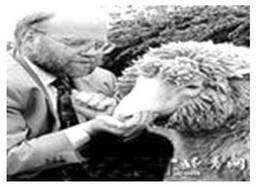 Cloning is producing an exact copy of a plant or an animal using its cells. The first mammal to be cloned successfully from an adult cell was Dolly the sheep. She was born in 1996 and died in early 2003,at a much younger age than normal. When she was born,many people were angry because they thought cloning would create more disease in the animal world. However,in general the scientists were praised for their wonderful scientific breakthrough.
The Scottish scientist who created Dolly,Ian Wilmut,is shocked that some scientists are now considering cloning human beings. Although he researches cloning,his intention has never been to create copies of humans. Instead,he thinks research efforts should concentrate on creating new tissues and organs that could eventually be used to cure diseases like cancer. However,some people consider that cloning human embryos with the intention of destroying them shows no respect for human life.
While cloning human embryos is illegal in many countries,some scientists are already pushing ahead with research so as to deliver a cloned human baby. Severino Antinori,an Italian doctor,is one of the leaders in this kind of research. He has declared that he wants to be the first to clone a human being.
In China,scientists have focused their efforts on cloning animals,as well as stern cells to be used in medical research. China has succeeded in producing clones of cows and goats,and continues to research ways in which cloning can benefit mankind.
51. Which of the following statements about cloning is TRUE according to the passage?
A. Cloning technology can only be applied to animals.
B. A cloned animal can live longer than a normal one.
C. People all over the world are happy about the birth of Dolly.
D. Cloning can produce valuable tissues and organs to cure human diseases.
52. The reasons why people are anti-cloning include the following EXCEPT that_______.
A. cloning may produce a real-life Frankenstein’s monster
B. cloning might create more disease in the animal world
C. cloning can’t help those who want to clone their dead children
D. cloning human embryos shows no respect for human life
53. Who is in favor of cloning human beings?
A. Ian Wilmut. B. Severino Antinori.
C. The author. D. The Chinese scientists.
54. What can be inferred from the last two paragraphs?
A. If we interfere with nature, we will change the world to be what we want.
B. It is impossible to clone babies for women who cannot have ones.
C. Cloning human beings is illegal in many countries,so no scientists want to do so.
D. Whether cloning human embryos is legal or not remains a matter of debate.
查看习题详情和答案>>What is cloning? Are there different types of cloning?
_____71____ Actually, there are different technologies which can be used for other purpose besides producing the genetic twin of another organism. A basic understanding of the different types of cloning is key to talking an informed stance on current public policy issues and making the best possible personal decisions. The following three types of cloning technologies are usually performed; recombinant DNA technology or DNA cloning, reproductive cloning, and therapeutic cloning.
___72_____
Scientists have been cloning animals for many years. In 1952, the first animal, a tadpole, was cloned. ___73_____ Since Dolly, researchers have cloned a number of large and small animals including sheep, goats, cows, mice, pigs, cats, rabbits, and a gaur. ____74____
Hundreds of cloned animals exist today, but the number of different species is limited. ____75____ Some species may be more resistant to somatic cell nuclear transfer than others. The process of stripping the nucleus from an egg cell and replacing it with the nucleus of a donor cell is a traumatic one, and improvements in cloning technologies may be needed before many species can be cloned successfully.
|
A.What animals have been cloned? |
|
B.All these clones were created using nuclear transfer technology |
|
C.When the media report on cloning in the news, they are usually talking about only one type called reproductive cloning. |
|
D.Recently Chinese scientists have also successfully cloned mammals such as an ox. |
E. Cloning is making a genetic copy of something else.
F. Attempts at cloning certain species such as monkeys, chickens, horses, and dogs, have been unsuccessful.
G. Before the creation of Dolly, the first mammal cloned from the cell of an adult animal, clones were created from embryonic cells.
查看习题详情和答案>>
The researchers, led by Hwang Woo-suk, insist they cloned an Afghan hound, only to help investigate (研究) human disease, including the possibility of cloning stem cells (干细胞) for treatment purposes.
But others immediately renewed calls for a global ban on human reproductive cloning before the technology moves any farther.
“Successful cloning of an increasing number of species confirms the general impression that it would be possible to clone any species of mammals, including humans,” said Ian Wilmut, a reproductive biologist at the University of Edinburgh who produced the first cloned mammal, Dolly the sheep, from an adult cell nearly a decade ago.
Researchers have since cloned cats, goats, cows, mice, pigs, rabbits, horses, deer, mules and gaur, a large wild ox of Southeast Asia. So far, efforts to clone a monkey or another primate with the same techniques have failed.
Uncertainties about the health and life span (寿命) of cloned animals continue to exsist; Dolly died at a young age in 2003 after developing cancer and arthritis.
Wilmut and others complimented Hwang’s achievement, reported Wednesday in the journal Nature. But they said politicians and scientists must face the larger issue — how to go on with the research without crossing the moral boundary of copying human life in the lab.
“The ability to use the technology is hopeful,” said Robert Schenken, president of the American Society for Reproductive Medicine. “However, the paper also points out that in dogs as in most species, cloning for reproductive purposes is unsafe.”
The cloned puppy was the lone success from more than 100 dogs implanted (嵌入)with more than 1,000 cloned embryos.
In a news conference in Seoul, the cloning team also condemned the reproductive cloning of humans as “unsafe and inefficient.” Human reproductive cloning already is banned in South Korea. Other nations, including the United States, are divided on whether to ban just human cloning or cloning of all kinds, including the production of stem cells.
1. An Afghan hound is a kind of ______.
A. cat B. dog C. cow D. goat
2. A ______ is a large wild ox of Southeast Asia.
A. horse B. deer C. mules D. gaur
3.Accrding to the passage, scientists haven’t been able to clone a ______ so far.
A. deer B. mule C. monkey D. mouse
4.The underlined word complimented is probably similar in meaning to ______.
A. praised B. doubted C. refused D. gave up
5.The cloning of human beings is banned in ______.
A. South Korea
B. the United States
C. both South Korea and the United States
D. neither South Korea nor the United States
查看习题详情和答案>>
The researchers, led by Hwang Woo-suk, insist they cloned an Afghan hound, only to help investigate (研究) human disease, including the possibility of cloning stem cells (干细胞) for treatment purposes.
But others immediately renewed calls for a global ban on human reproductive cloning before the technology moves any farther.
“Successful cloning of an increasing number of species confirms the general impression that it would be possible to clone any species of mammals, including humans,” said Ian Wilmut, a reproductive biologist at the University of Edinburgh who produced the first cloned mammal, Dolly the sheep, from an adult cell nearly a decade ago.
Researchers have since cloned cats, goats, cows, mice, pigs, rabbits, horses, deer, mules and gaur, a large wild ox of Southeast Asia. So far, efforts to clone a monkey or another primate with the same techniques have failed.
Uncertainties about the health and life span (寿命) of cloned animals continue to exsist; Dolly died at a young age in 2003 after developing cancer and arthritis.
Wilmut and others complimented Hwang’s achievement, reported Wednesday in the journal Nature. But they said politicians and scientists must face the larger issue — how to go on with the research without crossing the moral boundary of copying human life in the lab.
“The ability to use the technology is hopeful,” said Robert Schenken, president of the American Society for Reproductive Medicine. “However, the paper also points out that in dogs as in most species, cloning for reproductive purposes is unsafe.”
The cloned puppy was the lone success from more than 100 dogs implanted (嵌入)with more than 1,000 cloned embryos.
In a news conference in Seoul, the cloning team also condemned the reproductive cloning of humans as “unsafe and inefficient.” Human reproductive cloning already is banned in South Korea. Other nations, including the United States, are divided on whether to ban just human cloning or cloning of all kinds, including the production of stem cells.
43. An Afghan hound is a kind of ______.
A. cat B. dog C. cow D. goat
44. A ______ is a large wild ox of Southeast Asia.
A. horse B. deer C. mules D. gaur
45.Accrding to the passage, scientists haven’t been able to clone a ______ so far.
A. deer B. mule C. monkey D. mouse
46.The underlined word complimented is probably similar in meaning to ______.
A. praised B. doubted C. refused D. gave up
47.The cloning of human beings is banned in ______.
A. South Korea
B. the United States
C. both South Korea and the United States
D. neither South Korea nor the United States
查看习题详情和答案>>
The researchers, led by Hwang Woo-suk, insist they cloned an Afghan hound, only to help investigate (研究) human disease, including the possibility of cloning stem cells (干细胞) for treatment purposes.
But others immediately renewed calls for a global ban (禁令)on human reproductive cloning before the technology moves any farther.
"Successful cloning of an increasing number of species confirms the general impression that it would be possible to clone any species of mammals, including humans," said Ian Wilmut, a reproductive biologist at the University of Edinburgh who produced the first cloned mammal, Dolly the sheep, from an adult cell nearly a decade ago.
Researchers have since cloned cats, goats, cows, mice, pigs, rabbits, horses, deer, mules and gaur, a large wild ox of Southeast Asia. So far, efforts to clone a monkey or another primate with the same techniques have failed.
Uncertainties about the health and life span (寿命) of cloned animals continue to exist; Dolly died at a young age in 2003 after developing cancer and arthritis.
Wilmut and others complimented Hwang's achievement, reported Wednesday in the journal Nature. But they said politicians and scientists must face the larger issue — how to go on with the research without crossing the moral boundary of copying human life in the lab.
"The ability to use the technology is hopeful," said Robert Schenken, president of the American Society for Reproductive Medicine. "However, the paper also points out that in dogs as in most species, cloning for reproductive purposes is unsafe."
The cloned puppy was the lone success from more than 100 dogs implanted (嵌入)with more than 1,000 cloned embryos.
In a news conference in Seoul, the cloning team also condemned(谴责)the reproductive cloning of humans as "unsafe and inefficient." Human reproductive cloning already is banned in South Korea. Other nations, including the United States, are divided on whether to ban just human cloning or cloning of all kinds, including the production of stem cells.
56. An Afghan hound is a kind of ______.
A. cat B. goat c. cow D. dog
57. A ______ is a large wild ox of Southeast Asia.
A. horse B. deer C. mules D. gaur
58. Accrding to the passage, scientists haven’t been able to clone a ______ so far.
A. deer B. mule C. mouse D. monkey
59. The underlined word complimented is probably similar in meaning to ______.
A. praised B. doubted C. refused D. gave up
60. The cloning of human beings is banned in ______.
A. South Korea B. the United States
C. both South Korea and the United States D. neither South Korea nor the United States