网址:http://m.1010jiajiao.com/timu3_id_3042481[举报]
Wrong! Learning should last a lifetime. You exercise your body to stay strong, and you should exercise
your mind to stay sharp.
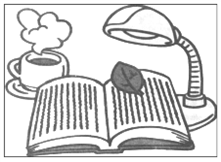
An English idiom says, "You can't teach an old dog new tricks." But scientists have discovered that
isn't true. Older people can learn, and they should, in order to keep their brain active. Now a new trend
has begun in several states in the US that encourages learning. Adults can attend One Day University.
They can spend a Saturday or Sunday hearing four 70-minute lectures. Each one is given by a top
university professor. One of the original participants said, "It's like a health club for the brain." Also,
universities like MIT have made all of their courses and lectures available online for free! Libraries offer
learning programs too. With so much available, there is no excuse not to learn!
 Learning is a habit.Don't leave it behind after you leave school. On the website lifehack.org, author
 Scott Young mentions several things to help you.
Always have a book. It doesn't matter if you read fast or slow. Just read.If you read just one book a
week, you'll read 52 over the course of a year. Think of the knowledge you'll gain!
Practice it. As you read, do something with what you've learned. Don't just enjoy the mental exercise.
Use the knowledge. If you read about painting, try it!
Make a "to learn" list. Compose a "to learn" list for yourself. Maybe you want to speak better English, play the piano, or cook French food. Whatever interests you, put it on your list and then make the time to do it. Teach others. Whatever you learn, teach someone else. You'll not only help others but also
understand what you've learned.

B. What you should do after leaving school.
C. Several tips on learning.
D. A new trend in learning.
B. Leaving learning behind is what you should do after a break.
C. You can relax as you have escaped from the hard life of studying.
D. You should have a good rest and then go on learning.
B. Two.
C. Three.

D. Four.
B. Always have a book.
C. List what you want to learn.
D. Teach others what you learn.
B. we should use the knowledge we have gained from books
C. we can gain every kind of knowledge through books
D. the main purpose of gaining knowledge is to teach others
B. love is one thing, and life is another
C. love in operas is truly touching
D. love can survive forever, though people die at different ages
B. he has a great way to promote his wife's love towards him
C. he has a false love for people even if the person is his wife
D. he loves his family members truly, whether they are in good conditions or not
B. criticizes the attitude of suspicion of the love
C. doesn't believe there is true love in the world
D. thinks the true love does not expect repayment
完形填空
Many people think advertisements are useful and helpful. But a man 1 said how useless it was to advertise.“Last week,”he said,“My umbrella was 2 from a London church. As it is 3 , I spent twice 4 much money in advertising, but did not 5 .”
“ 6 did you write your advertisement?”asked one of the 7 , a businessman.
“ 8 it is,”said the man, taking out of his pocket a piece 9 from a paper, which 10 ,“Lost from the city church last Sunday, a black 11 umbrella. The gentleman who 12 it will receive 5 pounds if he puts it 13 10 broad Street.”
The businessman said,“I often advertise and find it pays me 14 . But how it is 15 is of much 16 . Let's try again.“If it fails, I'll buy you one.”
Then the man wrote,“If the man who 17 to take an umbrella from the city church last Sunday evening 18 wish to get into trouble, he will return it to 10 Broad Street. He's well 19 .”
Soon this appeared in the paper. The next morning, the man was 20 when he opened the door and saw at 21 twelve umbrellas. His own was among them. Many had notes 22 to them,saying that 23 had been taken by mistake and 24 the loser not to say 25 about the matter.
1.
[ ]
A.ever B.still
C.once D.yet
2.
[ ]
A.stolen B.missing
C.disappeared D.taken
3.
[ ]
A.an object B.a thing
C.a present D.a tool
4.
[ ]
A.more B.than
C.so D.as
5.
[ ]
A.put it back B.hold it back
C.get it back D.keep it back
6.
[ ]
A.When B.Where
C.How D.What
7.
[ ]
A.lookers B.watchers
C.reporters D.listeners
8.
[ ]
A.So B.Here
C.As D.What
9.
[ ]
A.written B.broken
C.published D.cut
10.
[ ]
A.read B.wrote
C.meant D.explained
11.
[ ]
A.gold B.plastic
C.silk D.cotton
12.
[ ]
A.steals B.finds
C.owns D.repairs
13.
[ ]
A.on B.with
C.in D.at
14.
[ ]
A.nothing B.something
C.well D.little
15.
[ ]
A.said B.expressed
C.told D.explained
16.
[ ]
A.importance B.use
C.help D.care
17.
[ ]
A.had B.ought
C.was seen D.was made
18.
[ ]
A.won't B.shouldn't
C.didn't D.doesn't
19.
[ ]
A.paid B.known
C.said D.praised
20.
[ ]
A.surprised B.frightened
C.satisfied D.interested
21.
[ ]
A.all B.most
C.least D.best
22.
[ ]
A.written B.let
C.hung D.tied
23.
[ ]
A.they B.it
C.he D.there
24.
[ ]
A.begging B.warning
C.wanting D.telling
25.
[ ]
A.any longer B.any much
C.any more D.any thing
查看习题详情和答案>> Freda Bright says, "Only in opera do people die of love." It's true. You really can't love
somebody to death. I've known people to die from no love, but I've never known anyone
to be loved to death. We just can't love one another enough.
A heart-warming story tells of a woman who finally decided to ask her boss for a raise
in salary. All day she felt nervous and late in the afternoon she summoned the courage to
approach her employer. To her delight, the boss agreed to a raise.
The woman arrived home that evening to a beautiful table set with their best dishes.
Candles were softly glowing. Her husband had come home early and prepared a festive
meal. She wondered if someone from the office had tipped him off, or... did he just somehow
know that she would not get turned down?
She found him in the kitchen and told him the good news. They embraced and kissed, t
hen sat down to the wonderful meal. Next to her plate the woman found a beautifully
lettered note. It read, "Congratulations, darling! I knew you'd get the raise! These things
will tell you how much I love you."
Following the supper, her husband went into the kitchen to clean up. She noticed that
a second card had fallen from his pocket. Picking it off t he floor, she read, "Don't worry
about not getting the raise! You deserve(值得) it anyway! These things will tell you how
much I love you."
Someone has said that the measure of love is when you love without meas ure. What
this man feels for his wife is total acceptance and love, whether she succeeds or fails. His
love celebrates her victories and comforts her wounds. He stands with her, no matter what
life throws in their direction.
Upon receiving the Nobel Peace Prize, Mother Teresa said, "What can you do to
promote world peace? Go home and love your family." And love your friends. Love them
without measure.
B. Love is one thing, and life is another.
C. Love in operas is truly touching.
D. Love can survive forever, though people die at different ages.

B. he has a great way to promote his wife's love towards him.
C. he had a false love for people even if the person is his wife.
D. he loves his family member truly, whether they are in good condition or not.
B. c
 riticizes the attitude of doubt of love.
C. doesn't believe there is true love in the world.
D. thinks the true love does not expect repayment.
E
We might be surprised at the progress made in every field of study, but the methods of testing a person’s knowledge and ability remain as primitive as ever they were. It really is extraordinary that after all these years, educationists have still failed to design anything more efficient and reliable than examinations. For the claim that examinations test what you know, it is common knowledge that they more often do the exact opposite. They may be a good means of testing memory, or the knack(窍门) of working rapidly under extreme pressure, but they can tell you nothing about a person’s true ability and attitude.
As anxiety-makers, examinations are second to none. That is because so much depends on them. They are the marks of success or failure in our society. Your whole future may be decided in one fateful day. It doesn’t matter that you weren’t feeling very well, or that your mother died. Little things like that don’t count: the exam goes on. No one can give his best when he is in mortal terror, or after a sleepless night, yet this is precisely what the examination system expects him to do. The moment a child begins school, he enters a world of various competitions where success and failure are clearly defined and measured. Can we wonder at the increasing number of ‘drop-outs’: young people who are written off as failures before they have even started a career? Can we be surprised at the suicide rate among students?
A good education should, among other things, train you to think for yourself. The examination system does anything but that. What has to be learnt is rigidly laid down by a syllabus(教学大纲), so the student is encouraged to memorize. Examinations do not motivate a student to read widely, but to restrict his reading; they do not enable him to seek more and more knowledge, but induce cramming. They lower the standards of teaching, for they deprive(剥夺) the teacher of all freedoms. Teachers themselves are often judged by examination results and instead of teaching their subjects, they are reduced to training their students in exam techniques. The most successful candidates are not always the best educated; they are the best trained in the technique of working under pressure.
The results on which so much depends are often nothing more than a subjective assessment by some anonymous examiner. Examiners are only human. They get tired and hungry; they make mistakes. Yet they have to mark piles of hastily scrawled (潦草的)
scripts in a limited amount of time. They work under the same sort of pressure as the candidates. And their word carries weight. After a judge’s decision you have the right of appeal, but not after an examiner’s. There must surely be many simpler and more effective ways of assessing a person’s true abilities.
56.The main idea of this passage is _______.
A. examinations produce a harmful influence on education
B. examinations are ineffective
C. examinations are important to students’ development
D. examinations are a burden on students
57.The author’s attitude toward examinations is _______.
A. supportive B. neutral C. critical D. indifferent
58.The fate of students is decided by _______.
A. education B. examiners C. examinations D. students themselves
59.According to the author, the most important of a good education is _______.
A. to encourage students to read widely B. to train students to think on their own
C. to teach students how to deal with exams D. to master his fate
60.What does the author mean by saying “After a judge’s decision you have the right of appeal, but not after an examiner’s”(Para 4, Line 6) ?
A. Judges are not important.
B. The examiner has the final say concerning the result of the examination.
C. Prisoners are more powerful than students.
D. The court decisions are often inaccurate.