网址:http://m.1010jiajiao.com/timu3_id_3014368[举报]
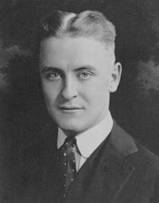 F. Scott Fitzgerald, born on September 24, 1896, an
American novelist, was once a student of St. Paul Academy, the Newman School and attended Princeton. University for a short while. In 1917 he joined the
army and was posted in Alabama, where he met his future wife Zelda Sayre. Then
he had to make some money to impress her.
F. Scott Fitzgerald, born on September 24, 1896, an
American novelist, was once a student of St. Paul Academy, the Newman School and attended Princeton. University for a short while. In 1917 he joined the
army and was posted in Alabama, where he met his future wife Zelda Sayre. Then
he had to make some money to impress her.
His life with her was full of great happiness, as he wrote in his diary:“ My own happiness in the past often approached such joy that I could share it even with the person dearest to me but had to walk it away in quiet streets and take down parts of it in my diary.”
This side of paradise, his first novel, was published in 1920. Encouraged by its success, Fitzgerald began to devote more time to his writing. Then he continued with the novel the Beautiful and Damned (1922), a collection of short stories Thales of the Jazz Age (1922), and a play The Vegetable (1923). But his greatest success was The Great Gatsby, published in 1925, which quick brought him praise from the literary world. Yet it failed to give him the needed financial security. Then, in 1926, he published another collection of short stories All the Sad Young Men.
However, Fitzgerald’s problems with his wife Zelda affected his writing. During the 1920s he tried to reorder his life, but failed. By 1930, his wife had her first breakdown and went to a Swiss clinic. During this period he completed novels Tender Is the Night in 1934 and The Love of the Last Tycoon in 1940. while his wife was in hospital in the United States, he got totally addicted to alcohol. Sheila Graham, his dear friend, helped him fight his alcoholism.
1.How many novels written by Fitzgerald are mentioned in the passage?
A. 5 B. 6 C. 7 D. 8
2.Which of the following is the correct order to describe Fitzgerald’s life according to the passage?
a. He became addicted to drinking.
b. He studied at St. Paul Academy.
c. He published his first novel This Side of Paradise.
d. The Great Gatsby won high praise.
e. He failed to reorder his life.
f. He joined the army and met Zelda.
A. f-c-e-a-b-d B. b-e-a-f-c-d C. f-d-e-c-b-a D. b-f-c-d-e-a
3.We can infer from the passage that Fitzgerald .
A. had made some money when he met Zelda in Alabama.
B. was well educated and well off before he served in the army
C. would have completed more works if his wife hadn’t broken down
D. helped his friend get rid of drinking while his wife was in hospital
4.The passage is probably followed by a concluding paragraph about .
A. Zelda’s personal life
B. Zelda’s illness and treatment
C. Fitzgerald’s friendship with Graham
D. Fitzgerald’s contributions to the literary world
查看习题详情和答案>>
It was the summer of 1936.The Olympic Games were being held in Berlin.I had trained, sweated and disciplined myself for 6 years on the running broad jump.A year before, as a college student at the Ohio State, I'd set the world's record of 26 feet 8 1/4 inches.Nearly everyone expected me to win.
I was in for a surprise.When the time came for the broad-jump trials(选拔赛), I was shocked to see a tall boy hitting the pit (坑) at almost 26 feet on his practice leaps.He turned out to be a German named Luz Long.He had easily qualified for the finals on his first attempt.
A nervous athlete is an athlete who will make mistakes.I fouled (犯规)twice on my qualifying jumps.Walking a few yards from the pit, I kicked at the dirt disgustedly.Suddenly I felt a hand on my shoulder.I turned to look into the friendly blue eyes of Luz Long."Hi, I'm Luz Long.I don't think we've met." "Glad to meet you," I said.Then, trying to hide my nervousness, I added, "How are you?" "I'm fine.Something must be eating you.You should be able to qualify with your eyes closed." He said.
He seemed to understand my nervousness, and took pains to reassure me.Finally, seeing that I had calmed down somewhat, he said, "What does it matter if you're not the first in the trials? Tomorrow is what counts." All the tension left my body as the truth of what he said hit me.Confidently I qualified with almost a foot to spare.
Luz broke his own record and pushed me on to a peak performance.The instant I landed from my final jump—the one which set the Olympic record of 26 feet 5 1/16 inches—he was at my side, congratulating me.
1.The author said "I was in for a surprise" because he _____.
A.beat Luz Long B.met a great competitor
C.qualified for the final D.joined in the Olympic Games
2.What can we learn about the author from the passage?
A.He remained confident in the Olympic Games.
B.He had qualified for the finals on his first attempt.
C.He broke the world record of the running broad jump.
D.He had prepared for Berlin Olympics in Ohio State.
3.What is the passage mainly about?
A.A memorable experience in the Olympics.
B.A reliable man in the Olympic Games.
C.A surprising result in the Olympic Games.
D.A good suggestion on how to win in the Olympics
查看习题详情和答案>>
President Barack Obama set out his plans for the nation on January 27. At the top of his to-do list: his jobs for Americans, health care and education.
“Although we have our difficulties, our union is strong. We do not give up. We do not stop,” President Barack Obama told American in his State of the Union speech on January 27. Guests and government officials filled the hall of the House of Representatives (众议院).
Obama looked back on his first year in office and explained his plan for the future. He dealt with important matters, including health care, the nation’ s high unemployment, national security (安全) and education. Many times during the 70-minute speech, people in the hall clapped (拍手) their hands happily.
The U.S. law system requires the President to report regularly to government officials. Presidents see the speech as an opportunity to set their goals and encourage the nation.
The President devoted much of his speech to the plight of unemployed (失业的) Americans. “Jobs must be our Number 1 focus (焦点) in 2010,” he said. “People are out of work. They are hurting.” Obama also stressed the value of education. “The best way for people to lead a better life is a first-class education.” he told the nation.
Following the President’s speech, the other party always gets the chance to speak. Bob McDonnell, the new governor of Virginia, spoke for Republicans (共和党人). He agreed with many of Obama’s goals, but pointed out policy difference. He tried to persuade both parties to work together. The President had made the same point earlier in the evening. He promised to hold monthly meetings with members of both parties. “Let’s show the American people,” he said, “that we can do it together.”
1.It can be inferred (推断) from the passage that Obama’s speech on January 27 __________.
|
A.was made to explain his plan for the future |
|
B.was welcomed by the government officials present |
|
C.was given to ask for foreign help |
|
D.was actually boring |
2.The underlined word “plight” in para. 5 probably means __________.
|
A.education |
B.safety |
|
C.goal |
D.sadness |
3.Which of the following things does Obama consider the most important in 2010?
|
A.Health care. |
B.Jobs. |
|
C.Education. |
D.National security. |
4.We can infer from the last paragraph that __________.
|
A.Republicans don’ t agree with Obama’ s goals |
|
B.Obama will try to cooperate with the other party |
|
C.Bob McDonnell was not clear about the two parties’ policy differences |
|
D.Republicans thought it difficult for the two parties to work together |
查看习题详情和答案>>
His first book next month is based on a true story.
A. published B. to be published C. to publish D. being published
查看习题详情和答案>>
| |||||||||||||||||||||||||||||||||||||||||||||||||||||||||||||||||||||||||||||||||||||||||||||||||||||||||||||||||||||||||||||||||||||||||||||||||||||||||||||||||||||||||||||||||||||||||||||||||||||||||||||||||||||||||||||||||||||||||||||||||||||||||||||||||||||||||||||||||||||||||||