网址:http://m.1010jiajiao.com/timu3_id_2663589[举报]
| |||||||||||||||||||||||||||||||||||||||||||||||||||||||||||||||||||||||||||||||||||||||||||||||||||||||||||||||||||||||||||||||||||||||||||||||
阅读短文并回答问题.
A young American doctor is sleeping when suddenly his doorbell begins to ring. It is midnight now, but what could the doctor do? He should get up, put on his coat and go downstairs(下楼).
When he opens the door, he sees a man standing with a hat in his hand. “Can you come at once to a place out of town? I can show you the way.” The man says. “Certainly.” says the doctor. After a few minutes the car is standing at the front door.
They are driving on for a long time. Then the man says, “Here we are. This is my home. Now I can pay you and you can go back to town.”
“What?” The doctor asks.
“You see, there are no taxis at this time of the night, but a doctor often makes night calls, so excuse me. Here is your money. Thank you, doctor. Good night.”
1.What does the man ask the doctor to do?
2.Ts the man ill?
3.Is the doctor happy at last?
查看习题详情和答案>>What do you do if you're stranded(处于困境的)on a lonely island? Surely you need to find a way to get in touch with the outside world. Your best chance of doing this is to draw the attention of a passing plane.
Body signals(信号)
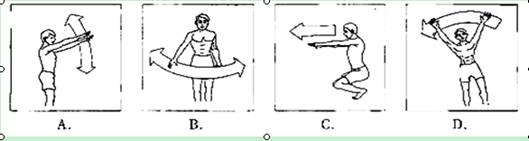
Pilots from different countries understand body signals if they have the correct training. When you wave your arms up and down in a straight line, it means "yes". When you point downwards and swing your arm from side to side, it means "no". If you want the pilot to know that it's safe to land, push your hands out in front of you and bend(弯曲)your knees. If you want to say that it's not safe to land, put your arms in the air and move them to one side.
Smoke signals
The smoke from a fire can be seen from far away, so it's a good way to draw attention. If the weather is dry, it isn't hard to start a fire. Remember, however, that fires can be very dangerous if they get out of control. Never light a fire unless you're sure that it can't spread. If the ground is dark, light smoke can be seen more easily. Green grass and leaves produce light smoke.
Ground-to-air signals
It's a good idea to build some signals, too. Use large pieces of wood to make the symbols(标记). If you can't find any wood, use earth. Some useful symbols are:
F "I need food and water."
II "I need medicine."
I "I am badly hurt."
X" I am unable to move from here."
Pilots' replies
If the pilot lowers the plane's wings from side to side, this means "message received and understood". (At night, the pilot flashes the plane's green lights.) If the pilots flies the plane in a clockwise circle, this means "message received but not understood".(At night, the pilot flashes the plane's red lights.)
However, there is no signal which means "message not received". Why not?
1. Which picture means "it's not safe land"?
2. What can we learn from the passage?
A. Swinging your arm from side to side means "yes".
B. If the ground is dark, light smoke can't be seen.
C. If you need some medicine, make a symbol "II".
D. The pilots make replies with a blue light at night.
3. What is the passage mainly about?
A. The explanation of building signals on an island.
B. The importance of making signals on an island.
C. Ways of sending out signals on a lonely island.
D. Ways of receiving signals from a lonely island
查看习题详情和答案>>
A thousand years ago Hong Kong was covered by a thick forest. As more and more people came to 31 in Hong Kong, these trees were cut down and burnt. Now there is 32 forest left, though there are still some small areas covered with trees. We call these woods.
Elephants, tigers and many 33 animals were living in the thick forest. When people came to live in Hong Kong, the 34 began to die out. Early farmers grew rice and 35 pigs and chickens in the valleys. They cut down the trees and burnt them. They needed 36 to keep themselves warm in winter, to cook their food and to keep away the dangerous animals. Elephants quickly disappeared because there was not enough food for them. 37 did most of the wolves and tigers. Monkeys and many other animals soon 38 in the same way.
You might think that there are no longer any animals in Hong Kong 39 in the zoos. But there are still about 36 different animals 40 there. One of the most interesting of Hong Kong's animals is the barking deer. These are beautiful little animals 41 a rich brown coat and a white patch (补丁) under the tail. They look like deer but they are much smaller. They are less than two feet 42 . They make a noise rather like a dog 43 . In Hong Kong the barking deer has only a real enemy-- 44 . People hunt these little animals though it is illegal (违法的). There are now not many barking deer left. So it is important 45 people to protect wild animals.
| 【小题1】 |
|
| 【小题2】 |
|
| 【小题3】 |
|
| 【小题4】 |
|
| 【小题5】 |
|
| 【小题6】 |
|
| 【小题7】 |
|
| 【小题8】 |
|
| 【小题9】 |
|
| 【小题10】 |
|
| 【小题11】 |
|
| 【小题12】 |
|
| 【小题13】 |
|
| 【小题14】 |
|
| 【小题15】 |
|
| |||||||