网址:http://m.1010jiajiao.com/timu3_id_2661888[举报]
What do you usually do to get pocket money from your parents? In western countries, many children do chores to get pocket money. They usually start to do this at 10 years old.
School students have to do homework and study for tests. They don’t have a lot of free time in the week. They often do chores at the weekend.
Young kids only do easy chores. So they don’t get much money. But that’s all right. Many of them only want to buy candy. And candy is cheap! They help wash up after dinner and feed the family cat or dog.
When they get older, kids want to buy more and more things. They want things that are more expensive than candy. Then they have to work harder! They often wash the family car, cut the grass, walk the dog and cook dinner.
Some jobs are a good way for kids to learn new things. For example, they can learn to use a lawnmower(割草机) or how to cook. Of course, their parents help them at first.
【小题1】How do the children in western countries get pocket money?
【小题2】When do they usually start to get pocket money?
【小题3】Why do the school students usually do chores at the weekend?
【小题4】Why do the elder kids have to work harder?
【小题5】How do they do the chores at the beginning?
What do you usually do to get pocket money from your parents? In western countries, many children do chores to get pocket money. They usually start to do this at 10 years old.
School students have to do homework and study for tests. They don’t have a lot of free time in the week. They often do chores at the weekend.
Young kids only do easy chores. So they don’t get much money. But that’s all right. Many of them only want to buy candy. And candy is cheap! They help wash up after dinner and feed the family cat or dog.
When they get older, kids want to buy more and more things. They want things that are more expensive than candy. Then they have to work harder! They often wash the family car, cut the grass, walk the dog and cook dinner.
Some jobs are a good way for kids to learn new things. For example, they can learn to use a lawnmower(割草机) or how to cook. Of course, their parents help them at first.
1.How do the children in western countries get pocket money?
2.When do they usually start to get pocket money?
3.Why do the school students usually do chores at the weekend?
4.Why do the elder kids have to work harder?
5.How do they do the chores at the beginning?
查看习题详情和答案>>
What do you do in a situation like this? You’re calling dinner with friends at a nice restaurant. You’re having a great time when a phone rings at the table next to you. A man takes out his phone and starts talking loudly about problems he’s having with his girlfriend. He talks for almost ten minutes! This happens all the time-on buses, in restaurants, everywhere!
Many people find cell phones useful in their daily lives. But we’ve all sat next to someone talking too loudly on a cell phone. You may want to tell the loudmouth to end the conversation, but let the management take care of those noisy customers. You can only control your own behavior. Here are a few rules:
Off means off! Follow the rules of restaurants and other public places. If a sign says “turn off cell phones”, don’t use your phone. If you are allowed, speak softly and for a short time and try to move away form other people.
Lights off, phone off! Never make calls in a theater or at the movies.
Pay attention! Talking on a cell phone while driving is dangerous. And watch where you’re going when you’re walking down the streets and talking on the phone.
As more people use cell phones, things are only going to get worse. So, the next time you’re getting ready to make a call, stop and consider the people around you.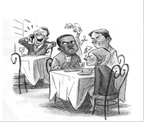
【小题1】 The man talking on the cell phone loudly in the restaurant will ________.
| A.talk for half an hour | B.pay more for his meal |
| C.make other customers angry | D.be driven out by the boss |
| A.they don’t consider the people around them |
| B.some public places allow them to do so |
| C.they are proud of having cell phones |
| D.cell phones are common and available everywhere |
| A.in restaurants | B.on buses |
| C.at the movies | D.on the street |
| A.cell phones have become the most useful tool in our life |
| B.public manners play an important role in our life |
| C.cell phones lead to people’s bad relationship |
| D.people ought to turn cell phones off in a public places |
School students have to do homework and study for tests. They don’t have a lot of free time in the week. They often do chores at the weekend.
Young kids only do easy chores. So they don’t get much money. But that’s all right. Many of them only want to buy candy. And candy is cheap! They help wash up after dinner and feed the family cat or dog.
When they get older, kids want to buy more and more things. They want things that are more expensive than candy. Then they have to work harder! They often wash the family car, cut the grass, walk the dog and cook dinner.
Some jobs are a good way for kids to learn new things. For example, they can learn to use a lawnmower(割草机) or how to cook. Of course, their parents help them at first.
小题1:How do the children in western countries get pocket money?
小题2:When do they usually start to get pocket money?
小题3:Why do the school students usually do chores at the weekend?
小题4:Why do the elder kids have to work harder?
小题5:How do they do the chores at the beginning?
What do you do at weekends? Some people like to 1 at home, but others like to go for a walk 2 have a picnic(野餐). My friend Jack works hard in a factory(工厂) during the 3 . At weekends he always 4 the same thing. On Saturday he 5 his car and on 6 he takes his family to a nearby(附近的)village. His uncle and aunt have a farm(农场) there. It isn't a 7 One ,but there are always 8 things to do. The children help with the animals and give them some 9 . Jack and his wife work in the fields. At the end of the day, they are all tired but 10 , and Jack's aunt cooks a big dinner for them.
1. A. go B. live C. stay D. like
2. A. and B. or C. but D. so
3. A. day B. Time C. Autumn D. weekdays
4 .A. does B. makes C. borrows D. has
5. A. watches B. drives C. sells D. washes
6. A. Monday B. Sunday C. Saturday D. Wednesday
7. A. small B. big C. hard D. short
8. A. much B. many C. fast D. far
9. A. clothes B. places C. food D. water
10. A. clean B. happy C. angry(生气) D. friendly
查看习题详情和答案>>