网址:http://m.1010jiajiao.com/timu3_id_2660107[举报]
阅读短文,根据短文内容完成表格,每空一词
I have always loved cars. After graduating from college, I got one, which I regarded as(把……当作)my favorite friend.I called it Victor. For the next three years, everything I did was connected with(与……有关)Victor. I lived a happy life. But because of money problems, I had to sell Victor. Then my life broke down. Without Victor, I was like a fish out of water. Three months later, with the encouragement of my friends, I decided to start a new life. I tried and made it. Everything went well again. Losing my car made me grow up. I have learned that life won’t always go our way, but we can chose to be positive(积极的)and make the best of it.
|
1 of the car |
Victor |
|
Time of getting the car |
2 graduating from college |
|
Reason for 3 the car to someone |
Because of money problems |
|
Feelings of losing the car |
Like a fish out of 4 |
|
Improvement from the experience |
5 won’t always go our way. We can be positive. |
查看习题详情和答案>>
阅读理解
上星期,戴维得和他同事在第一中学调查了该校学生收看电视的情况。以下是他们所做的两份调查表。
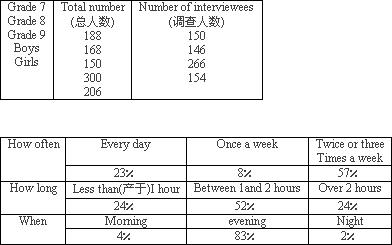
根据调查表内容,补全戴维得的调查报告
Last Monday, we made a student television viewing habit survey in No.1 Middle School.There are 1 boys and 2 girls in the school.We asked 3 students about their television viewing habits. 4 are boys and 5 are girls.When asked how often they watch TV, 6 of the students said that they watch TV every day, and 57% of the students said that they watch TV 7 .When asked how many hours they watch TV each time, 8 of the students said that they watch TV over two hours.When asked when they often watch TV, 83% of the students said they watch TV 9 , 10 of the students said that they watch TV in the morning or at night.Most students like watching TV when they are free.
| |||||||||||||||||||||||||||||||||||||||||||||||||||||||||||||||||||||||||||||||||||||||||||||||||||||||||||||||||||||||||||||||||||||||||||||||
| |||||
“Sorry” is a word that people in Britain often say in their daily life.
One day while I was w 1 on the street, a young man ran by hurriedly, brushing(轻擦)against my handbag. He continued his way, but turned b 2 and said “sorry” to me. Even in a rush, he didn’t f 3 to say “sorry”. One day, after I bought some bananas, the shopkeeper was passing me the change, but I wasn’t ready for it and a coin dropped onto the ground. “Sorry, Madam,” he said w 4 bending to pick it up. I was s 5 why he said “sorry” to me. Another time, I stepped on a man’s f 6 at the entrance to a cinema. At the same time, we b 7 said “sorry”.
Slowly, I got to know that when something unpleasant happens in daily life, the British don’t
c 8 much about who is wrong. If someone is in trouble, a “sorry” is always n 9 . Perhaps that is w 10 I seldom see people quarrel on the buses or streets in Britain.
查看习题详情和答案>>