网址:http://m.1010jiajiao.com/timu3_id_2599136[举报]
Many cities have slogans (宣传标语) to attract you to visit and spend your tourist money. These are
usually written by a travel agency, and no matter how clever or well thought out, they often fall on the deaf ears of experienced travelers. But there are proverbs that are time-tested-like this one, which translates
to: Up in the sky there is heaven, down on earth there is Suzhou and Hangzhou.
That's a pretty bold declaration (宣言) when you consider the size of China and the many beautiful
places to see within its borders. Yet, Suzhou's beauty has won it boasting (自夸) rights.
Suzhou, built in 514 BC, has a storied past. Marco Polo spent time there in 1276 while on the Silk
Road. Sun Tzu wrote The Art of War in Suzhou when it was the kingdom of Wu.
While famous for its gardens, Suzhou has long been inspirational to artists, musicians and craftsmen.
There is far more to Suzhou than its gardens - respect for art, just for starters.
There is a peaceful air that reflects the spirit of the area. You can see that it is a city trying to remain
very livable and keep its beauty even as it grows.
Perhaps it's the smiles you see on the streets, or maybe the way they take care of the elderly in the
city. Maybe it is the way they promote art and culture as the government provides studio space for artists
to work on their traditional skills - or it could be that there are pockets of beauty all over the city.
You don't have to go far to find one of these to escape the honking horns (汽车喇叭响) or the
electric bikes, and find your own little piece of Heaven on Earth.
B. are noticed
C. are paid much attention to
D. are understood
B. A travel agency wrote the slogan.
C. It matches reality.
D. It is meaningless.
B. its convenient facilities
C. the beautiful gardens in the city
D. the atmosphere and spirit of the city.
B. Drivers are not allowed to honk in Suzhou.
C. Its has a history of over 2000 years.
D. The large number of tourist visitors has affected its culture.
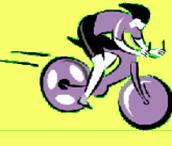 Bicycles are a great way to get around. They’re fun to ride, especially down hills. And, as you speed along the road, you might also think of ways in which you could improve your bike— make it safer, more efficient, or more comfortable. In fact, the two-wheeled machines make for some cool science projects.
This year's Intel International Science and Engineering Fair (ISEF), held last May in Cleveland, featured(had)three bicycle projects from three countries. Like many of the other experiments presented at ISEF, the bike projects showed that some of the most interesting scientific research often begins by taking a closer look at things you care about.
Renato Angulo Chu had even grander ambitions. The 12th-grader from Lima, Peru, wanted to address some of his country's economic troubles.
"I see a problem in my country," Renato said. "If you go to the forests in Peru, in some places you cannot find electricity. If you go with my bicycle, you can turn on the lights."
Renato, 16, spent 3 years designing his special Multibike. The device looks like a fixed exercise bike. It has wires fixed along the frame and a blender strapped(fastened) to the back. Turning the pedals operates the blender. The same principle can be used to sharpen knives or sweep city streets.
The Multibike can work either as a fixed bike or as a bicycle able to travel city streets and country roads. It's made from inexpensive materials, and the user gets exercise while pedaling to operate a machine.
"You pedal the bike, and you can mix any drink you want," Renato said. More importantly, he added, the same concept could be used to bring light to houses in remote regions of the rainforest.
19. What can we learn from the first paragraph?
A. Bicycles are the best way to go about
B. Bikes should be made more comfortable to ride.
C. You can improve your bicycle for science research.
D. Many inventions are connected with the bicycle.
20. Which of the following is true according to the passage?
A. ISEF is an exhibiton displaying bicycle experiments designed by students.
B. Looking closely at things you are concerned about can lead to scientific research.
C. Renato’s improvement of the bicycle has solved the country’s great problem.
D. Renato’s special bicycle will soon be put into use in remote areas.’
21. The underlined word “address” in the third paragraph probably has the same meaning as _______.
A. make address written B. give up C. work at D. speak at
22. Renato’s special Multibike has all the following EXCEPT ________.
A. making knives sharp B. mixing any kind of drinks
C. producing electricity D. operating a machine with its own electricity
23. It can be inferred that Renato’s special bicycle is mainly designed for ________.
A. distant areas in the rainforest without electricity.
B. the use of his own family to make life easier.
C. the competition of ISEF to win money to support remote rainforests
D. enough exercise by pedaling it
查看习题详情和答案>>To enjoy the scenery, Irene would rather spend long hours on the train _____ travel by air.
- A.as
- B.to
- C.than
- D.while
The thought of going back home was_______kept him happy while he was working abroad.
A.that B.all that C.all what D.Which
查看习题详情和答案>>Professor Barry Wellman of the University of Toronto in Canada has invented a term to describe the way many North Americans interact these days. The 1 is "networked individualism". This concept is not 2 to understand because the words seem to have opposite meanings. How can we be individuals and be networked 3 ? You need other people for 4 .
Here is 5 Professor Wellman means. 6 the invention of the Internet and email, our social networks 7 live interactions with relatives, neighbors and colleagues at work. Some of the _8 was by phone, but it was still voice to voice, person to person, in 9 time.
A recent 10 by the Pew Internet and American Life Project 11 that for a lot of people, electronic interaction through the computer has 12 the person-to-person interaction. However, a lot of people interviewed for the Pew's study 13 that's a good thing. Why?
In the past , many people were 14 that the Internet isolated (孤立) us and caused us to _15 too much time in the imaginary world of the computer. But the Pew's study discovered that the _16 is true. The Internet 17 us with more real people than expected -- 18 people who can give advice on careers, medical problems, raising children, and choosing a school or college. About 60 million Americans told Pew that the Internet 19 an important role in helping them make major life decisions.
Thanks to the computer, "networked individuals" are able to be 20 and together with other people -- at the same time!
1. A. saying B. term C. concept D. meaning
2. A. difficult B. different C. easy D. surprising
3. A. at the same time B. at once C. all the time D. once in a while
4. A. job B. food C. help D. networks
5. A. what B. how C. where D. which
6. A. After B. With C. Before D. As
7. A. included B. contained C. formed D. affected
8. A. appointment B. interaction C. invitations D. doings
9. A. true B. right C. wrong D. real
10. A. experiment B. study C. interview D. work
11. A. showed B. suggested C. learned D. added
12. A. ensured B. removed C. replaced D. exchanged
13. A. say B. discuss C. talk D. speak
14. A. excited B. surprised C. shocked D. worried
15. A. take B. spend C. cost D. stay
16. A. opposite B. thing C. outcome D. effect
17. A. connects B. offers C. shares D. informs
18. A. thankful B. considerate C. helpful D. friendly
19. A. finds B. plays C. catches D. possesses
20. A. united B. social C. separated D. alone
查看习题详情和答案>>