网址:http://m.1010jiajiao.com/timu3_id_2595761[举报]
SECTION B(10分)
Directions: Read the following passage.Answer the questions according to the information given in the passage and the required words limit.Write your answers on your answer sheet.
In a time of low academic achievement by children in the United States, many Americans are turning to Japan, a country of high academic achievement, for possible answers. However, the answers provided by Japanese preschools are not the ones Americans expected to find. In most Japanese preschools, surprisingly little emphasis is put on academic instruction. In one investigation, 300 Japanese and 210 American preschool teachers, child development specialists, and parents were asked about various aspects of early childhood education. Only 2 percent of the Japanese respondents (答问卷者)listed "to give children a good start academically" as one of their top three reasons for a society to have preschools. In contrast, over half the American respondents chose this as one of their top three choices. To prepare children for success full careers in first grade and beyond, Japanese schools do not teach reading, writing, and math emetics, but rather skills such as persistence, concentration, and the ability to function as a member of a group. The vast majority of young Japanese children are taught to read at home by their parents.
In the recent comparison of Japanese and American preschool education, 91 percent of Japanese respondents chose providing children with a group experience as one of their top three reasons for a society to have preschools. Sixty-two percent of the more individually oriented (强调个性发展的) Americans listed group experience as one of their top three choices. An emphasis on the importance of the group seen in Japanese early childhood education continues into elementary school education.
Like in America, there is diversity in Japanese early childhood education. Some Japanese kindergartens have specific aims, such as early musical training or potential development. In large cities, some kindergartens are attached to universities that have elementary and secondary schools. Some Japanese parents believe that if their young children attend a university-based program, it will increase the children’s chances of eventually being admitted to top-rated schools and universities. Several more progressive programs have introduced free play as a way out for the heavy intellectualizing in some Japanese kindergartens.
81.What’s the main reason for many American parents sending their children to preschools in Japan? (no more than 11 words)
_____________________________________________________________________________
82.Who teach the Japanese preschool children to read mostly? (no more than 2 words)
_____________________________________________________________________________
83.List three qualities that Japanese preschools encourage in their kids. (no more than 13 words)
_____________________________________________________________________________
84.According to the last paragraph, what problem do some Japanese kindergartens have? (no more than 3 words)
_____________________________________________________________________________
查看习题详情和答案>>
SECTION B
Directions: Read the following passage.Answer the questions according to the information given in the passage and the required words limit.Write your answers on your answer sheet.
In a time of low academic achievement by children in the United States, many Americans are turning to Japan, a country of high academic achievement, for possible answers.However, in most Japanese preschools, surprisingly little emphasis is put on academic instruction.In one investigation, 300 Japanese and 210 American preschool teachers, child development specialists, and parents were asked about various aspects of early childhood education.Only 2 percent of the Japanese respondents (答问卷者)listed "to give children a good start academically" as one of their top three reasons for a society to have preschools.In contrast, over half the American respondents chose this as one of their top three choices.To prepare children for successful careers in first grade and beyond, Japanese schools do not teach reading, writing, and mathematics, but rather skills such as persistence, concentration, and the ability to function as a member of a group.The vast majority of young Japanese children learn to read at home with their parents.
In the recent comparison of Japanese and American preschool education, 91 percent of Japanese respondents chose providing children with a group experience as one of their top three reasons for a society to have preschools.Sixty-two percent of the more individually-oriented (强调个性发展的) Americans listed group experience as one of their top three choices.An emphasis on the importance of the group seen in Japanese early childhood education continues into elementary school education.
Like in America, there is diversity in Japanese early childhood education.Some Japanese kindergartens have specific aims, such as early musical training or potential development.In large cities, some kindergartens are attached to universities that have elementary and secondary schools.Some Japanese parents believe that if their young children attend a university-based program, it will increase the children's chances of eventually being admitted to top-class schools and universities.Several progressive programs have introduced free play as a way out for the heavy intellectualizing in some Japanese kindergartens.
81.What’s the main reason for many American parents sending their children to preschools in Japan? (no more than 11 words)
_______________________________________________________________________________________________
82.Who teach the Japanese preschool children to read mostly? (no more than 2 words)
______________________________________________________________________________________________
83.List three qualities that Japanese preschools encourage in their kids.(no more than 13 words)
______________________________________________________________________________________________
84.According to the last paragraph, what problem do some Japanese kindergartens have? (no more than 3 words)
___________________________________________________________________________________________
查看习题详情和答案>>SECTION B
Directions: Read the following passage.Answer the questions according to the information given in the passage and the required words limit.Write your answers on your answer sheet.
In a time of low academic achievement by children in the United States, many Americans are turning to Japan, a country of high academic achievement, for possible answers. However, the answers provided by Japanese preschools are not the ones Americans expected to find. In most Japanese preschools, surprisingly little emphasis is put on academic instruction. In one investigation, 300 Japanese and 210 American preschool teachers, child development specialists, and parents were asked about various aspects of early childhood education. Only 2 percent of the Japanese respondents (答问卷者)listed "to give children a good start academically" as one of their top three reasons for a society to have preschools. In contrast, over half the American respondents chose this as one of their top three choices. To prepare children for success full careers in first grade and beyond, Japanese schools do not teach reading, writing, and math emetics, but rather skills such as persistence, concentration, and the ability to function as a member of a group. The vast majority of young Japanese children are taught to read at home by their parents.
In the recent comparison of Japanese and American preschool education, 91 percent of Japanese respondents chose providing children with a group experience as one of their top three reasons for a society to have preschools. Sixty-two percent of the more individually oriented (强调个性发展的) Americans listed group experience as one of their top three choices. An emphasis on the importance of the group seen in Japanese early childhood education continues into elementary school education.
Like in America, there is diversity in Japanese early childhood education. Some Japanese kindergartens have specific aims, such as early musical training or potential development. In large cities, some kindergartens are attached to universities that have elementary and secondary schools. Some Japanese parents believe that if their young children attend a university-based program, it will increase the children’s chances of eventually being admitted to top-rated schools and universities. Several more progressive programs have introduced free play as a way out for the heavy intellectualizing in some Japanese kindergartens.
81.What’s the main reason for many American parents sending their children to preschools in Japan? (no more than 11 words)
_____________________________________________________________________________
82.Who teach the Japanese preschool children to read mostly? (no more than 2 words)
_____________________________________________________________________________
83.List three qualities that Japanese preschools encourage in their kids. (no more than 13 words)
_____________________________________________________________________________
84.According to the last paragraph, what problem do some Japanese kindergartens have? (no more than 3 words)
_____________________________________________________________________________
查看习题详情和答案>>About 90 percent of Chinese believe the polarization between the rich and poor is "serious" in China, according to a survey conducted by China Youth Daily. And more than 80 per cent of the respondents surveyed said something must be done to narrow the expanding gap between the rich and poor, while 14.1 per cent said it was unnecessary.
The polarization has aroused wide concern among the public in recent years. The State Development and Reform Commission (国家发改委) said the Gini Coefficient had reached 0.47 for China, up from 0.29 two decades ago. Usually, a country with a ratio exceeding 0.4 is warned to pay more attention to the inequality issue.
To find out the people's view, the survey covered 10,250 respondents, between the ages of 20 and 30 with a college education and a monthly salary between 1,000 and 3,000 yuan. Surprisingly, most disagreed with the view of experts who claim the urban-rural disparity is causing the widening gap. More than 70 per cent of the respondents believed that "the group of special interests" is the prime reason for the polarization. Followed by "people in power" 68 percent, and "bosses" 50 per cent.
Another unexpected finding almost all agreed that a good educational background and knowledge were not the decisive factors in gaining wealth. About 95 per cent said rich people are not necessarily those who are able to speak English or have a college education.
Today in China, rich people, accounting for 10 per cent of the population, control 45 per cent of the total social fortune, and poor people, also 10 per cent of the population, only control 1.4 per cent, according to an investigation published by the National Bureau of Statistics last June.
1.It can be inferred that the Gini Coefficient (in Paragraph 2) would probably be____.
A.a unit used in advanced mathematics
B.the degree of a country’s development
C.the level of the citizen’s living standard
D.a measure of income inequality
2.Experts hold the view that the main reason for the polarization is____.
A.the urban-rural difference B.the group of special interests
C.the people in power D.the bosses
3.Which of the following can show the correct proportion of the social fortune among population?
A.Rich people control 45 per cent of the total social fortune, while poor people 1.4 percent.
B.14.1 per cent of the total social fortune was controlled by poor people.
C.More than 70 per cent of the rich people control the 68 per cent of the total social fortune.
D.Rich people control 95 per cent of the total social fortune.
4.Which statement is correct according to the text?
A.The total social fortune of the rich is more than that of the other population.
B.Not all respondents surveyed thought it necessary to close the gap between the rich and poor.
C.the respondents surveyed have the same view as the experts.
D.Those who can speak English and have a college education can easily become rich.
5.What’s the best title of the passage?
A.Close the gap between the rich and poor.
B.Survey conducted by China youth Daily.
C.Higher education , higher pay.
D.Rich-poor divide serious, study finds.
查看习题详情和答案>>About 90 percent of Chinese believe the polarization(分化) between the rich and poor is “serious” in China, according to a survey conducted by China Youth Daily. And more than 80 percent of the respondents(对象) surveyed said something must be done to narrow the expanding gap between the rich and poor, while 14.1 percent said it was necessary.
The polarization has aroused wide concern among the public in recent years. The State Development and Reform Commission(国家发改委) said the Gini Coefficient had reached 0.47 for China, up from o.29 two decades ago. Usually, a country with a number above 0.4 is warned to pay attention to the income inequality problem.
To find out the people’s view, the survey covered 10,250 respondents, between the ages of 20 and 30 with a college education and a monthly salary between 1,000 and 3,000 yuan. Surprisingly, most disagreed with the view of experts who claim the urban-rural difference is causing the widening gap. More than 70 percent of the respondents believed that “ the group of special interests” is the prime reason for the polarization, followed by “people in power” 68 percent, and “bosses” 50 percent.
Another unexpected finding is that almost all agreed that a good educational background and knowledge were not the decisive factors in gaining wealth. About 95 percent said rich people are not necessarily those who are able to speak English or have a college education.
Today in China, rich people , accounting for 10 percent of the population, control 45 percent of the total social fortune, and poor people, also 10 percent of the population, only control 1.5 percent, according to an investigation published by the National Bureau of Statistics last June.
It can be inferred that the Gini Coefficient ( in paragraph 2) would probably be _____.
A. the unit used in advanced mathematics
B. the degree of a country’s development
C. the level of the citizen’s living standard
D. a measure of income inequality
Experts hold the view that the main reason for the polarization is _____.
A. the urban-rural difference B. the group of special interests
C. the people in power D. the bosses
Which of the following can show the correct proportion(比例) of the social fortune among population?
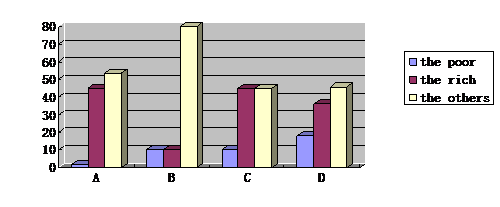
What’s the best title of the passage?
A. Close the Gap between the Rich and Poor
B. Surveys conducted by China Youth Daily
C. Higher education, Higher pay
D. Rich-Poor Divide Serious, Study Finds
查看习题详情和答案>>