网址:http://m.1010jiajiao.com/timu3_id_2589217[举报]
D
Recently there was a major discovery in the scientific research—the mapping of all DNA in a human gene(基因) is complete.Couple of years ago, this seems an impossible task for scientist to accomplish.All this progress in science leads us to believe that the day, when the human being will be cloned, is not far away.Human cloning has always been a topic of argument, in terms of morality or religion.
Taking a look at why cloning might be beneficial, among many cases, it is arguable that parents who are known to be at risk of passing a genetic limitation to a child could make use of cloning.If the clone was free of genetic limitations.then the other clone would be as well.The latter could foe inserted in the woman and allowed to ripen to term.Moreover, cloning would enable women, who can't get pregnant, to have children of their own.
Cloning humans would also mean that organs could be cloned, so it would be a source of perfect transfer organs.This, surely would be greatly beneficial to millions of unfortunate people around the world that are expected to lose their lives due to failure of single (or more) organ (s).It is also arguable that a ban on cloning may be unlawful and would rob people of the right to reproduce and limit the freedom of scientists.
Arguments against cloning are also on a perfectly practical side.Primarily, I believe that cloning would step in the normal "cycle" of life.There would be a large number of same genes, which reduce the chances of improvement, and, in turn, development—the fundamental reason how living things naturally adapt to the ever-changing environment.Life processes failing to do so might result in untimely disappearance.Furthermore, cloning would make the uniqueness that each one of us possesses disappear.Thus, leading to creation of genetically engineered groups of people for specific purposes and, chances are, that those individuals would be regarded as "objects" rather than people in the society.
Scientists haven't 100 per cent.guaranteed that the first cloned humans will be normal.Thus this could result in introduction of additional limitations in the human "gene-pool".
Regarding such arguable topics in "black or white" approach seems very innocent to me personally.We should rather try to look at all "shades" of it.I believe that cloning is only legal if its purpose is for cloning organs; not humans.Then we could regard this as for "saving life" instead of "creating life".I believe cloning humans is morally and socially unacceptable.
67.Which of the following is true according to the passage?
A.Genetic limitation will be beneficial for some women.
B.A large number of genes will prevent us from developing.
C.Prohibition of cloning might limit the freedom of scientists.
D.First cloned humans might be normal according to scientists.
68.What's the author's opinion on cloning?
A.Cloning should be entirely banned.
B.Cloning should be used in creating life.
C.Cloning will take away the right to reproduce.
D.Cloning is acceptable if it is used for cloning organs.
69.Where can you read this article?
A.In a story book.
B.In a magazine.
C.In a science fiction.
D.In a brochure.
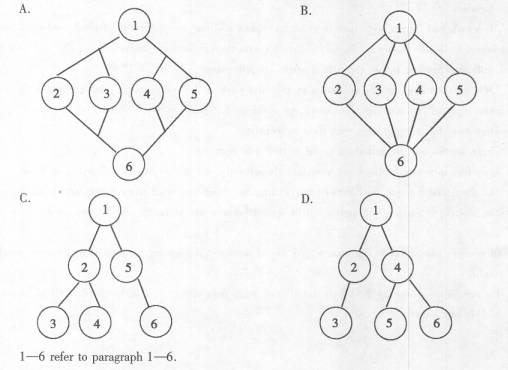
70.Which of the following shows the structure of the passage?
D
Recently there was a major discovery in the scientific research—the mapping of all DNA in a human gene(基因)is complete.Couple of years ago,this seems an impossible task for scientist to accomplish.All this progress in science leads us to believe that the day,when the human being will be cloned,is not far away.Human cloning has always been a topic of argument,in terms of morality or religion.
Taking a look at why cloning might be beneficial,among many cases,it is arguable that parents who are known to be at risk of passing a genetic limitation to a child could make use of cloning.If the clonc was free of genetic limitations。Then the other clone would be as well.The latter could foe inserted in the woman and allowed to ripen to term.Moreover,cloning would enable women,who can’t get pregnant,to have children of their own.
Cloning humans would also mean that organs could be cloned,so it would be a source of perfect transfer organs.This,surely would be greatly beneficial to millions of unfortunate peoplearound the world that are expected to lose their lives due to failure of single(or more) organ
(s).It is also arguable that a ban on cloning may be unlawful and would reb pepole of the right to reproduce and limit the freedom of scientists.
Arguments against cloning are also on a perfectly practical side.Primarily,I believe that cloning would step in the normal “cycle”of life.There would be a large number of same genes.,which reduce the chances of improvement,and,in turn,development-the fundamental reason how living things naturally adapt to the ever-changing environment. Life processes failing to do so might result in untimely disappearance.Futhermore,cloning would make the uniqueness that each one of us possesses disapparance.Thus,leading to creation of genetically engineered groups of people for specific purposes and,chances are,that those individuals would be regarded as “objects”rather than people in the society.
Scientists haven’t 100 percent. guaranteed that the first cloned will be normal.Thus this could result in introduction of additional limitations in the human “gene-pool”.
Regarding such arguable topics in “black or white” approach seems very innocent to me personally.We should rather try to look at all “shades:of it.I believe that cloning is only legal if its purpose is for cloning organs,not humans.Then we could regard this as for “saving life”instead of “creating life”.I believe cloning humans is morally and socially unacceptable.
67.Which of the following is true according to the passage?
A.Genetic limitation will be beneficial for some women
B.A large number of genes will prevent us from developing
C.Prohibition of cloning might limit the freedom of scientists
D.First cloned humans might be normal according to scientists
68.What’s the author’s oponion on cloning?
A.Cloning should be entirely banned
B. Cloning should be used in creating life
C. Cloning will take away the right to reproduce
D. Cloning is acceptable if it is used for cloning organs
69.Where can you read this article?
A.In a story book
B.In a magazine
C.In a science fiction
D.In a brochure
70.Which of the following shows the structure of the passage

D
Recently there was a major discovery in the scientific research—the mapping of all DNA in a human gene(基因) is complete.Couple of years ago, this seems an impossible task for scientist to accomplish.All this progress in science leads us to believe that the day, when the human being will be cloned, is not far away.Human cloning has always been a topic of argument, in terms of morality or religion.
Taking a look at why cloning might be beneficial, among many cases, it is arguable that parents who are known to be at risk of passing a genetic limitation to a child could make use of cloning.If the clone was free of genetic limitations.then the other clone would be as well.The latter could foe inserted in the woman and allowed to ripen to term.Moreover, cloning would enable women, who can't get pregnant, to have children of their own.
Cloning humans would also mean that organs could be cloned, so it would be a source of perfect transfer organs.This, surely would be greatly beneficial to millions of unfortunate people around the world that are expected to lose their lives due to failure of single (or more) organ (s).It is also arguable that a ban on cloning may be unlawful and would rob people of the right to reproduce and limit the freedom of scientists.
Arguments against cloning are also on a perfectly practical side.Primarily, I believe that cloning would step in the normal "cycle" of life.There would be a large number of same genes, which reduce the chances of improvement, and, in turn, development—the fundamental reason how living things naturally adapt to the ever-changing environment.Life processes failing to do so might result in untimely disappearance.Furthermore, cloning would make the uniqueness that each one of us possesses disappear.Thus, leading to creation of genetically engineered groups of people for specific purposes and, chances are, that those individuals would be regarded as "objects" rather than people in the society.
Scientists haven't 100 per cent.guaranteed that the first cloned humans will be normal.Thus this could result in introduction of additional limitations in the human "gene-pool".
Regarding such arguable topics in "black or white" approach seems very innocent to me personally.We should rather try to look at all "shades" of it.I believe that cloning is only legal if its purpose is for cloning organs; not humans.Then we could regard this as for "saving life" instead of "creating life".I believe cloning humans is morally and socially unacceptable.
67.Which of the following is true according to the passage?
A.Genetic limitation will be beneficial for some women.
B.A large number of genes will prevent us from developing.
C.Prohibition of cloning might limit the freedom of scientists.
D.First cloned humans might be normal according to scientists.
68.What's the author's opinion on cloning?
A.Cloning should be entirely banned.
B.Cloning should be used in creating life.
C.Cloning will take away the right to reproduce.
D.Cloning is acceptable if it is used for cloning organs.
69.Where can you read this article?
A.In a story book.
B.In a magazine.
C.In a science fiction.
D.In a brochure.
70.Which of the following shows the structure of the passage?
Psychologists take opposing views of how external rewards(外部奖赏), from warm praise to cold cash, affect motivation and creativity. Behaviorists, who study the relation between actions and their consequences, argue that rewards can improve performance at work and school. Cognitive (认知学派的) researchers, who study various aspects of mental life, believe that rewards often destroy creativity by encouraging dependence on approval and gifts from others.
The latter view has gained many supporters, especially among educators. But the careful use of small monetary (金钱的) rewards sparks creativity in grade-school children, suggesting that properly presented inducements (刺激) indeed aid inventiveness(创造力), according to a study in the June Journal of Personality and Social Psychology".
"If kids know they're working for a reward and can focus on a relatively challenging task, they show the most creativity," says Robert Eisenberger of the University of Delaware in
failing grades.
In earlier grades, the use of so-called token economies, in which students handle challenging problems and receive performance-based points toward valued rewards, shows promise in raising effort and creativity, the
71.Psychologists are divided with regard to their attitudes toward _____.
A.the choice between spiritual encouragement and monetary rewards
B.the amount of monetary rewards for students' creativity
C.the study of relationship between actions and their consequences
D.the effects of external rewards on students' performance
72.What is the response of many educators to external rewards for their students?
A.They have no doubts about them.
B.They have doubts about them.
C.They approve of them.
D.They avoid talking about them.
73.Which of the following can best raise students' creativity according to Robert Eisenberger?
A.Giving them tasks they have not dealt with before.
B.Giving them tasks which require inventiveness.
C.Giving them rewards they really deserve.
D.Giving them rewards they hope for.
74..It can be inferred from the passage that major universities are trying to tighten their grading standards because they believe ______.
A.rewarding poor performance may kill the creativity of students
B.punishment is more effective than rewarding
C.failing uninspired students helps improve their overall academic standards
D.discouraging the students' anticipation for easy rewards is a matter of urgency
75.The phrase "token economies" (Sentence 1, Paragraph 5) probably refers to _____.
A.ways to develop economy
B.systems of rewarding students
C.approaches to solving problems
D.methods of improving performance
查看习题详情和答案>>Psychologists take opposing views of how external rewards(外部奖赏), from warm praise to cold cash, affect motivation and creativity. Behaviorists, who study the relation between actions and their consequences, argue that rewards can improve performance at work and school. Cognitive (认知学派的) researchers, who study various aspects of mental life, believe that rewards often destroy creativity by encouraging dependence on approval and gifts from others.
The latter view has gained many supporters, especially among educators. But the careful use of small monetary (金钱的) rewards sparks creativity in grade-school children, suggesting that properly presented inducements (刺激) indeed aid inventiveness(创造力), according to a study in the June Journal of Personality and Social Psychology".
"If kids know they're working for a reward and can focus on a relatively challenging task, they show the most creativity," says Robert Eisenberger of the University of Delaware in Newark. "But it's easy to kill creativity by giving rewards for poor performance or creating too much desire for rewards." A teacher who continually draws attention to rewards or who hands out high grades for ordinary achievement ends up with uninspired students, Eisenberger holds. As an example of the latter point, he notes growing efforts at major universities to tighten grading standards and restore failing grades.
In earlier grades, the use of so-called token economies, in which students handle challenging problems and receive performance-based points toward valued rewards, shows promise in raising effort and creativity, the Delaware psychologist claims.
1.Psychologists are divided with regard to their attitudes toward _____.
A.the choice between spiritual encouragement and monetary rewards
B.the amount of monetary rewards for students' creativity
C.the study of relationship between actions and their consequences
D.the effects of external rewards on students' performance
2.What is the response of many educators to external rewards for their students?
A.They have no doubts about them.
B.They have doubts about them.
C.They approve of them.
D.They avoid talking about them.
3.Which of the following can best raise students' creativity according to Robert Eisenberger?
A.Giving them tasks they have not dealt with before.
B.Giving them tasks which require inventiveness.
C.Giving them rewards they really deserve.
D.Giving them rewards they hope for.
4.It can be inferred from the passage that major universities are trying to tighten their grading standards because they believe ______.
A.rewarding poor performance may kill the creativity of students
B.punishment is more effective than rewarding
C.failing uninspired students helps improve their overall academic standards D.discouraging the students' anticipation for easy rewards is a matter of urgency
5.The phrase "token economies" (Sentence 1, Paragraph 5) probably refers to _____. A.ways to develop economy
B.systems of rewarding students
C.approaches to solving problems
D.methods of improving performance
查看习题详情和答案>>