网址:http://m.1010jiajiao.com/timu3_id_2505858[举报]
The number of speakers of English in Shakespeare’s time is estimated(估计) to have been about five million. Today it is estimated that some 260 million people speak it as a native language, mainly in the United States, Canada, Great Britain, Ireland, South Africa, Australia and New Zealand. In addition to the standard varieties of English found in these areas, there are a great many regional and social varieties of the language as well as various levels of usage that are employed both in its spoken and written forms.
In fact, it is impossible to estimate the number of people in the world who have acquired an adequate(足够的) working knowledge of English in addition to their own languages. The purpose for English learning and the situations in which such learning takes place are so varied that it is difficult to explain and still more difficult to judge what forms an adequate working knowledge for each situation.
The main reason for the widespread demand for English is its present-day importance as a world language. Besides serving the indefinite needs of its native speakers, English is a language in which some of important works in science, technology, and other fields are being produced, and not always by native speakers. It is widely used for such purposes as meteorological and airport communications, international conferences, and the spread of information over the radio and television networks of many nations. It is a language of wider communication for a number of developing countries, especially former British colonies. Many of these countries have multilingual populations and need a language for internal communication in such matters as government, commerce, industry, law and education as well as for international communication and for entrance to the scientific and technological developments in the West.
1.What would be the best title for this passage?
|
A.The Difficulties of Learning English |
B.International Communications |
|
C.The Standard Varieties of English |
D.English as a World Language |
2.Which of the following statements is NOT true?
|
A.Some 260 million people in the world have an adequate working knowledge of English. |
|
B.There are some 260 million native speakers of English in the world. |
|
C.It is almost impossible to estimate the number of people with an adequate working knowledge of English. |
|
D.People learn English for a variety of reasons. |
3.According to the passage, what is the main reason for the widespread use of English?
|
A.It was popular during Shakespeare’s time. |
B.It is used in former British colonies. |
|
C.It serves the needs of its native speakers. |
|
|
D.It is a world language that is used for international communication. |
4.What forms an adequate working knowledge of English?
|
A.The ability to read a newspaper. |
|
|
B.It is difficult to judge because it differs for each situation. |
|
|
C.Being able to speak several languages. |
D.Being a native speaker. |
5.What type of developing countries would be most likely to use English?
|
A.Those geographically close to the United States. |
|
B.Those interested in the culture of the United States. |
|
C.Former colonies of Great Britain. |
|
D.Countries where international conferences are held. |
6.C。细节题。根据文章最后一段倒数第2句可推知此题
查看习题详情和答案>>
第一节:听独白或对话(共5小题;每小题1.5分,满分22.5分)
听下面5段对话或独白。每段对话或独白后有几个小题,从题中所给的A、B、C三个选项中选出最佳选项,并标在试卷的相应位置,听每段对话或独白前,你将有时间阅读各个小题,每小题5秒钟;听完后,各小题将给出5秒钟的作答时间。每段对话或独白读两遍。
听第1段对话,回答第1-3题。
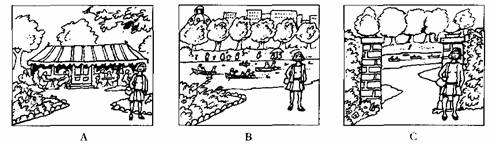
1.Where does Jane ask Tom to meet her at first?
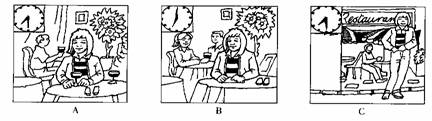
2.When and where do they agree to meet finally?
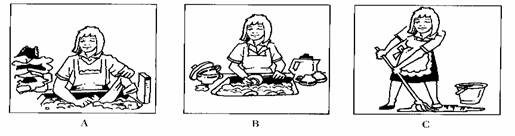
3.What does Jane have to do before going out to meet Tom?
听第2段对话,回答第4-6题。
4.According to Peter, what is the problem with the building?
A. The air-conditioning is too strong.
B. The air-conditioning is out of order.
C. The air-conditioning stops working sometimes.
5.Why did Peter miss the breakfast yesterday morning?
A. He overslept.
B. He couldn't fall asleep the night before.
C. He talked with his roommates late into the night.
6.How many students will be staying in this room?
A. Two. B. Three. C. Four.
听第3段对话,回答第7-9题。
7.Which subject (s) does David find particularly difficult?
A. Math. B. English. C. The sciences.
8.What does David do to help his uncle with the cows?
A. He milks the cows on Sundays and cleans the cowshed sometimes.
B. He drives the tractor on Sundays and does the milking sometimes.
C. He cleans the cowshed on Sundays and drives the tractor sometimes.
9.What is David going to do now?
A. He is going to work on his own farm.
B. He is preparing to attend an agricultural college.
C. He is going to study hard to pass the exams.
听第4段对话,回答第10-12题。
10.What is the probable relation between the man and woman?
A. A research student and a stranger.
B. A social worker and a businessman.
C. A businessman and a research student.
11.What made the woman begin to smoke at the age of 17?
A. Her boyfriend offered her a cigarette.
B. She often went to parties with her friends.
C. She wanted to follow her friends’ example.
12.What was the result of the woman's first attempt to stop smoking?
A. She stopped smoking for a while.
B. She managed to give up smoking completely.
C. She began to smoke fewer cigarettes than before.
听第5段对话,回答第13-15题。
13.What do the students come to the school for?
A. Visiting the school.
B. Attending summer courses.
C. A sightseeing tour of the area.
14.How long has the school been open?
A. Twenty years. B. Five years. C. Twenty-five years.
15.What could the students do in the study center if they were out late the night before?
A. Talk to the teachers. B. Use the equipment. C. Do the homework.
第二节:听取信息(共5小题;每小题1.5分,满分7.5分)
听下面1段对话。请根据题目要求,从所听到的内容中获取必要的信息,填入答题卡 标号为16—20的空格中。听录音前,你将有10秒钟的阅题时间,录音读两遍。你有80秒钟的作答时间。
|
Caller information |
|
|
Name of caller |
John Smith |
|
Where to go |
London |
|
When to go |
(16.) |
|
What to do there |
(17.) |
|
How long to stay |
A week or so |
|
Ticket information |
||||
|
Class |
Airline |
Price |
When to leave |
When to arrive |
|
Economy |
(18.) |
RMB 5600 |
7:40 a.m. |
In the morning |
|
Pacific Airline |
(19.) |
11:40 a.m. |
(20.) |
查看习题详情和答案>>
阅读下面短文,根据第1至第3小题的具体要求,简要回答问题。
A is for always getting to work on time.
B is for being extremely busy.
C is for the conscientious(勤勤恳恳的)way you do your job.
You may be all these things at the office, and more. But when it comes to getting ahead,
experts say, the ABCs of business should include a P, for politics, as in office politics.
Dale Carnegie suggested as much as more than 50 years ago hard work alone doesn’t ensure career advancement. You have to be able to sell yourself and your ideas, both publicly and behind the scenes. Yet , despite the obvious rewards of being dedicated to office politics –a better job, a raise, praise—many people are still unable —or unwilling—to “play the game.”
“People assume that office politics involves some manipulative(工于心计的)behavior,” says Deborah Comeran, assistant professor of management at Hofstra University. “But politics comes from the word ‘polite’. It can mean persuading and forming associations. It can mean being kind and helpful, or even trying to please your superior, and then expecting something in return.”
In fact, today, experts define office politics as proper behavior used to seek one’s own self-interest in the workplace. In many cases, this involves some form of getting along with others within the office environment—not just in large companies, but in small workplaces as well.
Yet, psychologists say, many employees and employers have trouble with the concept of politics in the office. Some people , they say, have an idealistic idea of work and what it takes to succeed. Still others associate politics with flattery(奉承),fearful that, if they speak up for themselves, they may appear, to be flattering their boss for favors.
Experts suggest changing this negative picture by recognizing the need for some self promotion.
1.What does it mean by saying “many people are still unable—or unwilling—to ‘play the game’”?(回答词数不超过15个)
2.According to today’s experts, what is office politics?(回答词数不超过12个)
3.What’s the main idea of the passage?(回答词数不超过8个)
查看习题详情和答案>>听力(共两节,满分35分)
第一节:听独白或对话(共15小题;每小题2分,满分30分)
听下面5段对话或独白。每段对话或独白后有几个小题,从题中所给的A、B、C三个选项中选出最佳选项。听每段对话或独白前,你将有时间阅读各个小题,每小题5秒钟;听完后,各小题将给出5秒钟的作答时间。每段对话或独白读两遍。
听第1段对话,回答第1~3题。
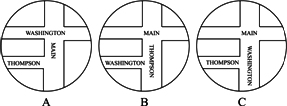
1.Which of the following shows the right direction?
2.Which of the following may be the building the woman referred to?
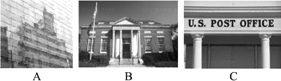
3.At what time does the shop close?
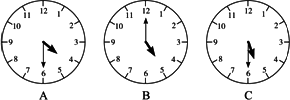
听第2段对话,回答第4~6题。
4.Where did the man go this morning?
A.His own garden.
B.A playground.
C.The Summer Palace.
5.Did the man often go there early in the morning in the past?
A.No, this is the first time for him.
B.Yes, often.
C.No, only several times.
6.Who did the man see sitting under a tree?
A.Two old women.
B.Two old men.
C.Two young girls.
听第3段独白,回答第7~9题。
7.What can we learn about North Dakota?
A.A block party is an early sign of summer there.
B.Indoor sports are popular there in winter.
C.Winter snows are usually deep there.
8.What do the people in North Dakota think of the season of winter?
A.Quiet and satisfying.
B.Long and dull(乏味).
C.Short but exciting.
9.Which of the following is true?
A.People in North Dakota like answering questions.
B.People in North Dakota have various(各种各样的)interests.
C.People in Ninth Dakota dislike answering questions.
听第4段独白,回答第10~12题。
10.Which of the following facts that does NOT make it easy for the mother to take care of the business?
A.She helped the father with the business before.
B.She looked after the children.
C.The speaker’s older brother was helping with the business.
11.When did the mother probably start to take care of the business?
A.Recently.
B.Six years ago.
C.Two years ago.
12.Who was George?
A.My younger brother.
B.My elder brother.
C.My father.
听第5段对话,回答第13~15题。
13.Where is the man calling?
A.A train station.
B.A park.
C.A theatre.
14.What are the prices of the tickets he wants?
A.$3.50.
B.$5.
C.$7.50.
15.What time does he have to collect the tickets?
A.Before 7∶50.
B.Before 7∶45.
C.Before 7∶15.
第二节:听取信息(共5小题;每小题1分, 满分5分)
听下面1段对话,请根据题目要求,从听到的内容中获取必要的信息,填入标号为16~20的空格中。听录音前,你将有10秒钟的阅题时间,录音读两遍。你有80秒钟的作答时间。
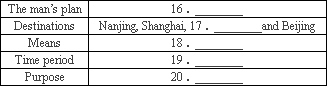
听力
第一节:听独白或对话(共15小题;每小题2分,满分30分)
听下面5段对话或独白。每段对话或独白后有几个小题,从题中所给的A、B、C三个选项中选出最佳选项。听每段对话或独白前,你将有时间阅读各个小题,每小题5秒钟;听完后,各小题将给出5秒钟的作答时间。每段对话或独白读两遍。
听第1段对话,回答第1~3题。
1.What does the dialogue take place?

2.What’s the speakers relation?

3.How did the man go to the theatre?

听第2段对话,回答第4~6题。
4.Why was Joan’s coat dirty?
A.She was pushed to the floor.
B.She fell by accident.
C.The back of her seat was dirty.
5.Where does the conversation most probably take place?
A.In the street.
B.In the office.
C.On the underground train.
6.Who caught the robber?
A.Two passengers.
B.The conductor.
C.A policeman.
听第3段独白,回答第7~9题。
7.Where could you go to borrow a magazine published in 2005?
A.Level 1.
B.Level 2.
C.Level 3.
8.How much is the fine for a book returned 45 days late?
A.$5.00.
B.$15.00.
C.$22.50.
9.When does the library close on Friday nights?
A.8∶30 p. m.
B.9∶00 p. m.
C.10∶00 p. m.
听第4段对话,回答第10~12题。
10.What is the main topic of the conversation?
A.Problems with living in an apartment.
B.A search for a new apartment.
C.The cost of rent near universities.
11.What kind of place is Ann looking for?
A.An apartment which costs $300 a month.
B.An apartment with furniture already in it.
C.An apartment within a short driving distance of campus.
12.How is Roger going to help Ann?
A.He is going to visit an apartment building near his place.
B.He is planning on calling a friend who owns an apartment building.
C.He will check the newspapers to see if he can find an apartment for rent.
听第5段对话,回答第13~15题。
13.What is the major problem with the man’s reservation?
A.There are no rooms available for the 18th.
B.The hotel confuses him with another guest.
C.Rooms are not available for five people for the 19th.
14.How much is the final discount on the double room for Mr.Nelson?
A.10%.
B.15%.
C.25%.
15.How does Mr.Nelson respond when he is told he will be offered a free room on his next visit?
A.He feels he should first receive an apology from the manager.
B.He suggests that the hotel should give guests discount in cases like his.
C.He implies(暗示)that he might not visit again because of his experience.
第二节:听取信息(共5小题;每小题1分,满分5分)
听下面1段独白。请根据题目要求,从所听到的内容中获取必要的信息,填入标号为16~20的空格中。听录音前,你将有10秒钟的阅题时间,录音读两遍。你有80秒钟的作答时间。
Summer Swim Classes
