网址:http://m.1010jiajiao.com/timu3_id_2485038[举报]
The dream of flying like Buzz Lightyear never dies. For years, space-age inventors have tested one wearable jet pack after another. And time after time, the designs have been grounded by dangerous fuels, excessive weight, or very loud noise levels. Now a Canadian inventor has sidestepped those weaknesses with an aquatic jet pack. Designed for travel over lakes or oceans, it’s driven by pressurized water, not burning rocket fuel.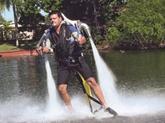
When Raymond Li first told the idea for the aquatic jet pack to his friends, they said he must be nuts. How could a jet pack carry that much water? Its thrust-to-weight rate would be so low and it would never become airborne. Thrust-to-weight rate is a measure of the forward force produced compared with the weight of the vehicle. A vehicle with a low thrust-to-weight rate is relatively heavy for the amount of force it generates.
Li's genius idea was to place the jet pack’s engine and its water pump in a separate boat. The pump would draw water from the lake the boat was floating on. It would then force the water under pressure through a hose connected to the jet pack. The hose would be long enough to let the pack go up as high as 8.5 meters (28 feet) in the air.
Today, Li's invention, the Jetlev-Flyer, is ready to go into production. The pack itself, complete with jet nozzles (管嘴) and handlebars, weighs just 14 kilograms. The  boat is a floating pod. To take off, the operator hits a trigger on a handlebar, which starts the pump, and then turns the throttle. Two streams of high-velocity water shoot through the hose and out the nozzles, lifting the operator into the air. The operator hovers there or pushes down on the handlebars, zooming forward at speeds of up to 64 kilometers per hour, pulling the pod behind.
【小题1】All the following factors contribute to the failure of inventing a wearable jet pack EXCEPT ______.
| A.excessive water | B.unbearable noise | C.unsafe fuels | D.too much weight |
| A.improved | B.reduced | C.avoided | D.solved |
| A.exciting | B.crazy | C.realistic | D.creative |
| A.His friends encouraged him to do the invention. |
| B.He put the engine and its water pump in the same boat. |
| C.The success of his invention lies in his bravery. |
| D.His invention finally succeeded and will go into production. |
a. The throttle is turned. b. The operator is lifted into the air.
c. A trigger is hit. d. Two streams of water shoot out.
The pump is started.
| A.c, e, a, d, b | B.c, e, a, b, d | C.e, c, d, b, a | D.e, a, c, d, b |
第二节:完形填空(共20小题;每小题1.5分,满分30分)
阅读下面短文,掌握其大意,然后从36—55各题所给的四个选项(A、B、C和D)中,选出最佳选项。
This is a true story. Rex White lived in a 36 some distance from the coast, so he 37 to drive to Lytham and leave his car in a car park beside the river. Then he 38 row out to the pilot boat, and wait for the 39 ship that it was his duty to guide.
Early one morning, Mr. White 40 to Lytham from a night on duty, only to 41 he couldn't start his car. He had driven from his village the evening before and left his car in the car park 42 . Now with his work finished; how he 43 to drive home to enjoy a cup of hot chocolate and a warm bed! 44 , no matter what he did, he could not get the engine to start.
It was a cold and windy night; there was no garage 45 to which he could turn for help. He was just about to 46 , and spend the rest of the night in his car, when a bright idea 47 him. He pushed his car round so that it was facing in the 48 of the wind, opened ail four doors, 49 it along a short way, and then jumped in. The doors acted like 50, and in no time the wind had taken him 51 out of the car park and away down the beach road. When he 52 the starter-switch once more, the engine roared to 53 immediately. All he had to do then was to stop the car and shut the 54 .
He went to bed later than usual, 55 he did not go without his cup of hot chocolate. Mr. White was not a seaman for nothing.
36. A. city B. town C. village D. family
37. A. decided B. had C. managed D. asked
38. A. could B. should C. would D. might
39. A. old B. foreign C. big D. particular
40. A. returned B. got C. went D. walked
41. A. accept B. tell C. find D. remember
42. A. once more B. as usual C. at last D. as well
43. A. prepared B. supposed C. hurried D. desired
44. A. Sadly B. Surprisingly C. Naturally D. Finally
45. A. inside B. around C. away D. ahead
46. A. shout at B. break down C. give out D. give up
47. A. knocked B. beat C. kicked D. struck
48. A. position B. direction C. speed D. strength
49. A. pulled B. rode C. pushed D. followed
50. A. brakes B. engines C. energies D. batteries
51. A. nearly B. right C. almost D. hardly
52. A. opened B. checked C. tried D. provided
53. A. effect B. way C. use D. life
54. A. windows B. doors C. lights D. systems
55. A. but B. or C. and D. so
My car's performance is ___ since the engine's been tuned and the tires have been changed.
A.better as twice B.twice as the condition
C.twice as good D.twice as better
查看习题详情和答案>>
Do’s and Don’ts in Whale(鲸)Watching
The Department of Fisheries and Oceans has developed guidelines for whale watching in Johnstone Strait,where killer whales are found on a daily basis each summer. It is strongly recommended that vessel(船只)operators follow these guidelines for all kinds of whales.
● Approach whales from the side, not from the front or the back.
● Approach no closer than 100 metres, then stop the boat but keep the engine on.
● Keep noise levels down-no horns, whistles or racing of engines.
● Start your boat only after the whales are more than 100 metres from your vessel.
● Leave the area slowly, gradually moving faster when you are more than 300 metres from the whales.
● Approach and leave slowly, avoiding sudden changes in speed or direction.
● Avoid disturbing groups of resting whales.
● Keep at low speeds and remain in the same direction if travelling side by side with whales.
● When whales are travelling close to shore, avoid crowding them near the shore or coming between the whales and the shore.
● Limit the time spent with any group of whales to less than 30 minutes at a time when within 100 to 200 metres of whales.
● If there is more than one vessel at the same observation spot, be sure to avoid any boat position that would result in surrounding the whales.
● Work together by communicating with other vessels, and make sure that all operators are aware of the whale watching guidelines.
1.For whom is this text written?
|
A.Tour guides. |
|
B.Whale watchers. |
|
C.Vessel operators. |
|
D.Government officials. |
2.When leaving the observation areas, the vessel should ________________.
|
A.move close to the beach |
|
B.increase speed gradually |
|
C.keep its engine running slowly |
|
D.remain at the back of the whales |
3.What is the shortest safe distance from the whales?
|
A.400 metres. |
B.300 metres. |
C.200 metres. |
D.100 metres. |
查看习题详情和答案>>