摘要:( ) A. no B. not C. any
网址:http://m.1010jiajiao.com/timu3_id_2378424[举报]
A desert is a very dry land where there is hardly any rain. In the day, it can be so hot that you could fry an egg on the ground. But during the night it is sometimes so could that water would turn into ice.
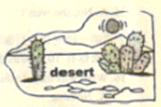
Many desserts are covered in sand. But some have mountains, rocks, or lakes that have dried up in the heat. The Great American Dessert has cliffs(悬崖) that have been made into amazing and beautiful shapes by the wind. The Sahara Desert in Africa is mostly sand. The Australian Desert has red sand.
Sometimes it does not rain for a whole year in the desert. But there is water deep under the ground and some plants have roots that go very deep to find it. Other plants have roots that spread out(延伸) a long way so they can suck up the rain as soon as it falls.
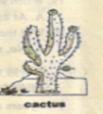
One desert plant is the cactus, which has long, spreading roots. The cactus stores water inside its hard skin. This skin protects it from heat and cold.
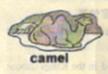
Camels are a bit like cactus plants! They store water too—inside their bodies. They have special fur which protects them from the sun during the day and keeps them warm at night.
Some other animals live in deserts, too. They have to be very good at seeing and hearing because most of them only come out at night. This is why many desert animals have extra big eyes or ears.
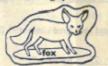
A desert fox has bigger ears than a normal for. A gerbil has huge eye, so that it can see at night. It stays cool in the day by staying underground, like most desert animals.
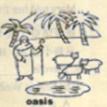
Some people live in the desert but they always make their homes near an oasis. An oasis is where water comes from an underground river. Near an oasis, people can grow lots of plants and keep animals.
Life is hard in the desert, for people, animals and plants. But desert people like to live there.
【小题1】A desert is very dry because__________.
【小题2】What does the underlined phrase"suck up"in paragraph 3 mean_________?
【小题3】Some desert animals have extra big eyes or ears because__________.
【小题4】Most desert animals stay cool in the day by_________.
【小题5】Which of the following is true?
查看习题详情和答案>>
Many desserts are covered in sand. But some have mountains, rocks, or lakes that have dried up in the heat. The Great American Dessert has cliffs(悬崖) that have been made into amazing and beautiful shapes by the wind. The Sahara Desert in Africa is mostly sand. The Australian Desert has red sand.
Sometimes it does not rain for a whole year in the desert. But there is water deep under the ground and some plants have roots that go very deep to find it. Other plants have roots that spread out(延伸) a long way so they can suck up the rain as soon as it falls.
One desert plant is the cactus, which has long, spreading roots. The cactus stores water inside its hard skin. This skin protects it from heat and cold.
Camels are a bit like cactus plants! They store water too—inside their bodies. They have special fur which protects them from the sun during the day and keeps them warm at night.
Some other animals live in deserts, too. They have to be very good at seeing and hearing because most of them only come out at night. This is why many desert animals have extra big eyes or ears.
A desert fox has bigger ears than a normal for. A gerbil has huge eye, so that it can see at night. It stays cool in the day by staying underground, like most desert animals.
Some people live in the desert but they always make their homes near an oasis. An oasis is where water comes from an underground river. Near an oasis, people can grow lots of plants and keep animals.
Life is hard in the desert, for people, animals and plants. But desert people like to live there.
【小题1】A desert is very dry because__________.
| A.it is sandy | B.there is so little rain |
| C.the wind is strong | D.there is no water deep under the ground |
| A.围堵 | B.讨好 | C.释放 | D.吸收 |
| A.the sunlight is too strong in the day | B.they need to see and hear well at night |
| C.it is very cold at nigh | D.they store water in them. |
| A.storing water in side their bodies | B.drinking water as much as they can |
| C.staying underground | D.growing lots of plants |
| A.Desert people like to live in the desert though life is hard. |
| B.People in the desert usually fry eggs on the ground. |
| C.Camels have special fur to store water. |
| D.All the deserts are covered in sand. |
A sign is another kind of language. Here are some of them that you see on the roads.

Number one is a sign with the number thirty on it. When drivers see this sign , they must not go at more than thirty kilometers can hour. We see this sign when we are getting near a town. Number two is a sign that we're near a crossing. We must drive carefully. Number three is a sign that there is a bend in the road. Again, we must drive slowly and carefully. It is not safe to go round a bend very fast. Number four is a sign that there is another road coming in from the right. There is a junction at this place. Number five is a sign that there is a hill and number six is a sign that the road gets narrow. Drivers must go slowly and carefully. Number seven has the word “ SCHOOL” on it. This is a sign that there is a school at the side of the street or the road. Perhaps there are children going to or leaving school. So drivers must look carefully and go slowly. Number eight is a sign with the letter “ P ” on it. The letter “ P ” means “ Parking ”. At some places, there're the signs “ No parking ” or “ No waiting”. If a driver leaves his car near one of these signs, a policeman may come and write down the number of his car.
【小题1】At the places where you see Sign 1, .
【小题2】The underlined word bend probably means here.
【小题3】You have to drive not only slowly but also carefully when you find .
【小题4】People put these signs on the road in order to .
【小题5】Which can be the best title for this message?
查看习题详情和答案>>
Number one is a sign with the number thirty on it. When drivers see this sign , they must not go at more than thirty kilometers can hour. We see this sign when we are getting near a town. Number two is a sign that we're near a crossing. We must drive carefully. Number three is a sign that there is a bend in the road. Again, we must drive slowly and carefully. It is not safe to go round a bend very fast. Number four is a sign that there is another road coming in from the right. There is a junction at this place. Number five is a sign that there is a hill and number six is a sign that the road gets narrow. Drivers must go slowly and carefully. Number seven has the word “ SCHOOL” on it. This is a sign that there is a school at the side of the street or the road. Perhaps there are children going to or leaving school. So drivers must look carefully and go slowly. Number eight is a sign with the letter “ P ” on it. The letter “ P ” means “ Parking ”. At some places, there're the signs “ No parking ” or “ No waiting”. If a driver leaves his car near one of these signs, a policeman may come and write down the number of his car.
【小题1】At the places where you see Sign 1, .
| A.you are already out of a town |
| B.you still have thirty kilometers to go |
| C.there must be many houses and buildings not far away |
| D.there must be a town thirty k8ilometers away |
| A.traffic | B.subway |
| C.turning | D.danger |
| A.each of the eight signs |
| B.either of Signs 2 and 3 |
| C.all of Signs 2, 4, 6 and 7 |
| D.any of Signs 3, 5, 6 and 7 |
| A.teach drivers lesson |
| B.make drivers even safer |
| C.stop cars going there |
| D.learn another kind of language |
| A.Another language. |
| B.On the road. |
| C.What to do. |
| D.Traffic signs. |

A group of people asked this question to a group 4-to-8-year-old children. “What does love mean?” The answers were surprising. The children would answer like they did below.
“When my grandmother hurt her knees (膝盖), she couldn’t bent (弯腰) over and paint her toenails (脚指甲) any more. So my grandfather does it for her all the time, even when his hands hurt too. That’s love.”
Rebecca–age 8
“Love is when someone hurts you. And you get so mad but you don’t shout at them because you know it would hurt her feelings.”
Samantha–age 6
“Love is what makes you smile when you’re tired.”
Terri–age 4
“I let my big sister pick on (捉弄) me because my mum says she only picks on me because she loves me. So I pick on my baby sister because I love her.”
Bethany–age 4
“I know my older sister loves me because she gives me all her old clothes and has to go out and buy new clothes.”
Lauren–age 4
“Love is when Mommy gives Daddy the best piece of chicken.”
Elaine–age 5
“My mommy loves me more than anybody. You don’t see anyone else kissing me to sleep at night.”
Clear–age 5
“You really shouldn’t say ‘I love you’ unless you mean it. But if you mean it, you should say it a lot. People forget.”
Jessica–age 8
【小题1】 The passage mainly tells us about ______.
| A.what “life” means to children | B.what “family” means to children |
| C.what “friends” means to children | D.what “love” means to children |
| A.Clear. | B.Elaine. | C.Rebecca. | D.Lauren. |
| A.Rebecca’s grandmother ever couldn’t bend over. |
| B.Bethany is willing to be picked on by any other person. |
| C.If Samantha becomes angry, she will not shout at others. |
| D.Lauren prefers to wear her sister’s old clothes. |
| A.Too much love is no love. | B.You should say love more often. |
| C.You mean what you think. | D.Say love more often if you have it. |
| A.Love is the care between husband and wife. |
| B.Love is a rest when you are tired. |
| C.Love is what cheers you up when you are tired. |
| D.Love is a kiss from parents. |
A blind boy sat on the steps of a building with a hat by his feet. He held up a sign which said, “I am blind, please help.” There were only a few coins in the hat.
A man was walking by. He took a few coins from his pocket and dropped them into the hat. He then took the sign, turned it around, and wrote some words. He put the sign back so that everyone who walked by would see the new words.
Soon the hat began to fill up. A lot more people were giving money to the blind boy. That afternoon the man who had changed the sign came to see how things were. The boy recognized(听出)his footsteps and asked, “Were you the one who changed my sign this morning? What did you write?”
The man said, “I only wrote the truth. I said what you said but in a different way.”
What he had written was, “Today is a beautiful day; I can not see it.”
Of course both signs told people the boy was blind. But the first sign simply sign the boy was blind. The second sign told people they were so lucky that they were not blind. Should we be surprised that the second sign was more effective (有效的)?
【小题1】The boy in the passage can not .
【小题2】 How did the man help the boy?
【小题3】The underlined words “held up” in the first paragraph mean .
【小题4】What happened after the man changed the sign?
【小题5】 What can we learn from the story?
查看习题详情和答案>>
A man was walking by. He took a few coins from his pocket and dropped them into the hat. He then took the sign, turned it around, and wrote some words. He put the sign back so that everyone who walked by would see the new words.
Soon the hat began to fill up. A lot more people were giving money to the blind boy. That afternoon the man who had changed the sign came to see how things were. The boy recognized(听出)his footsteps and asked, “Were you the one who changed my sign this morning? What did you write?”
The man said, “I only wrote the truth. I said what you said but in a different way.”
What he had written was, “Today is a beautiful day; I can not see it.”
Of course both signs told people the boy was blind. But the first sign simply sign the boy was blind. The second sign told people they were so lucky that they were not blind. Should we be surprised that the second sign was more effective (有效的)?
【小题1】The boy in the passage can not .
| A.see | B.walk | C.hear | D.speak |
| A.He gave the boy a lot of money. |
| B.He brought the boy back to his home. |
| C.He wrote some new words on the sign. |
| D.He sent the boy to a special school. |
| A.阻碍 | B.举着 | C.承受 | D.坚持 |
| A.The boy still got a few coins in the hat. |
| B.The boy got much more money. |
| C.No one gave the boy coins any more. |
| D.No one gave the boy coins any more. |
| A.Time can we learn from the story? |
| B.You should be brave even thought you’re blind. |
| C.Treating a thing differently brings a different result. |
| D.If we want to be rich, we should be honest.(结果) |
A thousand years ago Hong Kong was covered by a thick forest. As more and more people came to 1 in Hong Kong, these trees were cut down and burnt. Now there is 2 forest left, though there are still some small areas covered with trees. We call these woods.
Elephants, tigers and many 3 animals were living in the thick forest. When people came to live in Hong Kong, the 4 began to die out. Early farmers grew rice and 5 pigs and chickens in the valleys. They cut down the trees and burnt them. They needed 6 to keep themselves warm in winter, to cook their food and to keep away the dangerous animals. Elephants quickly disappeared because there was not enough food for them. So did 7 of the wolves and tigers. Monkeys and many other animals soon 8 in the same way.
You might think that there are no longer any animals in Hong Kong 9 in the zoos. But there are still about 36 different animals 10 there. One of the most interesting of Hong Kong's animals is the barking deer. These are beautiful little animals 11 a rich brown coat and a white patch (补丁) under the tail. They look like deer but they are much smaller. They are less than two feet(英尺) 12 . They make a noise rather like a dog 13 . In Hong Kong the barking deer has only a real enemy-- 14 . People hunt these little animals though it is illegal (违法的). There are now not many barking deer left. So it is important 15 people to protect wild animals.
| 【小题1】 |
|
| 【小题2】 |
|
| 【小题3】 |
|
| 【小题4】 |
|
| 【小题5】 |
|
| 【小题6】 |
|
| 【小题7】 |
|
| 【小题8】 |
|
| 【小题9】 |
|
| 【小题10】 |
|
| 【小题11】 |
|
| 【小题12】 |
|
| 【小题13】 |
|
| 【小题14】 |
|
| 【小题15】 |
|