题目内容
阅读理解
Hundreds of years ago, news was carried from place to place by people on foot or by horse. It took days, weeks and sometimes months for people to receive news. Now it is possible to send words and pictures around the world in seconds. Billions of people learn about new stories of their own country and all over the world, either by watching TV or reading newspapers. Newspapers have been an important part of everybody life since the 18th century. Many countries have hundreds of different newspapers. How do newspaper editors decide which stories news to print? Why do they print some stories and not others? What makes a good newspaper story?
Firstly, it is important to report news stories. TV stations can report news much faster then newspapers. Yet, newspapers give more about the same story. They may also look at the story in another way, or they may print completely different stories to those on TV.
Secondly, a news story has to be interesting and unusual. People don't want to read stories about everyday life. As a result, many stories are about some kinds of danger and seem to be “bad” news. For example, newspapers never print stories about planes landing safely, instead they print stories about plane accident.
Another factor(因素) is also important in many new stories. Many people are interested in foreign countries, but more prefer to read stories about people, places and events in their own country. So the stories on the front page in Chinese newspapers are usually different from the ones in British, French and American newspapers.
(1) According to the passage, how do people learn about news stories in the world now?
[ ]
A. They carry news stories and tell others from place to place on foot or by horse.
B. They tell each other what they have seen with their eyes.
C. They watch TV or read newspapers.
D. They listen to the radio every day.
(2) The difference between newspaper stories and TV news reports is that________.
[ ]
A. people can learn more about the same news story from a newspaper
B. people can read the news story more quickly in a newspaper
C. people can read news stories in other countries
D. people can read news stories about their own country
(3) To make a good newspaper story, how many factors does the passage talk about? _________.
[ ]
(4) According to the passage, which of the following can you mostly possibly watch on TV?
[ ]
A. You often play football with your friends after school.
B. Your teacher has got a cold.
C. A tiger in the city zoo run out and. hasn't been caught.
D. The bike in front of your house is lost.
(5) Which of the following is not true in this passage?
[ ]
A. News stories on the front page of .every country are always the same.
B. People like to read interesting and unusual news.
C. Not only TV but also newspapers can help people to learn what is happening around the world.
D. Newspapers have been an important part of everyday life for more than three hundred years.
解析:
|
(1) C 根据第一段第四句。 (2) A 根据第二段第三句。 (3) B 分别根据第二、三、四段第一句,共有三个因素。 (4) C 根据第三段第三句来判断。 (5) A 根据最后一段来判断。 |

阅读理解
George Stephenson was born in 1781 in a poor family. He had to start work when he was only eight. When George was fourteen, he became his father’s helper. He spent a lot of time learning about engines. And on holidays he often took one to pieces and studied each piece carefully. Soon he became a very good worker though he could not read or write. He began to learn the English letters when he was seventeen years old. Every day after he did twelve hours of hard work, he walked a long way to have lessons from a young school teacher. On his eighteenth birthday, he wrote his own name for the first time in his life. George invented many things in his life. The train was the greatest one among them. Today when we watch or take trains from one place to another, we will think of this great man -- George Stephenson.
【小题1】 In which year did George Stephenson start to help his father?
| A.In 1781. | B.In 1789. | C.In 1795. | D.In 1798. |
| A.through reading and writing |
| B.by taking it to pieces and studying each piece carefully |
| C.at lessons from a young teacher |
| D.by asking a lot of questions |
| A.a great man | B.a good maker |
| C.a good worker | D.a good student |
| A.didn’t go to school |
| B.had lessons from a very good teacher |
| C.lived an easy life |
| D.invented the train |
| A.everybody should work hard for a living |
| B.one can start studying at school at the age of 18 |
| C.George Stephenson liked working very much |
| D.hard work leads to success |
阅读理解
Special Offers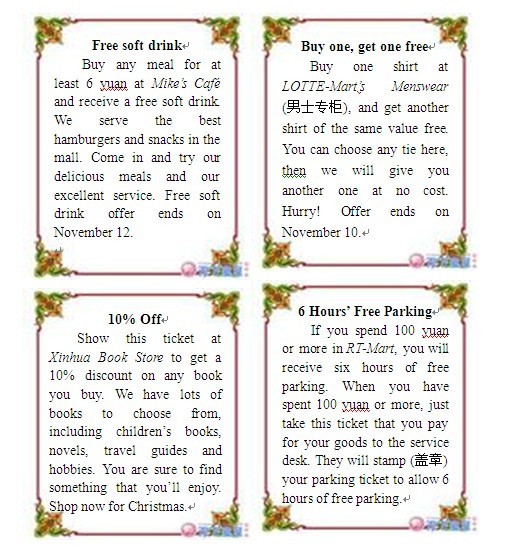
【小题1】The information above is probably taken from .
| A.a sports report | B.a story book |
| C.a fashion magazine | D.an advertisement poster |
| A.4 yuan | B.36 yuan | C.40 yuan | D.44 yuan |
| A.on November 9 | B.on November 11 |
| C.on December 10 | D.on Christmas Day |
| A.1 hour. | B.5 hours. | C.6 hours. | D.7 hours. |
| A.A soft drink. | B.The best hamburgers. |
| C.The best snacks. | D.A delicious meal |
阅读理解
Accident Report Form(表格)
Accident: A car crashed(冲撞) into a tree.
Some people were trapped (困)in the car.
Weather: There was a heavy rain.
Date of call: June 3,2006
Time of call: 9:30 p.m.
Name of caller: Mrs Green
Place: Zhongshan Road, Nanjing
Conditions of victims(受害者): Mr Green hurt his head.
Mrs Green hurt her left leg.
Their daughter felt frightened.
Action: Policemen arrived at 9:40 p.m. and sent the victims to Gulou Hospital at 9:45 p.m.
1.What time did Mrs Green call the police?
|
A.At 9:30 a.m. |
B.At 9:30 p.m. |
|
C.At 9:40 p.m. |
D.At 9:45 p.m. |
2.How many people were trapped in the car?
|
A.One. |
B.Two |
C.Three |
D.Four |
3.Whose left leg was hurt?
|
A.Mrs Green's. |
B.Their daughter's. |
C.Mr. Green's |
D.Their friend's. |
4.What was the weather like that day?
|
A.It was sunny. |
B.It was snowy. |
C.It was cloudy. |
D.It was rainy. |
5.Which of the following is TRUE?
|
A.The car crashed into a wall. |
|
B.Their daughter hurt her leg and was sent to the hospital. |
|
C.The car accident happened on Zhongshan Road in Nanjing. |
|
D.The policemen arrived half an hour later and sent the victims to the hospital. |